
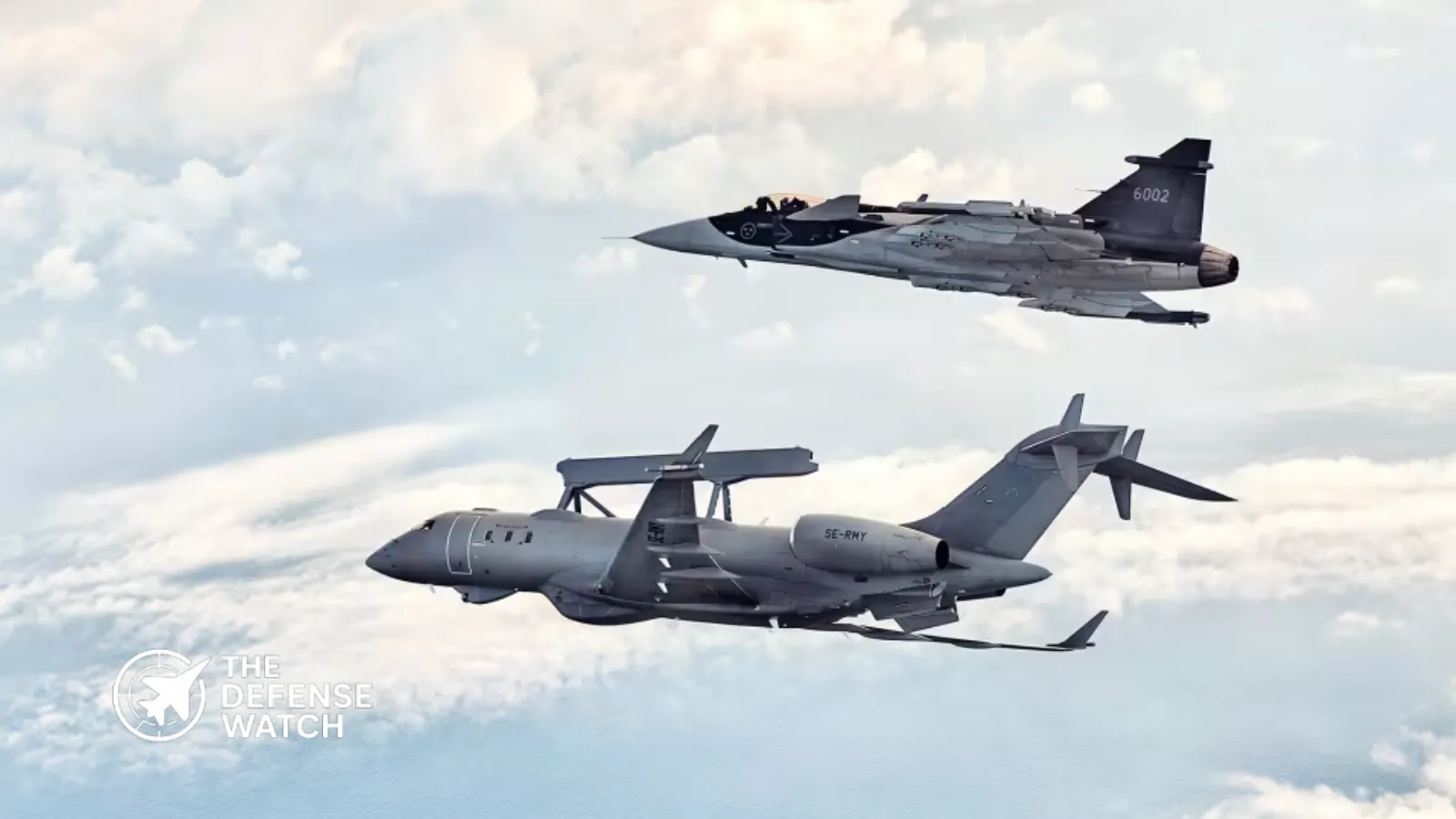
Saab Achieves Historic Order Growth Amid European Defense Modernization
Swedish defense contractor Saab AB reported record-breaking order bookings of SEK 100.1 billion ($10.2 billion) in Q4 2025, marking a dramatic acceleration in military procurement across European and international markets. The fourth-quarter performance drove the company to upgrade its medium-term organic sales growth target from 18% to 22% compound annual growth rate through 2027.
The Linköping-based defense manufacturer, which produces everything from fighter aircraft to underwater systems, reported full-year results that underscore the strategic shift in defense spending following Russia’s invasion of Ukraine and ongoing geopolitical tensions. CEO Micael Johansson characterized 2025 as a “record year for Saab” during the company’s February 5 earnings presentation.
Operating income (EBIT) increased 67% to SEK 3.26 billion ($332 million) in Q4 2025, representing an 11.8% margin compared to 9.4% in the prior-year period. Excluding a one-time capital gain from divesting Saab TransponderTech AB, adjusted EBIT still climbed 50% year-over-year, demonstrating organic operational improvements across the company’s business segments.
Operational Performance Reflects Capacity Expansion
Saab’s quarterly sales reached SEK 27.7 billion ($2.82 billion), representing 34.5% organic growth compared to Q4 2024. The company attributed the revenue acceleration to strong performance across all business areas, with particularly robust development in its Surveillance and Dynamics divisions.
Operational cash flow increased to SEK 6.28 billion ($640 million) in Q4, nearly doubling from SEK 3.56 billion in the prior-year period. This cash generation enabled Saab to maintain a net liquidity position of SEK 3.99 billion ($406 million) while simultaneously investing in production capacity expansion to meet rising order volumes.
The company’s board proposed a dividend of SEK 2.40 ($0.24) per share for 2025, representing a 20% increase from the SEK 2.00 dividend paid for 2024. This distribution reflects management confidence in sustained cash flow generation despite significant capital expenditure requirements.
Strategic Positioning in European Defense Markets
Saab’s record order intake reflects the company’s strategic positioning within European NATO defense modernization programs. The Swedish manufacturer has secured major contracts for its Gripen fighter aircraft, GlobalEye airborne early warning system, and various ground-based air defense systems across multiple European nations implementing multi-year procurement programs.
The upgraded medium-term guidance maintains the company’s target for EBIT growth to exceed organic sales growth, while preserving its cumulative cash conversion target above 60%. These metrics indicate management’s focus on profitable growth rather than pure revenue expansion, a discipline increasingly valued by defense procurement agencies seeking reliable long-term suppliers.
Saab employs approximately 27,000 personnel globally and maintains operations in over 30 countries, with products sold to more than 100 nations. The company’s diversified portfolio spans aeronautics, weapons systems, command and control platforms, sensors, and underwater systems—positioning it as a comprehensive defense solutions provider rather than a single-platform manufacturer.
Market Context and Industry Implications
The company’s performance aligns with broader trends in the global defense industry, where European NATO members have committed to sustained increases in military spending following the 2022 Russian invasion of Ukraine. Germany, Poland, and the Baltic states have announced multi-year procurement programs worth hundreds of billions of dollars, creating sustained order pipelines for established defense contractors.
Saab’s financial results also reflect supply chain stabilization after pandemic-era disruptions, enabling the company to convert its substantial order backlog into delivered systems. The 34.5% organic sales growth rate significantly exceeds typical defense industry norms of mid-single-digit growth, indicating successful execution on previously secured contracts.
The Swedish manufacturer faces competition from larger multinational defense contractors including Lockheed Martin, BAE Systems, and Rheinmetall in various market segments. However, Saab maintains competitive advantages in certain niche capabilities, particularly its airborne surveillance systems and non-strategic fighter aircraft that appeal to medium-sized nations seeking alternatives to U.S. platforms.
Production Capacity and Workforce Expansion
Johansson emphasized that Saab continues to “invest in capacity expansion and new capabilities to build for future growth” despite already delivering record revenues. This capital investment strategy suggests management anticipates order volumes will remain elevated beyond the current medium-term planning horizon.
Industry analysts note that defense manufacturing capacity expansion requires multi-year lead times, particularly for aerospace and complex electronics production. Saab’s current investments indicate the company expects sustained elevated demand through at least the late 2020s, aligning with European defense planning cycles that extend through 2030.
The company has not disclosed specific headcount expansion plans, though defense industry workforce growth typically lags capital investment by 12-24 months as new production facilities reach operational status. Saab’s career portal currently lists numerous open positions across engineering, manufacturing, and program management disciplines.
Financial Guidance and Shareholder Returns
Saab’s upgraded medium-term guidance represents a significant upward revision from previous targets, reflecting management confidence in both order pipeline visibility and execution capability. The 22% compound annual growth rate target through 2027 would position Saab among the fastest-growing major Western defense contractors by revenue.
Earnings per share reached SEK 4.73 ($0.48) in Q4 2025, compared to SEK 2.66 in the prior-year period, representing a 78% increase. This earnings growth exceeded revenue growth percentages, indicating improving operational leverage as the company scales production volumes.
The company’s EBITDA margin improved to 15.2% in Q4 from 13.1% in the prior-year quarter, suggesting fixed cost absorption benefits from higher production volumes. Saab’s ability to maintain margin expansion while investing heavily in capacity suggests pricing power in its core markets and favorable contract terms on recent awards.
Outlook and Strategic Priorities
Saab’s management emphasized that the company secured “several important orders” during 2025 while experiencing “high demand” across its product portfolio. The company’s diversified business model—spanning air, land, and naval domains—provides multiple growth vectors and reduces dependence on any single platform or customer.
The defense contractor’s upgraded targets assume continued strong European defense spending, stable supply chain conditions, and successful execution on existing contracts. Geopolitical factors including NATO expansion, Chinese military modernization, and ongoing conflicts will likely influence procurement timelines and budgets across Saab’s customer base.
Investors and industry observers will monitor Saab’s ability to convert its record order backlog into delivered systems while maintaining margin performance and cash generation. The company’s next quarterly update will provide additional visibility into production ramp execution and new order activity during the first quarter of 2026.
Get real time update about this post category directly on your device, subscribe now.
