
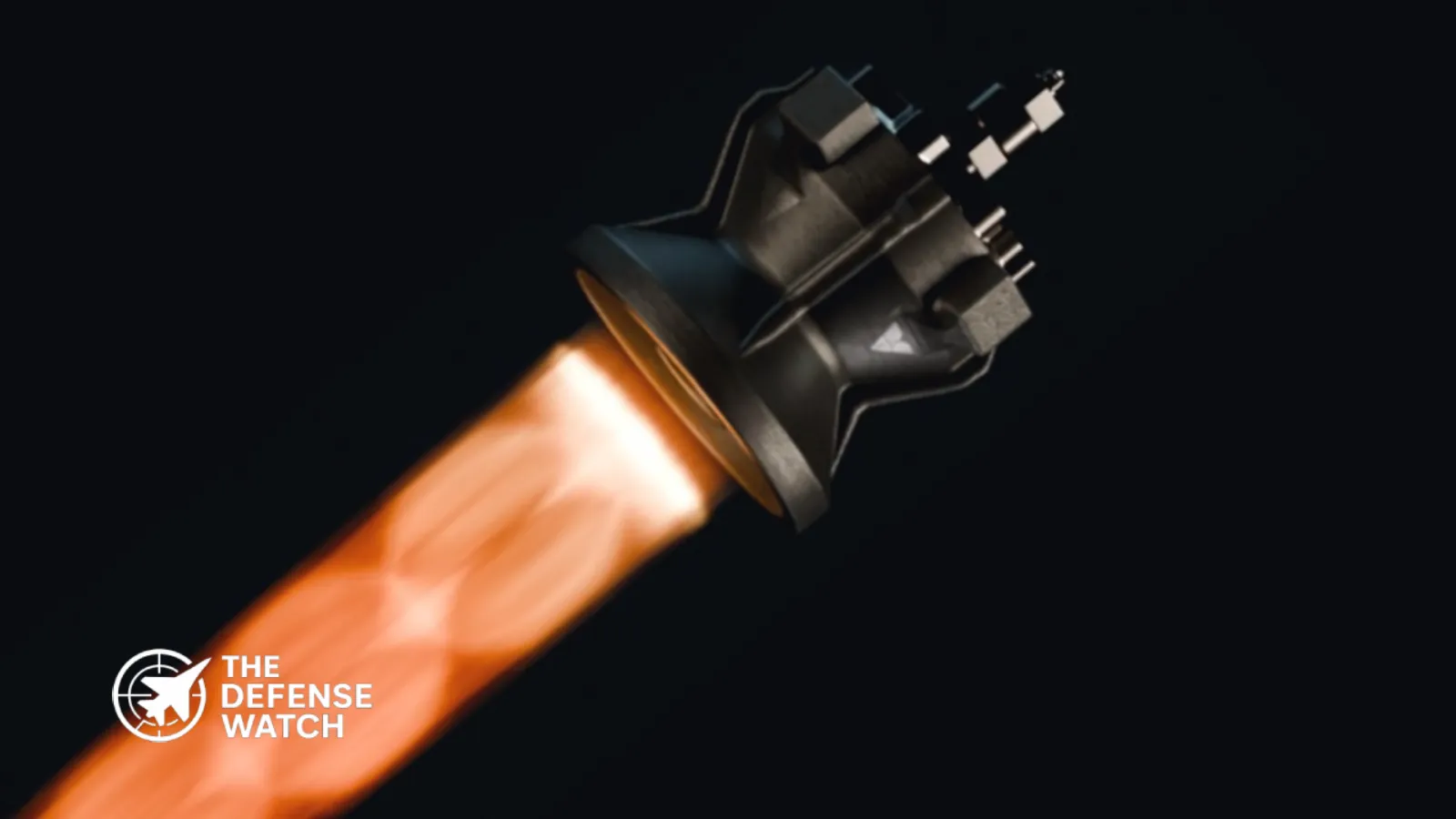
- ► Houston based Venus Aerospace conducted a successful Rotating Detonation Rocket Engine flight test in 2025.
- ► The demonstration took place at Spaceport America in New Mexico following adverse weather conditions.
- ► The RDRE uses a supersonic detonation wave traveling around an annular combustor to generate thrust.
- ► Venus Aerospace states the engine is approximately 15 percent more efficient than conventional rocket engines.
- ► The test validated performance and system integrity under real flight conditions.
Venus Aerospace Advances Rotating Detonation Rocket Engine In Flight Test
The Rotating Detonation Rocket Engine, or RDRE, reached a key milestone last year when Venus Aerospace completed a successful flight demonstration at Spaceport America.
According to the company, the engine launched and operated as planned on its first flight attempt, validating performance and structural integrity under real world conditions. The test followed a night of heavy winds, adding environmental stress to the demonstration.
The result places Venus Aerospace among a small group of U.S. firms and research institutions pursuing detonation based propulsion as an alternative to conventional rocket systems.
What Makes A Rotating Detonation Rocket Engine Different
Traditional liquid rocket engines rely on subsonic combustion, known as deflagration, where fuel and oxidizer burn at relatively slower flame speeds. The Rotating Detonation Rocket Engine operates on a different principle.
In an RDRE, a detonation wave travels continuously around an annular combustor at supersonic speeds. This wave compresses and burns the propellant mixture almost instantaneously. The process produces higher thermodynamic efficiency by leveraging pressure gain combustion, long considered a goal in propulsion research.
NASA and several U.S. universities have studied rotating detonation concepts for years. The U.S. Air Force Research Laboratory has also examined pressure gain combustion for future missile and space launch applications. Until recently, most demonstrations remained ground based.
A successful flight test, even at small scale, signals technical maturity beyond laboratory conditions.
Claimed Efficiency Gains And Practical Implications
Venus Aerospace states that its Rotating Detonation Rocket Engine is approximately 15 percent more efficient than traditional rocket engines. While independent performance data has not been publicly released, the claim aligns with theoretical models suggesting pressure gain combustion can increase specific impulse and reduce propellant mass.
If validated at scale, that efficiency gain could translate into:
- Increased payload capacity for space launch vehicles
- Extended range for hypersonic systems
- Reduced engine size and weight
- Lower overall launch costs
For defense applications, improved thrust to weight ratio and compact engine geometry are especially relevant. Smaller propulsion systems can enable more agile missiles or reusable high speed aircraft concepts.
However, scaling detonation engines presents engineering challenges. Managing thermal loads, controlling wave stability, and ensuring material durability under extreme pressure cycles remain critical hurdles. Flight validation is a step forward, but sustained operational testing will determine long term viability.
Strategic Context For U.S. Aerospace
The Rotating Detonation Rocket Engine concept fits within broader U.S. efforts to modernize propulsion technologies amid growing competition in hypersonics and space access.
China and Russia have both invested heavily in advanced missile propulsion and high speed flight systems. U.S. defense planners have responded by prioritizing propulsion research across agencies, including NASA, the Department of Defense, and DARPA.
Private sector firms now play a central role. Companies like Venus Aerospace aim to bridge civil space and defense markets, developing propulsion architectures that could support commercial launch, high speed transport, and military platforms.
Spaceport America, operated by the State of New Mexico, has become a test hub for emerging launch providers and experimental propulsion systems. Its remote location and established infrastructure make it suitable for early stage flight demonstrations.
Technical Validation Versus Commercial Readiness
While the successful flight of a Rotating Detonation Rocket Engine is notable, commercialization requires far more than a single test. Certification, repeatability, manufacturing scalability, and integration with full vehicle systems will determine whether RDRE technology transitions into operational programs.
Historically, propulsion breakthroughs often take years to move from demonstration to deployment. Liquid hydrogen engines, staged combustion cycles, and reusable booster architectures all required extended refinement before widespread adoption.
The same will likely apply to rotating detonation systems.
Still, flight validation under real atmospheric conditions is a meaningful benchmark. It demonstrates that detonation waves can be controlled in a practical engine environment, not just in controlled laboratory rigs.
For U.S. aerospace and defense stakeholders, the test signals continued innovation in propulsion at a time when performance margins increasingly matter.
Get real time update about this post category directly on your device, subscribe now.
