
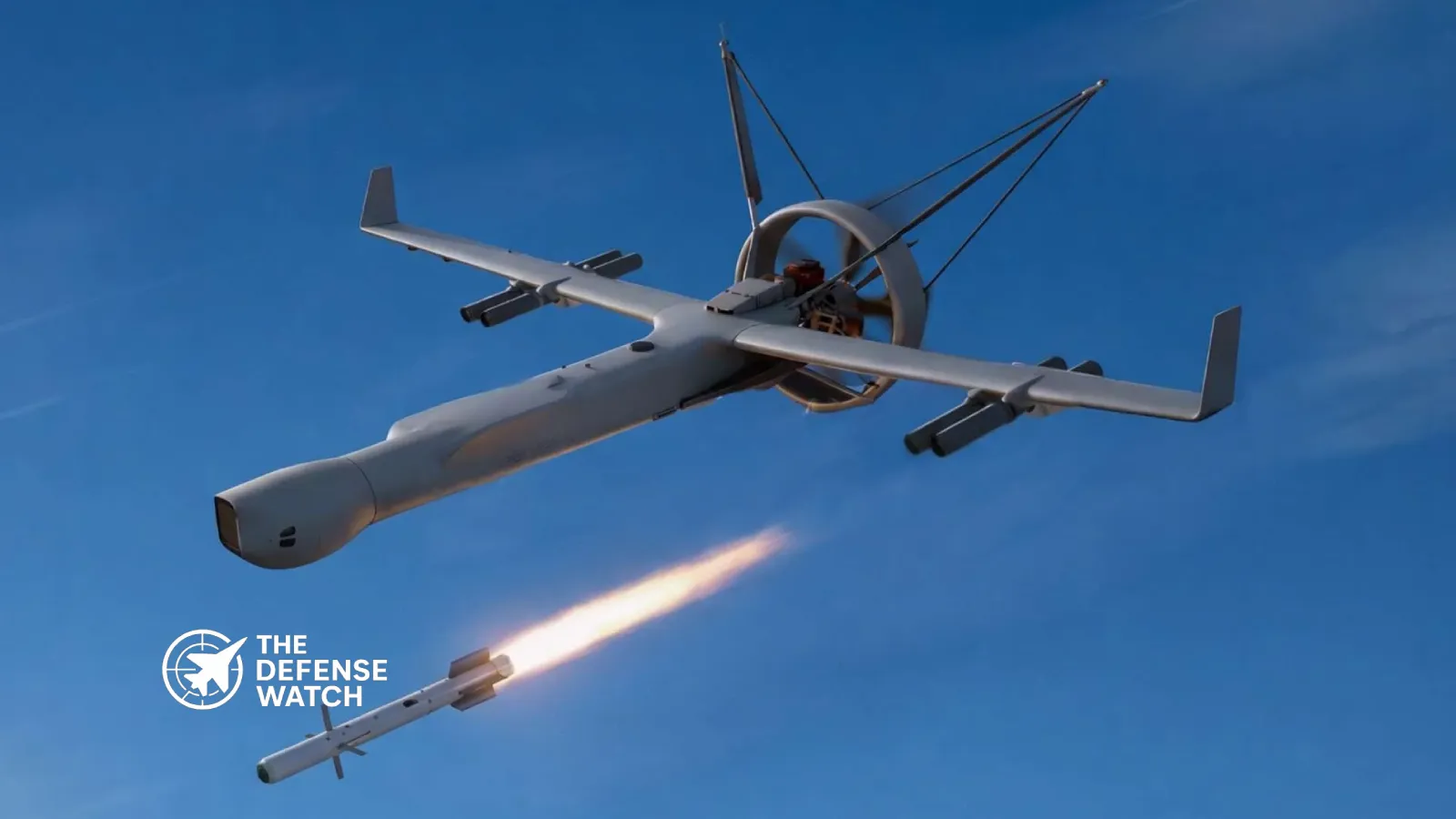
The U.S. V-BAT drone armed with guided missiles has emerged as a notable development in unmanned aerial warfare, reflecting the growing push to combine intelligence, surveillance, reconnaissance, and precision strike in a single vertical takeoff platform.
Recent demonstrations confirmed that the V-BAT vertical takeoff unmanned aerial vehicle has been successfully integrated with South Korean developed guided missiles, expanding its operational role beyond ISR missions. The development underscores evolving U.S. interest in deployable, runway independent armed drones for expeditionary and maritime operations.
The system has drawn attention across defense and aerospace circles for its modular design and its ability to operate from confined environments, including ship decks and austere forward bases.
V-BAT Drone Overview
The V-BAT is a vertical takeoff and landing unmanned aircraft system originally designed for long endurance ISR missions. Its ducted fan configuration allows it to launch and recover without runways, a feature increasingly valued by U.S. forces operating in dispersed environments.
The aircraft is optimized for persistent surveillance, electronic payloads, and communications relay missions. With the addition of guided missile capability, the platform now enters the armed UAV category, significantly broadening its mission set.
This integration aligns with broader U.S. military trends favoring flexible unmanned systems capable of both sensing and striking in contested areas.
Guided Missile Integration
The armed configuration features South Korean guided missiles, adapted for lightweight UAV deployment. These precision weapons are designed for engaging ground targets with minimal collateral damage.
According to publicly released information, the missile integration required limited airframe modification, highlighting the V-BAT’s modular payload architecture. This allows rapid mission reconfiguration depending on operational needs.
The move reflects closer interoperability between allied defense industries, particularly in unmanned systems and precision munitions.
Operational Implications for U.S. Forces
The U.S. V-BAT drone armed configuration offers several operational advantages:
- Vertical takeoff capability eliminates runway dependence
- Persistent ISR combined with strike reduces sensor to shooter timelines
- Compact footprint supports shipboard and forward deployment
- Lower cost compared to larger armed UAVs
These attributes make the system suitable for maritime security, expeditionary warfare, and distributed operations where traditional air assets may be constrained.
The platform also supports emerging U.S. doctrine emphasizing unmanned systems as force multipliers rather than replacements for crewed aircraft.
Broader Context in Unmanned Warfare
The weaponization of smaller vertical takeoff UAVs reflects a broader global shift in drone warfare. Armed drones are no longer limited to large medium altitude long endurance platforms.
By integrating precision guided munitions onto compact UAVs, military planners gain scalable options for surveillance, deterrence, and limited strike missions without escalating force posture.
Similar trends are visible across allied militaries, particularly in naval and expeditionary forces seeking organic air support without large aviation infrastructure.
Defense Industry and Allied Cooperation
The V-BAT missile integration highlights growing collaboration between U.S. and Asian defense manufacturers. South Korea has increasingly positioned itself as a supplier of advanced guided weapons compatible with allied platforms.
This cooperation supports faster fielding of capabilities while reducing development risk and cost. It also reflects shifting defense supply chains toward greater allied interoperability.
Outlook
While the armed V-BAT remains a relatively lightweight strike platform, its successful missile integration demonstrates how unmanned systems continue to evolve toward multi role combat capabilities.
As the U.S. military refines its unmanned force structure, platforms like the V-BAT may play a growing role in maritime security, border surveillance, and expeditionary operations where speed, flexibility, and persistence are critical.
Get real time update about this post category directly on your device, subscribe now.

