

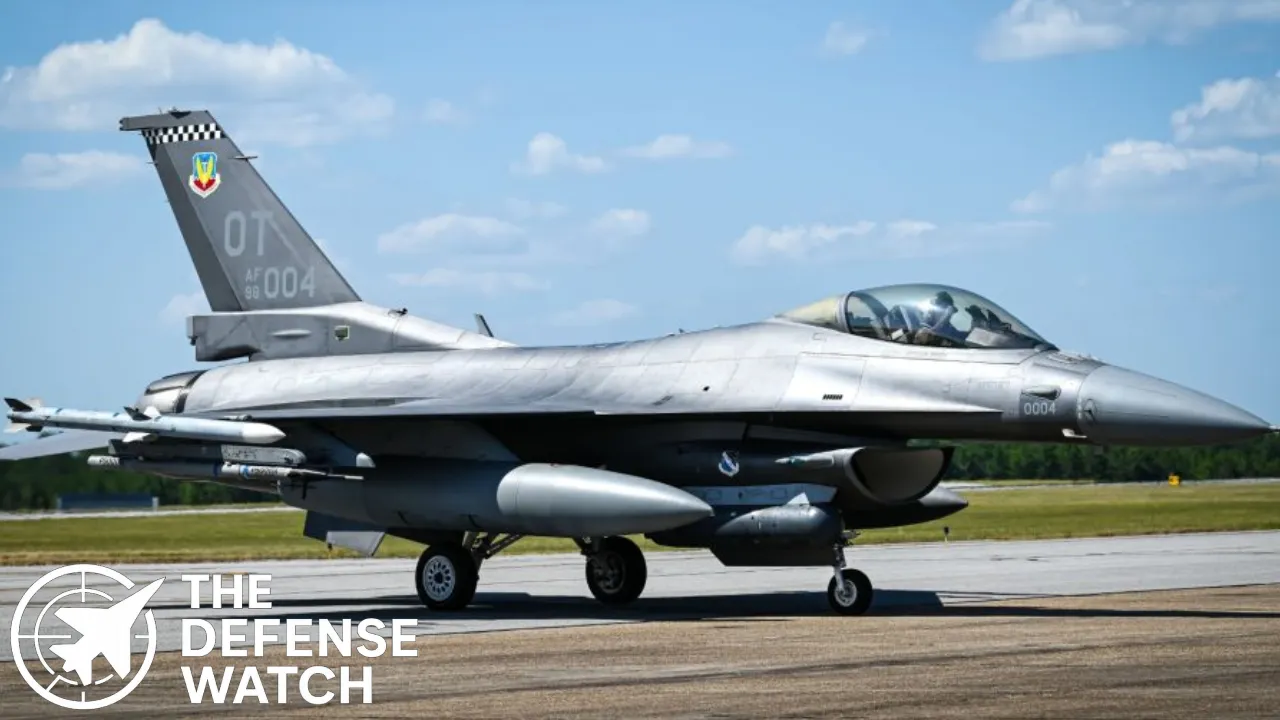
The Northrop Grumman Corporation ALQ-257 Integrated Viper Electronic Warfare Suite (IVEWS) for the F‑16 Fighting Falcon is poised to enter production, with the first tranche of 72 units scheduled for deployment to the Middle East under an urgent operational requirement. The U.S. Air Force began green-lighting the programmed in late 2025, with production slated to start as early as next year.
Background
The F-16, a workhorse fourth-generation fighter in U.S. and allied service, has faced increasingly advanced air-defense and electronic-threat environments, particularly in contested theatres. In response, IVEWS was selected in 2019 as the dedicated EW suite for the U.S. F-16 fleet. The ALQ-257 design integrates ultra-wideband detection, digital radar warning receivers and jamming capability, enabling the F-16 to operate in dense electromagnetic spectrum threat environments. It is also architected to work in conjunction with the SABR AESA radar (AN/APG-83) on modernized F-16 variants.
Details of the Program
According to Northrop Grumman’s vice president of targeting and survivability, Jim Conroy, the upcoming production run will initially equip 72 Block 50 F-16s, as directed by a Urgent Operational Need (UON) from United States Air Forces Central Command (AFCENT) for operations in the Middle East.
Funding for the initiative has been bolstered by congressional action: a reconciliation bill allocated US$187 million to conclude final engineering and manufacturing development and initiate initial production. The proposed FY 2026 appropriations include an additional US$250 million for full-rate production.
From a technical standpoint, IVEWS is a fully internal, line-replaceable module for the F-16, unlike previous external EW pods such as the ALQ-131 or ALQ-184. This internal integration frees up external stations for additional fuel or weapons.
Flight testing concluded its operational assessment phase in April 2024 after about 250 flight hours and testing against representative threats. The suite demonstrated interoperability with the SABR AESA radar system, allowing radar and EW functions to operate pulse-to-pulse without interference.
Industry officials say the urgency of the Middle East deployment stems from the evolving threat environment — mobile radars, frequency-hopping emitters and dense spectrum congestion challenge legacy EW architectures. Conroy noted that “you can’t just pre-plan how you’re going to execute your mission, because you don’t know where the threats are going to be.”
One senior Northrop program lead described the IVEWS capability as effectively giving the F-16 “mini EA-18G Growler-like” electronic attack functionality, enabling the platform to detect, geo-locate and jam threats from within the aircraft itself, rather than relying on external escort assets.
Expert and Policy Perspective
From a policy and force-structure perspective, the deployment of IVEWS underlines a growing recognition within the U.S. Air Force that legacy fourth-generation platforms must be upgraded not only for weapons and sensors but for survivability in contested, electromagnetic environments. A service spokesperson stated that “the Air Force has identified multiple scenarios where enhanced electronic warfare systems can help meet … operational needs across different AORs,” referencing the IVEWS program by name.
For allied partners operating F-16s, the exportability of IVEWS is noteworthy. The system is marketed for global F-16 operators and aligns with Northrop’s ultra-wideband EW architecture for future threat environments.
Operationally, the Middle East theatre presents acute requirements: F-16s deployed in the region have recently engaged advanced surface-to-air missile systems, drone threats, and adversary aircraft from near-peer sources. The addition of IVEWS is intended to bolster survivability for those missions.
Impact and What’s Next
The ramp-up of IVEWS production marks a significant milestone for F-16 modernisation. With the first units committed to Middle East deployment, the U.S. and partner air forces signal an elevated focus on electronic warfare as a core component of air-dominance and platform survivability.
The next steps include full-rate production later in FY 2026, broader installation across the F-16 fleet (potentially up to 600 aircraft) and continued integration of new threat libraries and software updates under the system’s modular EW architecture.
Ultimately, the IVEWS deployment seeks to extend the relevance of the F-16 among fourth-generation fighters by equipping them with EW capability approaching that of fifth-generation aircraft—a strategic gain in an era of proliferated air and missile defenses.

8 comments
[…] Martin manufactures the F-16V at its Greenville, South Carolina facility — the only active F-16 production line worldwide. However, pandemic-era disruptions and global supply shortages, particularly in […]
[…] — able to project power without necessarily firing a shot. The Ford-class carrier, the most advanced in the U.S. fleet, is now entering the operational sphere of Venezuela, where U.S. authorities allege significant […]
[…] their new scorecards, that the Joint Acceleration Reserve is properly funded, and that the Wartime Production Unit can scale capacity quickly. Experts warn that changing culture and incentives is difficult, […]
[…] According to CENTCOM, Task Force Scorpion Strike was activated on 3 December 2025. The new force is built around one-way, expendable attack drones derived from the Shahed-136 design. These drones, known as Low-cost Unmanned Combat Attack System (LUCAS), have already been deployed to the Middle East. […]
[…] for the APX-126(V) units currently used on flight-test examples of the Boramae. Delivery of the CIT units is scheduled ahead of the KF-21’s first production deliveries in […]
[…] is scheduled for April 2027. The agreement does not include option provisions, indicating a defined production scope tied to current fleet […]
[…] to the Indo Pacific, place constant pressure on US forces. The budget proposal aims to ensure that deployed units are fully equipped while also preparing the force for future […]
[…] jets will be assigned to two frontline units, the Southern Lions Squadron (116 Squadron) and the Golden Eagle Squadron (140 Squadron). Upon […]