Acting Navy Secretary Tours Blount Island, Examines Marine Corps Global Logistics Network
Acting Secretary of the Navy Hung Cao visited Marine Corps Support Facility Blount Island in Jacksonville, Florida, on November 4, 2026, to examine how the installation prepares, maintains and positions military equipment for U.S. Marines operating around the world.
The visit brought attention to an important part of Marine Corps readiness that receives less public attention than ships, aircraft and weapons systems: the logistics infrastructure needed to move combat equipment from storage facilities to deployed forces.
Blount Island Command, which operates under Marine Corps Logistics Command, manages equipment preparation, maintenance and distribution activities supporting the service’s forward-positioned logistics network.
During the visit, Marine Corps Col. David Merles, commander of Blount Island Command, and installation department director Michael Erhardt briefed Cao aboard the Military Sealift Command vessel USNS Dahl.
Their briefing covered the facility’s waterfront infrastructure, maintenance warehouses, equipment staging areas and slipway facilities used to support Marine Corps logistics operations.
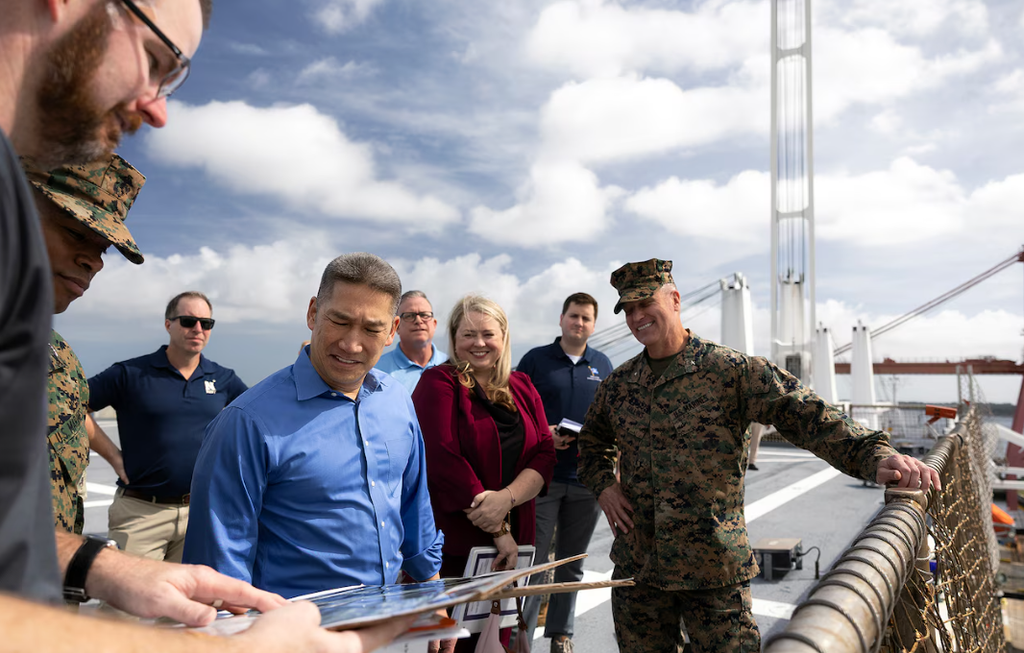
Cao was accompanied by Benjamin Kohlmann, assistant secretary of the Navy for manpower and reserve affairs, and Marjorie Lutz, assistant deputy commandant of the Marine Corps for installations and logistics. Marine Corps Brig. Gen. Kevin Collins, commander of Marine Corps Logistics Command, also participated.
According to the Department of War’s November 6 report, the visit focused on how Blount Island’s industrial waterfront supports the positioning and movement of equipment for Marines worldwide.
How Blount Island supports Marine deployments
Located along the St. Johns River in Jacksonville, Blount Island is an important component of the Marine Corps’ equipment prepositioning and sustainment system.
Its mission extends beyond conventional equipment storage. The installation supports the preparation, inspection, maintenance, replacement and distribution of equipment and supplies that can be positioned aboard ships or at facilities ashore closer to operational areas.
This arrangement allows Marine forces to access equipment without having to transport every vehicle, supply item and support asset from the continental United States after a crisis begins.
Blount Island Command coordinates these activities as part of the Marine Corps’ wider forward-positioned sustainment network.
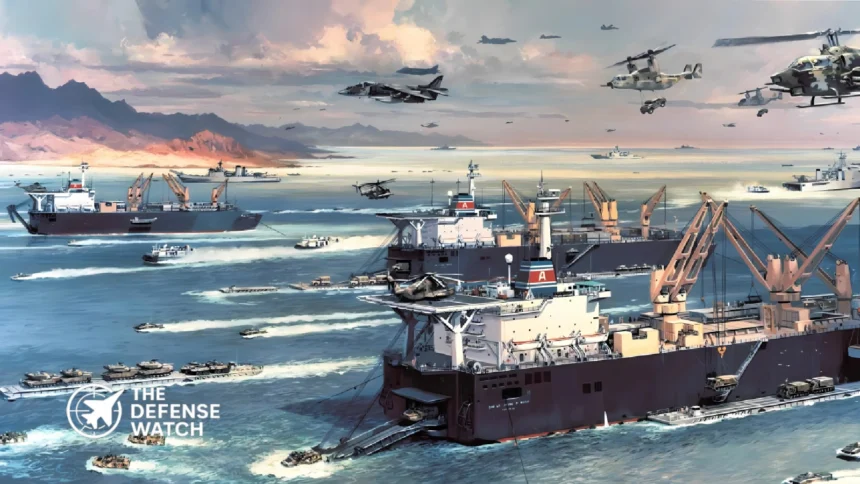
The installation supports both afloat and ashore prepositioning programs, including the Maritime Prepositioning Force and the Marine Corps Prepositioning Program-Norway.
The Maritime Prepositioning Force uses strategically positioned ships carrying equipment and supplies intended to support Marine expeditionary forces. Marines can deploy separately and link up with the prepositioned equipment when required.
This approach reduces the amount of heavy equipment that must accompany personnel during the initial stages of an overseas deployment.
The Marine Corps’ official description of Blount Island identifies the command as a central organization responsible for generating, sustaining, modernizing and distributing forward-positioned equipment and supplies.
A real-world example: 22nd MEU equipment transfer
One of the clearest demonstrations of Blount Island’s operational value occurred in May 2026, when the installation supported the 22nd Marine Expeditionary Unit (Special Operations Capable) during its Caribbean deployment.
On May 5, Marines moved an up-armored MK36 Medium Tactical Vehicle Replacement wrecker ashore at Blount Island using a Navy landing craft utility.
The landing craft departed the San Antonio-class amphibious transport dock USS Fort Lauderdale (LPD 28) and traveled along the St. Johns River to the installation.
The vehicle was unloaded using Blount Island’s sand ramp, allowing the Marines to move the heavy recovery vehicle ashore and continue their operations.
The operation demonstrated how an established waterfront facility can provide an alternative equipment transfer point when conventional landing locations present difficulties.
According to the Marine Corps account published on May 7, Blount Island Command coordinated the landing after the deployed unit requested assistance.
The facility’s protected slipway and sand ramp provided the necessary infrastructure for the movement.
The May operation is separate from Cao’s November visit. It provides an earlier operational example of the installation’s logistics role.
Emergency replacement parts for deployed vehicles
The May equipment transfer was not the only example of Blount Island supporting the 22nd MEU.
During the same Caribbean deployment, the unit required replacement windows for its armored vehicles to meet a force-protection requirement.
Blount Island Command approved the request, while Marine Corps contractors prepared replacement panels from prepositioned stocks for shipment.
Using existing stocks can reduce the time needed to obtain replacement components compared with initiating a new procurement process.
The episode illustrates another important aspect of military logistics: maintaining access to replacement parts can be as important as positioning complete vehicles and other major equipment.
For deployed forces, delays in obtaining essential components can affect equipment availability and operational continuity.
Public information does not specify the number of replacement panels supplied or provide a detailed account of the delivery schedule.
Waterfront infrastructure also supports Navy training
Blount Island’s facilities also serve a training role for Navy personnel involved in expeditionary logistics.
During a separate exercise in late May 2026, sailors assigned to the 2nd Navy Expeditionary Logistics Regiment practiced crane operations, line handling and equipment staging alongside the installation’s workforce.
The exercise involved USNS Red Cloud and Navy causeway ferries, which supported ship-to-shore equipment transfer training.
Experienced Navy veterans working as contracted watercraft masters, engineers and crew members helped guide sailors through vessel movements and crane operations.
These activities address practical requirements associated with moving heavy military equipment between ships and shore facilities.
Successful expeditionary logistics requires coordination among vessel crews, port personnel, maintenance teams and the units receiving equipment. Training in these activities helps personnel maintain the skills needed to support deployments and contingency operations.
Why the Marine Corps needs forward-positioned equipment
The Marine Corps relies on a combination of strategic transportation, maritime access and prepositioned equipment to deploy forces overseas.
Moving personnel and equipment together can create significant transportation demands, particularly when a Marine expeditionary unit must respond quickly to a developing crisis.
Prepositioning addresses part of that challenge by keeping selected equipment and supplies closer to potential operating areas.
Blount Island supports this system through maintenance, storage, equipment preparation and coordination with maritime transportation assets.
Its importance is particularly relevant to expeditionary operations, where Marines may need to move equipment through ports, coastal facilities or temporary landing locations rather than relying exclusively on established commercial infrastructure.
The facility also contributes to equipment readiness between deployments. Prepositioned assets require inspection, maintenance and periodic replacement to ensure they remain suitable for operational use.
This creates a continuing requirement for skilled personnel, industrial facilities, contractors and reliable access to maritime transportation.
The Marine Corps’ historical account traces its maritime prepositioning enterprise to the early 1980s, when equipment and supplies began being positioned aboard ships to support rapid overseas deployments. Blount Island Command was established in 1986 and subsequently became a central organization for maintaining and distributing forward-positioned Marine Corps equipment.
Industrial waterfront capacity remains a readiness requirement
Cao’s visit also placed emphasis on the relationship between maritime infrastructure and the wider U.S. defense industrial base.
During the tour, he highlighted the importance of skilled workers, available industrial space and waterfront access in supporting the nation’s maritime capabilities.
These requirements extend beyond the construction and maintenance of warships.
Military logistics installations need suitable waterfront facilities, storage capacity, heavy-equipment handling infrastructure and maintenance capabilities to support the movement of military assets.
Blount Island brings several of these functions together at one location.
Its operations also demonstrate how Navy and Marine Corps logistics activities depend on civilian contractors and experienced maritime personnel, rather than military personnel alone.
However, the November visit announcement did not disclose new infrastructure contracts, expansion funding, equipment procurement decisions or specific construction milestones.
It therefore provides evidence of continued senior-level attention to the installation’s logistics mission, rather than confirmation of a new modernization program.
For the Marine Corps, maintaining these facilities is part of ensuring that forward-positioned equipment remains available when deployed units need it.
The effectiveness of the wider prepositioning system ultimately depends not only on the equipment held overseas or aboard ships, but also on the industrial facilities and personnel responsible for maintaining, replacing and moving those assets.