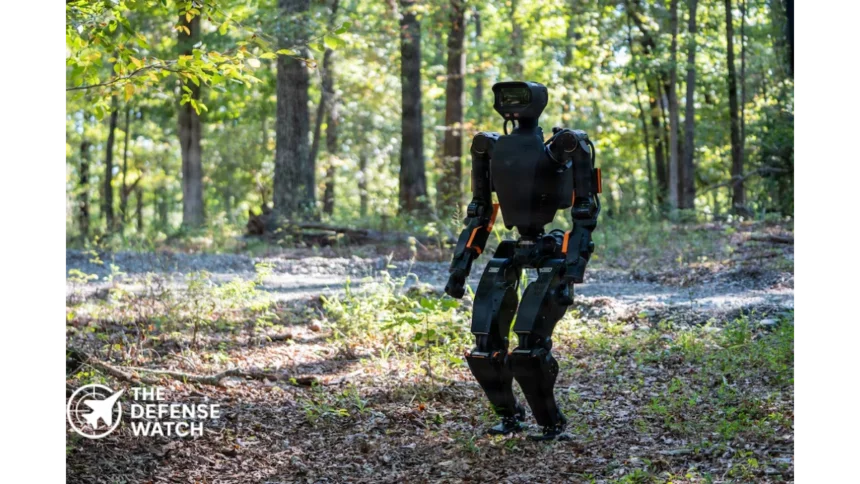
The U.S. Army is evaluating whether humanoid robots and their supporting technologies can help soldiers perform hazardous tasks, from obstacle clearance and reconnaissance to maintenance and emergency response. Five companies were selected as winners of the Army’s xTechHumanoid competition after demonstrations at Marine Corps Base Quantico, Virginia, on Sept. 9 and 10, 2026.
The competition focused on an early-stage technology question: which commercially developed robotic systems and components could eventually meet military requirements? The Army received 103 white paper submissions and selected five winners following its evaluation process, according to an official Army announcement published Sept. 30.
The results provide a snapshot of industry progress, but they do not establish that humanoid robots are ready for routine deployment with combat units.
Five companies target different robotics challenges
The Army selected companies working on complete robotic platforms as well as specialized components. That distinction matters because a humanoid robot’s military usefulness depends on more than its ability to walk or manipulate objects. Power supply, tactile sensing, software, control and reliable operation in difficult environments are also essential.
The five winners were:
IHMC Robotics
The Florida Institute for Human and Machine Cognition developed Alex, a humanoid platform featuring impact-resilient actuators, ballistic protection and a hybrid autonomy approach that combines artificial intelligence with human control. The Army identified IHMC as the winner in the baseline humanoid system category.
ACES Group
ACES Group focused on integrated power systems and scalable energy storage. Energy availability is a central engineering constraint for robots that must move, process sensor data and operate without frequent charging or battery replacement.
Hydroplane Limited
Hydroplane presented a compact mobile power-generation system intended to support extended operation in contested logistics environments. Its work addresses the challenge of supplying energy to robotic platforms away from established infrastructure.
Ras Labs
Ras Labs developed sensitive fingertip sensors designed to detect force, object shape, slippage and other physical interactions. Such sensing could help robots handle tools and equipment more reliably than systems relying primarily on cameras.
Velocity Explorations
Velocity Explorations worked on software that translates trusted information and command intent into actions for humanoid robotic systems. The approach addresses how operators can direct robotic platforms through complex tasks without manually controlling every movement.
What the Army wants humanoid robots to do
The Army’s competition announcement identifies a range of possible missions for future militarized humanoid systems. These include facility security, obstacle reconnaissance and clearance, chemical and radiological hazard assessment, firefighting, maintenance, sustainment and forward surveillance.
The service also envisions robots helping small units move materials across difficult terrain and assess obstacles before soldiers approach them. The stated objective is to augment military personnel, not replace them.
Humanoid designs offer one potential advantage over conventional wheeled or tracked robots: their body shape and manipulators could allow them to interact with equipment, tools and infrastructure designed for people.
That advantage is conditional, however. A robot must be able to maintain balance, manipulate objects, interpret its surroundings and recover from unexpected conditions. A machine that can walk across a test area may still struggle with mud, rubble, narrow passages, damaged structures or poor visibility.
For many military missions, a conventional unmanned ground vehicle may remain more practical. Wheeled and tracked platforms can carry loads without the mechanical complexity of a bipedal system. The Army’s challenge is to identify tasks where a humanoid form offers enough additional value to justify its cost, maintenance and power requirements.
The main obstacle is reliable operation, not appearance
The competition’s emphasis on supporting technologies reflects several interdependent problems.
Power and endurance: Walking, balancing and manipulating objects consume energy. Batteries must also support computing, communications and sensors. Greater endurance can require heavier batteries or additional power-generation equipment, which in turn increases the load the robot must carry.
Dexterity: Military tasks may require opening doors, handling tools, moving debris or manipulating unfamiliar objects. Tactile sensing can improve physical interaction, but sensors alone cannot guarantee that a robot will perform a task successfully.
Autonomy and control: Robots operating in unfamiliar environments need to recognize obstacles, respond to changing conditions and follow operator instructions. Software must also cope with incomplete information, communication interruptions and unexpected situations.
Field maintenance: A robot intended for military use must withstand repeated movement, impacts, dust, moisture and other environmental stresses. It must also be repairable with the personnel, parts and tools available to the unit operating it.
These are not separate engineering problems. A heavier power system can reduce mobility, while additional sensors and onboard computing can increase energy demand. The Army will need to evaluate how the components work together under realistic conditions, rather than treating individual demonstrations as proof of an operational capability.
How the competition fits into Army procurement
The xTechHumanoid program is part of the Army’s effort to identify commercial technology that could support military requirements without relying exclusively on traditional defense contractors.
According to the official competition page, the program offered up to $490,000 in total cash prizes and up to $1.25 million in potential follow-on contracts or agreements. Finalists could receive $25,000 each, while winners in the baseline humanoid category were eligible for an additional $75,000 and winners in the advanced subsystem category for an additional $30,000.
Those figures describe the competition’s funding framework, not a $1.25 million contract awarded to every winner. The Army’s public announcement identifies the five winners but does not establish that each has received a follow-on procurement contract.
The distinction is important. A technology competition allows the military to assess available systems, identify shortcomings and give developers feedback. Transitioning a promising prototype into service requires further work on reliability, safety, cybersecurity, logistics, training and integration with military command systems.
The Army’s broader Humanoid Community of Collaboration, established in December 2023, coordinates work on developing and integrating humanoid capabilities across the joint force. The Army says the competition’s findings will inform future research, including work on power and energy constraints.
What remains unproven
The competition does not establish that humanoid robots can independently conduct combat missions, operate for extended periods without support or function reliably in contested environments.
Nor does selecting a company as a winner mean its technology has passed military qualification or entered operational service. The Army has described the effort as a way to assess commercial technology maturity and determine where further development could be useful.
For now, the most immediate value may lie in individual technologies that can improve a range of robotic systems, including power generation, energy storage, tactile sensors and command software. These components could prove useful even if a particular humanoid platform does not progress to field use.
The Army’s next challenge is to demonstrate that these technologies can work together in demanding military conditions. Until that happens, humanoid robots remain an area of experimentation rather than an established addition to the force.