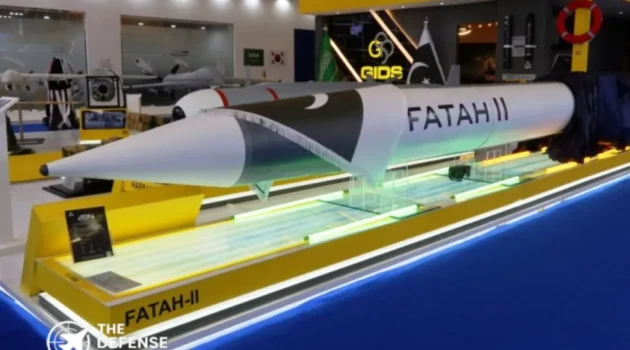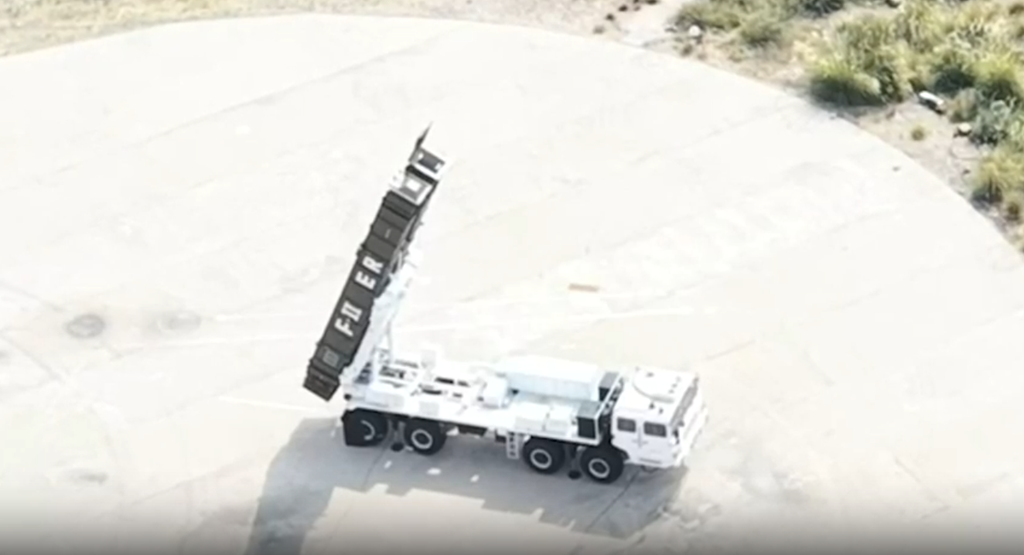
Pakistan’s Army conducted a test launch of the Fatah-2 Extended Range (ER) hypersonic ballistic missile on October 13, 2026, evaluating a longer-range version of a weapon system the military says is designed to strike targets with precision and challenge missile defenses.
The Inter-Services Public Relations (ISPR), Pakistan’s military media wing, announced the test and said the missile incorporates advanced navigation and avionics. It also attributed the system’s claimed ability to penetrate opposing missile defenses to its trajectory and maneuverability.
The announcement did not disclose the missile’s maximum range, flight speed, test trajectory, accuracy results or the status of its operational deployment. Those omissions limit independent assessment of how much capability the extended-range variant adds to Pakistan’s existing conventional strike forces.
What Pakistan disclosed about the Fatah-2 ER test
According to the official account, the launch was witnessed by the commander of the Army Rocket Force Command, senior Pakistan Army officers, and scientists and engineers involved in the program.
Pakistan’s president, Asif Ali Zardari, Prime Minister Shehbaz Sharif, Chief of Army Staff and Chief of Defence Forces Field Marshal Syed Asim Munir, and the service chiefs subsequently congratulated the teams responsible for the test, ISPR said.
The military identified three principal features of the Fatah-2 ER:
- Extended range: The new version is intended to increase the Army’s reach against targets farther from launch positions.
- Navigation and avionics: The system reportedly incorporates updated navigation capabilities and onboard electronics to support its intended precision-strike role.
- Trajectory and maneuverability: ISPR says these characteristics could make interception more difficult for opposing missile defense systems.
These are official descriptions of the system’s intended capabilities. The public announcement did not provide independently verifiable test data demonstrating the claimed accuracy or ability to defeat specific missile defense systems.
Why the extended-range version matters
Range affects how a land-based missile force can be positioned and employed. A weapon capable of reaching more distant targets can potentially hold additional military facilities, logistics infrastructure and other fixed installations at risk without requiring launch units to move as close to the intended target area.

Image Grab from ISPR Video For Pakistan, the practical value of the Fatah-2 ER will depend on its actual range, payload, accuracy, launch readiness and integration with targeting and command systems. None of those operational details was fully established in the October 13 announcement.
A longer nominal range alone does not establish that a missile can reliably strike a defended target. Effective precision strikes require dependable target information, navigation under operational conditions and sufficient accuracy at the intended engagement distance.
The test therefore provides evidence of continued missile development, but not enough information to quantify the weapon’s military effectiveness.
Hypersonic speed does not automatically mean an impenetrable missile
The term hypersonic generally describes flight at speeds of at least Mach 5, or five times the local speed of sound. Ballistic missiles can reach hypersonic speeds during portions of their flight, particularly during powered ascent and atmospheric reentry.
That distinction matters when evaluating Pakistan’s description of the Fatah-2 ER. The public statement identifies the weapon as a hypersonic ballistic missile and refers to maneuverability, but does not specify its maximum speed, the portion of flight during which maneuvering occurs, or whether the system uses a specialized hypersonic glide vehicle.
A ballistic missile’s speed, flight path and maneuvering characteristics affect how an interceptor can engage it. However, interception also depends on detection, tracking, engagement timing, defensive-system design and the geometry of the attack.
Consequently, ISPR’s claim that the Fatah-2 ER can defeat enemy missile defenses should be treated as an official performance claim, not as independently demonstrated proof that the missile can evade every modern defense system.
Fatah-2 ER follows another Pakistani missile test
The launch came days after Pakistan tested an extended-range version of the Fatah-4 ground-launched cruise missile, according to reporting by Geo News and Pakistan’s state broadcaster. The Fatah-4 is described by the military as a precision-strike weapon incorporating advanced avionics and navigation aids.
The two systems should not be confused. The Fatah-2 ER is identified as a ballistic missile, while the Fatah-4 is a ground-launched cruise missile. Their different flight profiles imply different operating characteristics and potential engagement opportunities, although detailed comparative performance data has not been released in the cited announcements.
Testing both systems in an extended-range configuration suggests that Pakistan is continuing to develop its land-based conventional strike options across more than one missile category. The available evidence does not, however, establish a common development schedule, a shared guidance architecture or a specific deployment plan linking the programs.
For regional military planners, the relevant questions are not simply whether Pakistan can launch these weapons, but how many systems might eventually enter service, how reliably they can be used, and how they would be integrated with surveillance, targeting and command networks.
What remains unconfirmed
Several important details are still missing from the public record of the October 13 test.
Range and speed: ISPR did not publish a numerical range for the extended-range Fatah-2 or provide measured flight-speed data.
Accuracy: The military described the weapon as capable of high-precision engagement but did not release target-impact measurements or other test results.
Missile defense performance: No specific opposing defense system was identified, and no independent evidence was supplied to substantiate the claim that the missile can defeat such systems.
Operational status: The announcement confirmed a test launch, not the beginning of operational deployment. It did not specify a production order, induction date or unit-level fielding schedule.
Payload and configuration: The announcement did not disclose payload capacity or provide enough technical information to establish the missile’s detailed configuration.
These gaps are important because a successful test is a program milestone, not a complete measure of operational capability. Further public information would be needed to assess the system’s performance and its contribution to Pakistan’s conventional strike force.
For now, the Fatah-2 ER test confirms Pakistan’s continued work on an extended-range ballistic missile. The degree to which it improves the Army’s ability to conduct accurate strikes against defended targets remains uncertain without published technical data and independently verifiable evidence.