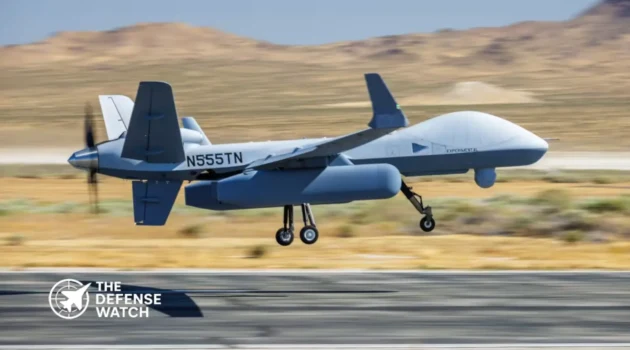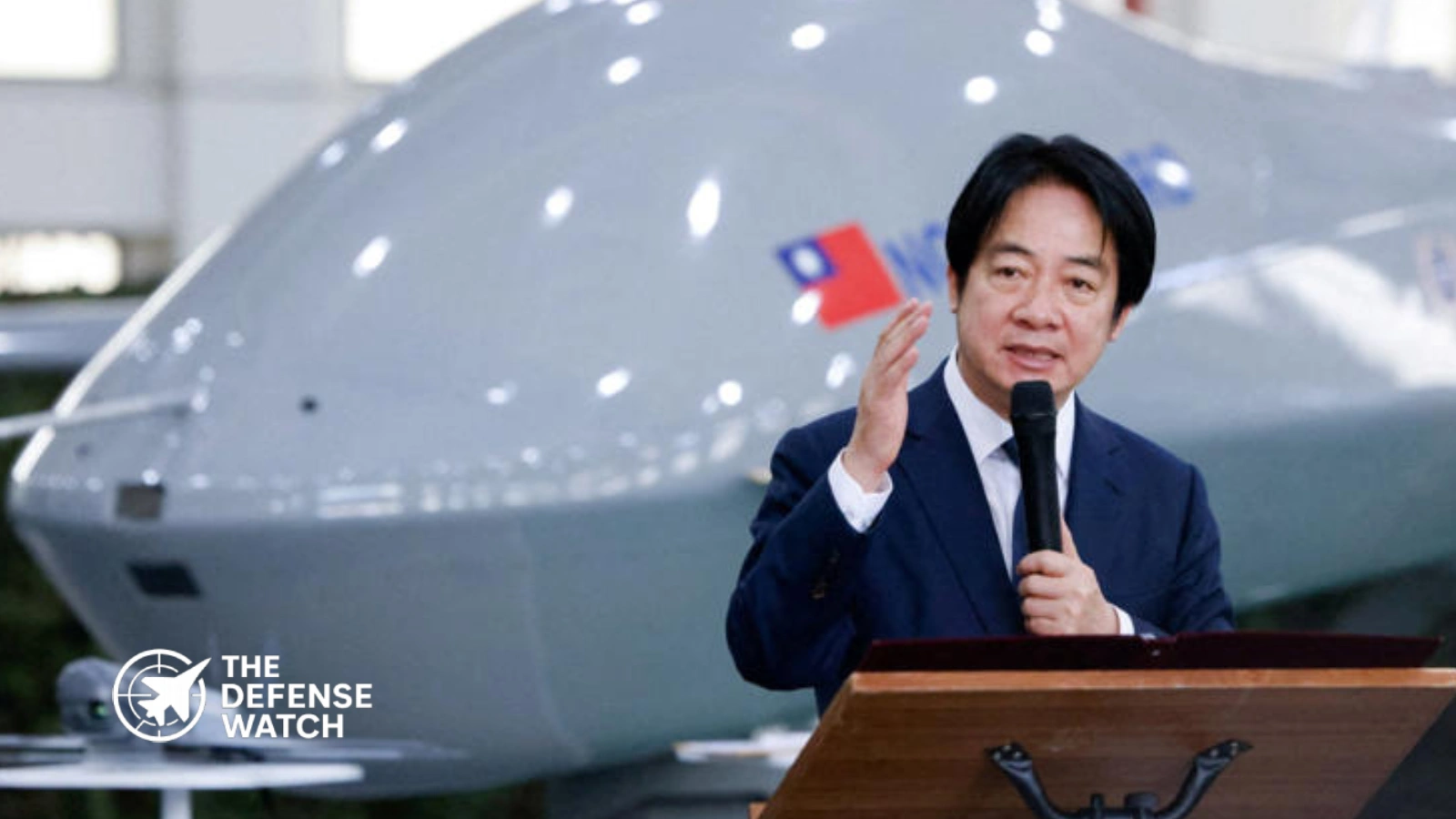
Executive Summary: Taiwan has begun flight testing the first two of four U.S.-built MQ-9B unmanned aircraft at Hualien Air Base. The aircraft are intended primarily for long-endurance intelligence, surveillance and reconnaissance missions, including monitoring PLA warships and Chinese coast guard vessels operating around Taiwan. The program gives Taiwan a persistent airborne surveillance capability that can complement crewed reconnaissance aircraft, ground-based radar, maritime forces and smaller unmanned systems.
Taiwan Begins MQ-9B Flight Testing
Taiwan has begun flight testing its MQ-9B unmanned aircraft, marking the transition of the first two U.S.-built aircraft from delivery and ground preparation into operational testing. Taiwan’s Ministry of National Defense confirmed that the first two aircraft were handed over in the United States on March 17, 2026, with the two remaining aircraft scheduled for delivery in 2027.
The first two aircraft conducted their initial flight tests at Hualien Air Base on September 14, according to Taiwan’s Central News Agency and other Taiwanese reporting. The aircraft had arrived in Taiwan earlier in 2026 and underwent assembly, inspection, ground testing and preparation before the first flight.
The MQ-9Bs will provide Taiwan with a long-endurance airborne sensor designed to remain over an area for extended periods while transmitting information to ground-based command elements. That capability is particularly relevant to Taiwan’s need to monitor recurring Chinese military and maritime activity around the island.
Taiwan’s Ministry of National Defense has said the four-aircraft program is intended to improve its surveillance and reconnaissance capability. The original U.S. approval for the program covered four MQ-9B aircraft and associated equipment at an estimated value of $600 million.
Why the MQ-9B Matters for Taiwan’s Maritime Surveillance
The principal value of the MQ-9B is persistence.
A conventional crewed reconnaissance aircraft can collect substantial intelligence, but maintaining continuous coverage requires aircraft rotations, crews and supporting infrastructure. A long-endurance unmanned aircraft can remain airborne for much longer periods, allowing Taiwan to maintain surveillance over important maritime approaches without assigning a crewed aircraft to every routine mission.
General Atomics describes the MQ-9B as a long-endurance, medium-altitude remotely piloted aircraft capable of beyond-line-of-sight operations through satellite communications. The current company specification lists a maximum endurance of up to 40 hours, an altitude of 40,000 feet and a range of up to 6,000 nautical miles for the SkyGuardian configuration.
The SeaGuardian maritime configuration adds sensors and mission equipment intended for operations over water. General Atomics lists maritime surface-search radar, high-definition electro-optical and infrared sensors, automatic identification system capability and beyond-line-of-sight communications among the aircraft’s available capabilities.
MQ-9B Capability at a Glance
Capability MQ-9B published specification Manufacturer General Atomics Aeronautical Systems Wingspan 79 feet / 24 meters Maximum gross takeoff weight 12,500 pounds / 5,670 kg Maximum altitude 40,000 feet Maximum endurance Up to 40 hours Maximum airspeed 210 KTAS Maximum range Up to 6,000 nautical miles Powerplant Honeywell TPE331-10 turboprop Communications Line-of-sight and beyond-line-of-sight links Maritime sensors 360-degree maritime radar, EO/IR and AIS options Specifications vary according to aircraft configuration and mission equipment.
A Tool for Monitoring PLA and Chinese Coast Guard Activity
Taiwan’s immediate requirement is not simply to find aircraft or ships. It is to maintain a persistent picture of activity across a maritime environment where military and law-enforcement vessels can operate close to the island without necessarily entering an armed conflict.
That makes the MQ-9B relevant to what Taiwan describes as grey-zone activity.
The aircraft can potentially monitor PLA naval vessels, Chinese coast guard ships and other maritime traffic while remaining on station for extended periods. Its maritime radar and electro-optical sensors can provide complementary information, allowing operators to identify and track contacts across a broad area.
Taiwan’s Ministry of National Defense reported that between September 14 and 15 it detected eight PLA aircraft, seven PLAN ships and two official vessels operating around Taiwan. Seven of the eight aircraft crossed the Taiwan Strait median line and entered Taiwan’s northern, southwestern or eastern air defense identification zone.
The MQ-9B therefore enters service at a time when Taiwan is already conducting continuous monitoring of Chinese military activity.
Its significance is less about replacing existing sensors than about adding another layer of persistent surveillance.
MQ-9B Can Extend the Surveillance Network
The aircraft’s greatest operational advantage is the ability to combine endurance, sensors and communications.
An MQ-9B operating at altitude can observe maritime areas while passing information to command centers and other forces. General Atomics has demonstrated SeaGuardian operations involving real-time intelligence feeds, maritime radar, electro-optical and infrared systems, signals intelligence and data links during U.S.-led exercises.
This creates an important distinction between a drone as an isolated sensor and a drone as part of a wider surveillance architecture.
For Taiwan, the more useful model is the second one.
The MQ-9B can search large areas and identify contacts. Other systems can then provide closer identification, additional tracking or a response. These could include coastal radars, naval vessels, crewed aircraft, smaller drones and other intelligence systems.
That layered approach also reduces the pressure on any single platform.
The Aircraft Is More Than a Reaper Derivative
The MQ-9B is derived from the MQ-9 family but incorporates significant changes intended to improve endurance, airworthiness, communications and operation in wider airspace environments.
General Atomics lists a 24-meter wingspan, a maximum gross takeoff weight of 5,670 kg, automatic takeoff and landing, a detect-and-avoid system, all-weather features and a fatigue- and damage-tolerant airframe. The company also describes the aircraft as having a 40,000-hour design service life.
For Taiwan, the communications architecture is particularly important.
The MQ-9B is designed to use beyond-line-of-sight satellite communications, allowing operators to control and receive information from the aircraft beyond the physical range of a conventional ground-control link.
That does not make the aircraft immune to electronic warfare, communications disruption or other forms of interference. It does, however, give Taiwan a platform designed from the outset for persistent operations over large distances.
Four Aircraft Will Not Provide Continuous Coverage Everywhere
The main limitation is fleet size.
Taiwan is acquiring only four MQ-9Bs, with two aircraft delivered in 2026 and the remaining two planned for 2027.
Four aircraft cannot simultaneously provide persistent coverage across every maritime approach surrounding Taiwan. Aircraft require maintenance, crew support, mission preparation and periodic downtime.
This means Taiwan’s MQ-9B fleet should be viewed as a high-value surveillance layer rather than a complete solution for maritime domain awareness.
The practical objective is likely to use the aircraft where their endurance and sensor suite provide the greatest benefit, while lower-cost drones, coastal sensors and other surveillance platforms cover less demanding missions.
Taiwanese defense analysts have also discussed combining the MQ-9B with locally developed unmanned aircraft, including the Teng Yun 2, creating a higher-end and lower-cost mix of surveillance platforms.
Such an approach could eventually be more important than simply increasing the number of MQ-9Bs.
The MQ-9B’s Weapons Capability Is a Secondary Issue
The MQ-9B family can support weapons and other mission systems, but Taiwan’s immediate requirement is surveillance.
General Atomics has continued expanding the aircraft’s potential mission set. In 2026, the company announced work on long-range weapons capabilities for MQ-9B aircraft and separately reported progress toward integrating the Joint Strike Missile with the platform.
Those developments demonstrate the flexibility of the basic aircraft design, but they should not be confused with Taiwan’s current operational priority.
Taiwan’s Ministry of National Defense has emphasized the reconnaissance role of the aircraft. The first phase of the program is therefore better understood as an effort to improve persistent sensing rather than as the introduction of another strike aircraft.
That distinction matters because surveillance can support a much broader set of defensive missions.
Implications for the First Island Chain
The MQ-9B’s deployment also has wider significance for the U.S.-aligned security architecture in the western Pacific.
Taiwan occupies a central position in the first island chain, making information about maritime movements around the island relevant not only to Taiwan but also to the wider regional operating picture.
SeaGuardian has already demonstrated the ability to provide real-time ISR information during U.S. Navy exercises. During RIMPAC 2024, a SeaGuardian provided ISR data feeds to the U.S. Pacific Fleet command center and supported dynamic tasking involving participating surface and air forces.
Taiwan’s aircraft are not automatically equivalent to a U.S. Navy operational asset, and their exact connectivity and information-sharing arrangements are subject to Taiwan’s systems and policies.
However, the broader technical principle is clear: long-endurance unmanned aircraft can serve as distributed sensors that collect information and pass it into a wider command-and-control network.
For a theater where maritime movements can span hundreds or thousands of miles, persistence can be as important as raw sensor performance.
What Comes Next
The immediate priority for Taiwan will be completing flight testing, validating the aircraft’s sensors and communications systems, training operators and integrating the MQ-9B into existing reconnaissance procedures.
The first two aircraft have now moved into that process.
The remaining two aircraft are expected in 2027, which will give Taiwan the full four-aircraft fleet originally planned under the program.
The longer-term question is how Taiwan builds around the MQ-9B rather than simply how many MQ-9Bs it operates.
A layered system combining high-end long-endurance aircraft, locally produced unmanned systems, coastal radar, naval sensors, crewed reconnaissance aircraft and other intelligence sources would provide greater resilience than relying on a small fleet of expensive aircraft.
For Taiwan, the MQ-9B’s most important contribution may therefore be its ability to keep watching for long periods and provide commanders with a more persistent view of the maritime environment.
That capability directly addresses one of the central challenges of grey-zone operations: maintaining awareness of repeated activity without treating every encounter as a crisis.
Key Facts
- Taiwan has begun flight testing its first two MQ-9B aircraft at Hualien Air Base.
- Four MQ-9Bs are being acquired from the United States.
- The first two aircraft were handed over in the United States on March 17, 2026.
- The remaining two aircraft are scheduled for delivery in 2027.
- Taiwan’s original U.S. arms-sale notification was valued at $600 million.
- The aircraft are intended primarily to strengthen intelligence, surveillance and reconnaissance.
- The MQ-9B can conduct long-endurance missions and operate through beyond-line-of-sight satellite communications.
- The maritime SeaGuardian configuration can employ maritime radar, EO/IR sensors and other maritime mission systems.
- Taiwan can use the MQ-9B alongside crewed aircraft, coastal sensors, naval forces and smaller unmanned aircraft.
- Four aircraft alone cannot provide continuous surveillance of every area surrounding Taiwan, making broader sensor integration essential.