• Home
  • About
  • Defense Systems
  • Manufacturer
  • Comparisons
  • Compare 
  • Tools
TheDefenseWatch.com
  • Aerospace & Aviation
  • Military & Ordnance
  • Naval & Maritime
  • Cyber & Space Defense
  • Policy & Strategy
  • Global News
  • Tools Library
    • Smart Calculator
    • Drone Flight Time Calculator
    • Drone Range Calculator
    • Counter-Drone Jammer Effective Range Calculator
    • Counter-Battery Radar Detection Calculator
    • Artillery Fire Correction Calculator
    • Thermal Camera Detection Range Calculator
    • Missile Range & Time-of-Flight Calculator
    • Radar Detection Range Calculator
    • FPV Strike Drone Payload vs Range Calculator
    • Loitering Munition Endurance Calculator
    • Sniper Ballistic Drop & Windage Calculator
    • Bullet Drop Calculator
    • U.S. Army Combat Fitness Test (ACFT) Calculator
    • Military Pension Calculator
    • Military Retirement Calculator
    • Military Pension Calculator
    • Large Number Calculator
Font ResizerAa

TheDefenseWatch.com

The Defense Watch | U.S. & Global Defense News, Analysis & Military Updates

Search
  • Home
  • About
  • Defense Systems
  • Manufacturer
  • Comparisons
  • Compare 
  • Tools

Stay Updated

Get the latest update

Subscribe

Explore

  • Drone
  • Fighter Jets & Military Aircraft
  • Hypersonic Weapons
  • Aircraft Carriers
  • Strategic History & Missions
  • Tools Library
Home » Leaked Images Spotlight China’s Tailless J-50: A Bold Step in Sixth-Generation Fighter Design
Aerospace & AviationFighter Jets & Military Aircraft

Leaked Images Spotlight China’s Tailless J-50: A Bold Step in Sixth-Generation Fighter Design

TeamDefenseWatch
Last updated: September 8, 2026 7:20 pm
TeamDefenseWatch
Share
2 Min Read
china sixth generation fighter
Image courtesy of breakingdefense
SHARE
Follow The Defense Watch on Google:

China Sixth Seneration Fighter J-50: Leaked Images Offer New Glimpse of Sixth-Gen Ambitions

Recent images circulating online show, for perhaps the first time, detailed views of what is believed to be china sixth generation fighter—commonly dubbed the J-50 (also referred to by analysts as J-XD or J-XDS). The photographs reveal a striking tailless configuration, swiveling wingtip control surfaces, twin divergent intakes, plus thrust vectoring nozzles—all hallmarks of a radically new design philosophy.

Contents
China Sixth Seneration Fighter J-50: Leaked Images Offer New Glimpse of Sixth-Gen AmbitionsWhat the Leaks Reveal: Features & Design InsightsTailless Design and Control SurfacesDiverterless Supersonic Intakes & AirframeThrust Vectoring ExhaustsCockpit, Sensors, and Underbelly DesignLanding Gear and Airframe ScaleStrategic Implications & CaveatsA Two-Track Sixth-Gen ApproachStealth vs. Agility TradeoffsTiming and Operational ProspectsConclusionFAQs

While the Chinese government has not officially confirmed the aircraft’s designation or capabilities, these images provide the most complete external views yet of a jet that may represent Beijing’s push to field a true sixth-generation fighter.

What the Leaks Reveal: Features & Design Insights

Tailless Design and Control Surfaces

Foremost among the visual revelations is the absence of vertical stabilizers. Instead, the aircraft appears to rely on full-all-moving wingtip surfaces, which may function as control surfaces for yaw or roll control at lower speeds. Analysts suggest this design optimizes for reduced radar cross-section and lower drag.
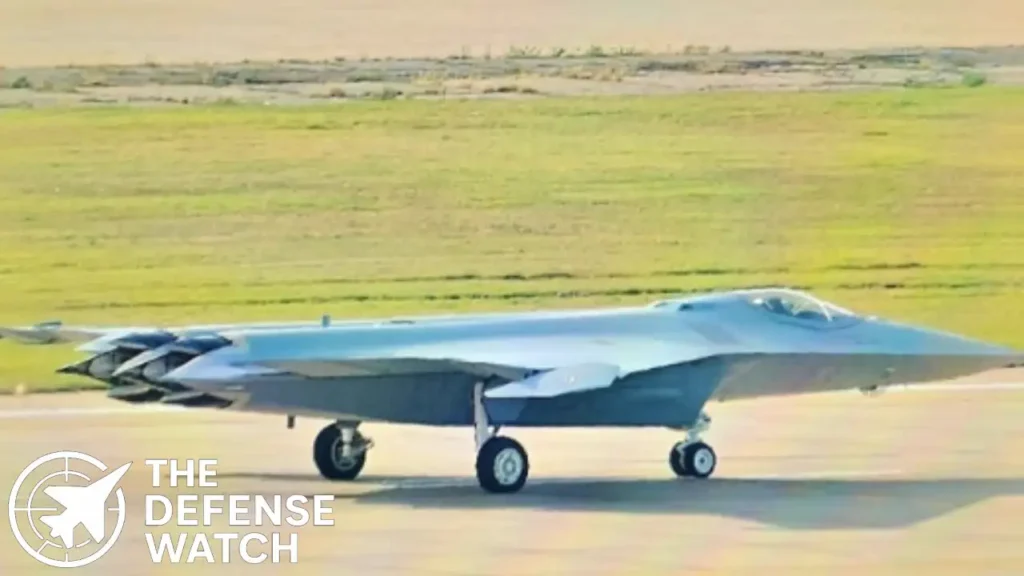
china sixth generation fighter
Image courtesy of breakingdefense

Diverterless Supersonic Intakes & Airframe

The images depict twin diverterless supersonic intakes (DSI) feeding the twin engines, arranged in a stealth-friendly layout. The fuselage surface is smooth, with few protruding edges—a sign that stealth shaping is a priority.

- Advertisement -

Thrust Vectoring Exhausts

Engine exhaust nozzles appear to be equipped with two-dimensional (2D) thrust vectoring, reminiscent of designs like the U.S. F-22, but adapted to a tailless platform. Serrated edges around the exhausts further suggest effort to manage radar signature.

Cockpit, Sensors, and Underbelly Design

The cockpit appears to be intended for a single pilot, with a smooth, blended canopy.Under the nose, an electro–optical targeting system (EOTS) bay is visible, while earlier sightings of a nose-mounted air data boom appear absent in the latest version—perhaps indicating a more advanced internal sensor suite or reconfigured instrumentation.

Two belly weapon bays and side panels also appear on the airframe. The side panels’ function (whether weapon bays or access panels) remains unclear.

Landing Gear and Airframe Scale

One clear image shows a twin-wheeled nose landing gear, perhaps hinting at higher weight or robust structural demands. Some analysts speculate that this may even suggest carrier capability aspirations, though a tailless design introduces challenges at high angles of attack and in yaw control during low-speed operations.

Relative to other Chinese fighters, the china sixth generation fighter J-50 appears smaller than designs like the heavier J-36, suggesting a “low” component in a two-track development strategy.

Strategic Implications & Caveats

A Two-Track Sixth-Gen Approach

China appears to be pursuing parallel designs: the lighter, more agile J-50 by Shenyang and a larger, heavier J-36 by Chengdu. The J-36 may prioritize range, payload, and strike capabilities, while the J-50 could serve as a high-survivability air superiority fighter. Such a “hi-lo” mix mirrors strategies being considered in the U.S. Next Generation Air Dominance (NGAD) effort.

Stealth vs. Agility Tradeoffs

Dropping vertical tails reduces radar cross-section but complicates stability and control. The use of swiveling wingtips and thrust vectoring may mitigate some control losses, but agility—especially in yaw—could be constrained. The reliance on advanced flight control systems will be critical.

Timing and Operational Prospects

Given the rapid imagery updates over 2024–2025, some analysts project China might aim to begin limited deployment of china sixth generation fighter J-50 variants by circa 2030. However, major unknowns remain: sensor fusion, engine performance, electronic warfare integration, and full stealth attributes.

- Advertisement -

Conclusion

The leaked images of China’s alleged J-50 sixth-generation stealth fighter mark a compelling advance in public insight into Beijing’s next step in aerial warfare. The tailless architecture, swiveling wingtips, thrust vectoring, and stealth shaping cohere into a bold design that seeks to push stealth and control technologies in new directions.

Yet, many questions remain: how mature the systems are, whether the design can deliver in agility and combat resilience, and how it will compare to U.S. NGAD or other emerging sixth-generation efforts. What is clear is that China is signaling a serious ambition to close or surpass the U.S. lead in future fighter technology—and that the global balance in airpower may face fresh paradigms in the next decade.

FAQs

Is China’s J-50 confirmed or officially acknowledged?

No. The aircraft remains unconfirmed by the Chinese government. The designation “J-50 / J-XD / J-XDS” is used by analysts, based on leaked images and speculation.

Why remove vertical tails? Doesn’t that compromise control?

Removing vertical stabilizers lowers radar cross-section, but presents stability challenges. Designers must rely on control surfaces (such as swiveling tips), thrust vectoring, and flight control computers to maintain controllability.

Could the J-50 operate from carriers?

Some features—such as twin-wheeled nose gear—might hint at carrier adaptation, but a tailless design complicates high-angle attack control, especially in yaw, which is critical for carrier operations.

When might the J-50 reach service?

While speculative, analysts suggest around 2030 for limited deployment, assuming testing and maturation proceed rapidly.

How does the J-50 fit into China’s overall airpower roadmap?

It appears to be the lighter, air superiority component of a dual approach, with the heavier J-36 handling strike roles. Together, they could form a next-gen force structure to challenge regional powers and contest U.S. aerial dominance.

Source 1 | Source 2 | Source 3

Enjoying our coverage?

Make The Defense Watch a preferred source on Google to see more of our geopolitical and defense insights when relevant to you.


TAGGED:ChinaJ-50Shenyang Aircraftsixth generation fighterStealth Technology
Share This Article
Facebook Copy Link Print
ByTeamDefenseWatch
TeamDefenseWatch is the official editorial byline of TheDefenseWatch.com. Working under one umbrella, TheDefenseWatch.com, the team delivers verified, factual reporting on global defense, military technology, aerospace systems, and security developments. Articles are sourced from official statements, defense industry releases, and trusted media, with editorial review to ensure accuracy and clarity.Contact: info@TheDefenseWtach.com
7 Comments
  • Pingback: Which 5 Air Forces Possess the Costliest Fighter Jet Fleets in the World 2025
  • Pingback: China’s Sixth-Generation Fighter Race Accelerates With Two Prototypes in Flight
  • Pingback: China’s Sixth-Generation Fighter Accelerates as U.S. Jet Project Faces Pressure in Air Superiority Race
  • Pingback: China Claims Breakthrough in Hypersonic Engine with Mach 16 Potential
  • Pingback: Europe’s GCAP 6th-Generation Stealth Fighter Faces Affordability Challenges
  • Pingback: Norway Moves to Expand Military Police Authority on Remote Arctic Island Jan Mayen
  • Pingback: France Orders Long-Range Kamikaze Drones From MBDA and Aviation Design | TheDefenseWatch.com

Leave a Reply Cancel reply

Your email address will not be published. Required fields are marked *

Search Defense Systems

Latest Defense Systems

  • F-15J Eagle Fighter Jet F-15J Eagle Fighter Jet
  • China’s GJ-21 Stealth Drone China’s GJ-21 Stealth Drone
  • China’s GJ-11 Stealth Drone China’s GJ-11 Stealth Drone
  • F-15EX Eagle Fighter Jet F-15EX Eagle Fighter Jet
  • TRML-4D Radar TRML-4D Radar
  • F-47A Fighter Jet F-47A Fighter Jet
  • China DF-61 Missile China DF-61 Missile
  • B61 Nuclear Bomb B61 Nuclear Bomb
  • Japan E-767 Airborne Japan E-767 Airborne

Recent Compares

  • J-10C vs JF-17 Thunder: Which Fighter Is More Capable? J-10C vs JF-17 Thunder: Which Fighter Is More Capable? View Comparison →
  • Tejas vs Gripen: Key Differences and Capabilities Tejas vs Gripen: Key Differences and Capabilities View Comparison →
  • Tejas vs MiG-21 Bison: How India Replaced Its Iconic Supersonic Fighter Tejas vs MiG-21 Bison: How India Replaced Its Iconic Supersonic Fighter View Comparison →
  • F-35 vs F-16: Stealth, Sensors and Combat Roles F-35 vs F-16: Stealth, Sensors and Combat Roles View Comparison →
  • Tejas Fighter Jet vs F-16 Fighting Falcon: Capability Compared Tejas Fighter Jet vs F-16 Fighting Falcon: Capability Compared View Comparison →
  • Rafale Fighter Jet vs F-16 Fighting Falcon : Which Fighter Has the Edge? Rafale Fighter Jet vs F-16 Fighting Falcon : Which Fighter Has the Edge? View Comparison →
  • Su-57 Fighter Jet vs J-20 Fighter Jet: Stealth and Air Combat Compared Su-57 Fighter Jet vs J-20 Fighter Jet: Stealth and Air Combat Compared View Comparison →
  • Mirage 2000 vs Tejas Mk1A: Legacy Combat Power vs Indigenous Modernization Mirage 2000 vs Tejas Mk1A: Legacy Combat Power vs Indigenous Modernization View Comparison →
  • Rafale Fighter Jet vs F-22 Raptor: Which Air Dominance Fighter Has the Edge? Rafale Fighter Jet vs F-22 Raptor: Which Air Dominance Fighter Has the Edge? View Comparison →
  • Tejas Fighter Jet vs. Rafale Fighter Jet: India’s Indigenous Fighter Meets France’s Proven Multirole Combat Aircraft Tejas Fighter Jet vs. Rafale Fighter Jet: India’s Indigenous Fighter Meets France’s Proven Multirole Combat Aircraft View Comparison →

Recent Posts

  • 1th Airborne Division Tests 3,000-Mile Pacific Deployment From Alaska to Hawaii
  • Australia Receives New MH-60R Seahawk Helicopters as Naval Fleet Modernization Continues
  • Italy Plans More Than €6 Billion for Hybrid Threat Defense
  • Boeing B-1B LAM Pylon Clears Design Review, Advancing Hypersonic Weapons Integration
  • Pakistan, Türkiye Explore Deeper Air Force Cooperation in Drones and Electronic Warfare

You Might Also Like

F-22 stealth fighters deployment
Aerospace & AviationFighter Jets & Military Aircraft

US Moves To Forward Deploy F-22 Stealth Fighters As Taiwan Tensions Rise

September 7, 2026
China Guowang constellation
Cyber & Space DefenseSpace Assets & Satellites

China Races To Deploy Guowang Constellation Amid Global Competition In Low Earth Orbit

October 14, 2026
US F-22 Raptors UK
Aerospace & AviationFighter Jets & Military AircraftStealth Technology

F-22s Raptor: How Many Does the U.S. Still Have?

September 7, 2026
Rafale F5 development
Aerospace & AviationFighter Jets & Military Aircraft

France and UAE Revive Rafale F5 Fighter Development Partnership

October 24, 2026

Logo

Copyright © 2026 TheDefenseWatch.com

Helpful Links

  • Home
  • About Us
  • Privacy Policy
  • Terms of Use / Disclaimer
  • U.S. Privacy Notice – CCPA Compliance

Defense Systems

  • Defense Systems
  • Comparisons 
  • Manufacturer
  • Tactical Calculators

Popuplar

Which 5 Air Forces Possess the Costliest Fighter Jet Fleets in the World
Evolving Strategic Value: Carrier Strike Groups in the Indo-Pacific’s Future Security Architecture
Autonomous Weapon Systems Spark U.S. Ethics Debate Amid Rapid Military AI Integration

We report on developments involving military forces, governments, defense companies, research organizations, and security institutions around the world. 

Welcome Back!

Sign in to your account

Username or Email Address
Password

Lost your password?

Enjoying our coverage?

Make The Defense Watch a preferred source on Google to see more insights.