


Why the J-50 Technology Road Map Matters
The J-50 is an unofficial designation used by analysts for a Shenyang next-generation combat aircraft prototype that appeared in flight-test imagery in December 2024. Chinese authorities have not publicly confirmed the J-50 designation, and the aircraft’s exact role and specifications remain undisclosed.
The latest development is therefore less about confirming what is already installed on the aircraft and more about understanding where Chinese fighter design is heading.
Researchers from the Shenyang Aircraft Design & Research Institute, part of state-owned Aviation Industry Corporation of China, have described a future flight-control architecture built around autonomous operation, satellite-independent navigation and coordinated manned-unmanned combat formations.
The research paper does not identify the J-50 by name, and it does not establish that every technology described has been integrated into the aircraft. Instead, it provides a rare public look at the engineering direction being considered for China’s next-generation combat aircraft.
That distinction is important. The J-50 remains a developmental aircraft, while the published research represents a technology road map rather than a confirmed equipment list.
Takeaways
Research associated with the Shenyang Aircraft Design & Research Institute points toward a next-generation combat architecture built around autonomous flight control, resilient navigation and large-scale manned-unmanned teaming.
J-50 and the Shift Toward Cognitive Maneuverability
Traditional fighter flight-control systems are primarily designed to keep an aircraft stable, controllable and responsive to pilot inputs.
Modern fifth-generation aircraft expanded that role by connecting flight control with sensors, propulsion and mission systems.
The Shenyang researchers describe another transition, from what they characterize as energy maneuverability, through information maneuverability, toward cognitive maneuverability.
The concept is significant because it changes the aircraft from an independently operated platform into a node within a wider combat system.
Under this approach, a fighter’s flight-control system would not simply respond to the pilot’s stick and throttle movements. It could receive higher-level tactical instructions, calculate an appropriate flight path, coordinate with other aircraft and continuously adapt its behavior to changing conditions.

An image of what appears to be one of China’s sixth-generation fighters, sometimes referred to as the J-50 and consistent with designs developed by Shenyang Aircraft Corporation, surfaced on Chinese social media late last year. Chinese authorities did not confirm the authenticity of the images. Photo: Handout This resembles the broader systems approach now being pursued by the United States and other advanced air forces.
The U.S. Air Force describes the F-47 as the central fighter platform of its Next Generation Air Dominance family of systems. The Air Force awarded Boeing the Engineering and Manufacturing Development contract in March 2025.
The difference is that China is publicly revealing some of the engineering concepts being considered for its next-generation aircraft, while many technical details of the F-47 remain classified. Boeing has also described the F-47 within a wider architecture involving advanced autonomy and collaborative combat aircraft.
J-50 Autonomous Flight and Pilot Backup
One of the most consequential concepts in the Shenyang research is autonomous control during pilot incapacitation or extreme workload.
The proposed system would continuously monitor aircraft condition using data from multiple sources, potentially including:
- Inertial navigation sensors
- Airspeed measurements
- Control-surface positions
- Engine performance data
- Aircraft health monitoring systems
- Flight-state estimates
- Mission and navigation information
The objective is not simply to make the aircraft fly without a pilot.
Instead, the system would establish a human-machine control hierarchy in which the pilot remains responsible for high-level decisions while automated systems handle increasingly complex portions of aircraft control.
During routine operations, autonomy could reduce pilot workload. During a high-workload engagement, the system could execute portions of a maneuver or trajectory. In a serious emergency, it could assume control to maintain aircraft stability and potentially continue the mission or prioritize safe recovery.
That creates an important distinction between autonomous flight and fully autonomous combat.
The research does not establish that a J-50 prototype can independently conduct combat missions today. It describes a future flight-control architecture that Chinese researchers believe could support those functions.
Why the Inner and Outer Control Loops Matter
A major strength of the research is its recognition that AI introduces a difficult engineering problem in aviation.
AI systems can identify patterns and optimize complex decisions, but they can also behave unpredictably outside the conditions represented in their training or validation data.
That is particularly dangerous in flight control.
An aircraft cannot afford an uncertain AI response at the level of basic attitude stabilization, control-surface actuation or flight-envelope protection.
The researchers therefore propose a layered architecture.
The inner control layer would remain highly deterministic and safety-focused. Conventional control laws would continue to manage essential aircraft functions.
AI-based systems would operate further out from the core, supporting tasks such as:
- Trajectory optimization
- Tactical decision support
- Multi-aircraft coordination
- Mission planning
- Payload adaptation
- Higher-level maneuver decisions
This architecture is important because it addresses one of the central problems facing autonomous combat aircraft: how to obtain the advantages of AI without allowing an opaque algorithm to become the final authority over safety-critical flight functions.
Satellite-Denied Navigation and Quantum Inertial Systems
The second major technology area is navigation without satellite positioning.
Modern military aircraft can use inertial navigation systems, satellite navigation, terrain databases and other sensors to determine position. In a major conflict, however, satellite navigation can be disrupted by jamming, spoofing or physical attacks against space infrastructure.
China’s researchers therefore identify multiple passive navigation technologies.
Quantum Inertial Navigation
Quantum inertial navigation uses quantum sensing principles to improve the measurement of acceleration and rotation.
In theory, better inertial measurements can reduce navigation drift over time.
The important point is that the Shenyang research does not establish that an operational quantum navigation system has already been installed on the J-50.
Instead, it identifies quantum inertial navigation as part of a future approach to maintaining navigation resilience.
Visual Navigation
Electro-optical sensors and computer vision can compare observed terrain and objects with known reference data.
This can provide another source of position information without depending on satellite signals.
Geomagnetic Navigation
Variations in Earth’s magnetic field can also provide geographic reference information. A sufficiently detailed magnetic map can be matched against sensor measurements to estimate an aircraft’s position.
Terrain Matching
Terrain-referenced navigation compares measured terrain features with stored terrain information.
Using several methods together creates a form of sensor fusion.
If one navigation source becomes unreliable, other systems can continue contributing information.
This is particularly important in an environment where electronic warfare is expected to be a central part of air combat.
Large-Scale Drone Wingmen and Reconfigurable Formations
The most strategically significant part of the research may be its treatment of unmanned aircraft.
The concept goes beyond a simple fighter controlling a small number of drones.
The researchers describe a reconfigurable combat formation in which crewed and uncrewed aircraft can share tasks, coordinate movement and reorganize when the composition of the force changes.
Potential roles include:
- Reconnaissance
- Attack
- Electronic or electromagnetic support
- Protection
- Sensor extension
- Communications support
- Decoy or penetration missions
The critical feature is dynamic task allocation.
If one aircraft is damaged or removed from the formation, remaining platforms could redistribute its responsibilities.
The proposed virtual-leader mechanism is also significant. Instead of depending permanently on one aircraft as the central command node, another aircraft could assume leadership when necessary.
This is closer to a distributed combat network than a conventional fighter formation.
What This Means for Chinese Airpower
China already operates a large fifth-generation fighter fleet centered on the J-20 and is developing other advanced aircraft.
The emergence of the J-36 and the Shenyang aircraft commonly called the J-50 indicates that China is testing more than one configuration for its next-generation combat aircraft.
Open-source imagery has shown the two aircraft undergoing development, while satellite imagery has also placed both designs at China’s Lop Nur test area. Air & Space Forces Magazine reported that satellite imagery in 2025 showed the J-36 and J-50 at the remote Chinese test and evaluation facility.
Janes previously assessed the two aircraft as possible new-generation Chinese stealth platforms, while cautioning that their precise missions and technical characteristics remained uncertain.
The simultaneous development of different airframes could provide China with options for different missions.
A smaller, fighter-oriented platform could emphasize air dominance, sensing and command of unmanned aircraft.
A larger platform could emphasize long-range penetration, strike, sensing and command-and-control functions.
These roles remain analytical possibilities, not confirmed Chinese specifications.
J-50 vs F-47: A Comparison of Development Approaches
The comparison between the J-50 and F-47 should be treated carefully because neither aircraft has a complete public specification set.
The more useful comparison concerns architecture and development direction, rather than speed, range or payload.
Metric J-50 F-47 Country China United States Developer Associated with Shenyang Aircraft Corporation Boeing Program status Flight testing, exact designation unofficial Engineering and Manufacturing Development Generation Widely assessed as sixth-generation candidate U.S. sixth-generation fighter First public flight imagery December 2024 Development program publicly announced in 2025 Crew Appears to be crewed based on later imagery Crewed Autonomous functions Proposed in Shenyang research Planned as part of NGAD architecture Drone teaming Proposed large-scale manned-unmanned formations Collaborative Combat Aircraft integration Satellite-independent navigation Quantum, visual, geomagnetic and terrain navigation identified as research areas Detailed technical capability not publicly disclosed Speed Not publicly disclosed Not publicly disclosed Combat radius Not publicly disclosed Not publicly disclosed Payload Not publicly disclosed Not publicly disclosed Unit cost Not publicly disclosed Not publicly disclosed Current status Development and flight testing EMD and future testing The U.S. Air Force says the F-47 is intended to provide greater range, stealth, adaptability and availability than existing fifth-generation fighters, while Boeing describes it as the central node in the NGAD family of systems.
That creates a notable convergence in design philosophy.
Both programs point toward aircraft that are more than conventional fighters. They are intended to function as networked command, sensing and combat nodes.
China’s J-50 and the Future of Collaborative Combat Aircraft
The Chinese concept also fits into the global movement toward Collaborative Combat Aircraft.
The United States is developing autonomous aircraft intended to operate alongside crewed fighters. Boeing, for example, describes CCAs as systems designed to operate with both manned and unmanned platforms.
The central military logic is straightforward.
A crewed fighter is expensive, technically complex and limited by the need to protect the pilot. An unmanned aircraft can potentially accept greater risk.
That allows commanders to distribute missions across a larger number of platforms.
Instead of asking one fighter to perform sensing, electronic warfare, air combat and strike simultaneously, a network could divide those functions among several aircraft.
The result could be greater geographic coverage and more options during an engagement.
China’s research suggests that its planners are considering this problem at the flight-control level rather than treating drone cooperation only as an external command-and-control issue.
That could make autonomous formation management an integral part of future Chinese fighter design.
The Critical Problem: Communications and Electronic Warfare
A large drone formation is only useful if its members can communicate and coordinate under combat conditions.
A sophisticated adversary will attempt to:
- Jam communications
- Degrade navigation
- Disrupt data links
- Spoof sensors
- Attack command nodes
- Inject false information
- Separate unmanned aircraft from their controlling force
This makes distributed autonomy especially important.
If every drone depends on one fighter or ground station, destroying that node could disrupt the entire formation.
A system capable of local decision-making and dynamic leadership replacement could be harder to defeat.
The concept therefore has direct relevance to the broader electronic warfare competition between China and the United States.
It also increases the importance of low-probability-of-intercept communications, secure networking, onboard processing and resilient navigation.
Why China Is Emphasizing Flight-Control Architecture
The research reveals an important change in the meaning of flight control.
For decades, flight control was primarily about making an aircraft respond predictably.
For a sixth-generation combat aircraft, flight control may become a bridge between the aircraft’s physical performance and its broader mission system.
That means the flight-control system could eventually help determine:
Where the aircraft flies.
How it cooperates with other aircraft.
How it responds to threats.
How it reallocates tasks.
How it maintains control after damage.
How it responds when the pilot is overloaded.
This is why the Shenyang researchers describe the transition as moving from basic flight stability toward combat effectiveness.
The aircraft becomes an adaptive participant in a wider combat system.
What the Research Does Not Prove
Several claims should not be overstated.
First, the paper does not confirm that the J-50 currently has all of these capabilities.
Second, the J-50 designation itself remains unofficial.
Third, the research describes technologies that require additional engineering, simulation and flight testing.
Fourth, the paper does not establish the operational size of any future Chinese drone formation.
Finally, public imagery cannot provide reliable information about classified radar performance, electronic warfare systems, infrared sensors, engine performance, weapons capacity or combat radius.
These limitations matter because sixth-generation aircraft programs remain highly classified.
The strongest conclusion is therefore not that China has already deployed a fully autonomous J-50 combat system.
The stronger conclusion is that Chinese aircraft researchers are publicly describing the technical architecture needed to build one.
Challenges for China’s Next-Generation Fighters
The proposed architecture faces significant engineering challenges.
AI Verification
AI-based control and mission systems need extensive testing before they can be trusted in unpredictable combat environments.
Sensor Fusion
Combining inertial, visual, magnetic and terrain data requires accurate timing, calibration and fault detection.
Communications
Large autonomous formations require resilient communications that can survive jamming and physical attacks.
Thermal and Computing Demands
Advanced autonomy requires substantial onboard computing power. Processing large quantities of sensor data also creates electrical and thermal management requirements.
Human-Machine Control
The aircraft must determine when to follow the pilot, when to recommend an action and when to intervene automatically.
Cybersecurity
A highly networked aircraft can gain combat power through connectivity while also creating additional attack surfaces.
Flight-Test Validation
A proposed algorithm is not an operational capability until it has been demonstrated across a sufficiently broad range of flight conditions and failure scenarios.
The researchers’ emphasis on layered control and extensive simulation suggests that Chinese engineers recognize these problems.
Strategic Implications for the United States and Allies
The implications extend beyond the J-50 itself.
If China succeeds in integrating autonomous flight, resilient navigation and large-scale manned-unmanned coordination, the competitive issue will not simply be which fighter has the better radar or missile.
It will become a question of which side can generate the most effective combat network.
For the United States and its allies, that increases the importance of:
- Collaborative Combat Aircraft
- Counter-autonomy capabilities
- Electronic warfare
- Resilient communications
- GPS alternatives
- Distributed sensors
- AI assurance and verification
- Long-range air-to-air weapons
- Advanced data links
- Autonomous mission management
It also strengthens the argument for treating future air combat as a system-of-systems problem.
The U.S. F-47 program already follows this broad approach. The Air Force describes the aircraft as part of the NGAD family of systems, while Boeing identifies collaborative combat aircraft as a complementary element of future airpower.
The strategic competition is therefore developing on similar conceptual ground, even though the actual technical solutions remain largely classified.
Future Outlook
The J-50’s importance will ultimately depend less on its appearance and more on what China can integrate into the aircraft and its supporting network.
The most important milestones to watch will be:
- Official Chinese identification of the aircraft and program.
- Evidence of advanced sensor and electronic warfare integration.
- Testing with unmanned wingmen.
- Demonstrations of autonomous or optionally autonomous flight.
- Evidence of resilient navigation during satellite-denied operations.
- Testing of distributed formation control.
- Integration with China’s wider airborne and space-based surveillance network.
China’s researchers have already outlined the architecture.
The harder task is turning that architecture into a reliable operational system.
The United States faces the same basic challenge with the F-47 and Collaborative Combat Aircraft programs.
Conclusion
The latest J-50-related research offers an unusually useful look at how China is thinking about next-generation air combat.
Its significance is not that the J-50 has suddenly been confirmed as an autonomous fighter with quantum navigation and large drone swarms.
Those claims would go beyond the available evidence.
The important development is that researchers from the Shenyang Aircraft Design & Research Institute are describing a flight-control architecture built around autonomy, resilient navigation and distributed manned-unmanned combat.
That points toward a fundamental change in fighter design.
The next generation of combat aircraft will increasingly be judged not only by speed, stealth, radar or weapons capacity, but by how effectively they can command, cooperate with and survive alongside other autonomous systems.
For China, the J-50 and J-36 programs provide visible evidence that this transition is already being explored through flight testing. For the United States, the F-47 and CCA programs show a parallel movement toward networked airpower.
The long-term competition will therefore be about much more than two aircraft.
It will be about which nation can build the more resilient, intelligent and scalable combat aviation network.


China Sixth Seneration Fighter J-50: Leaked Images Offer New Glimpse of Sixth-Gen Ambitions
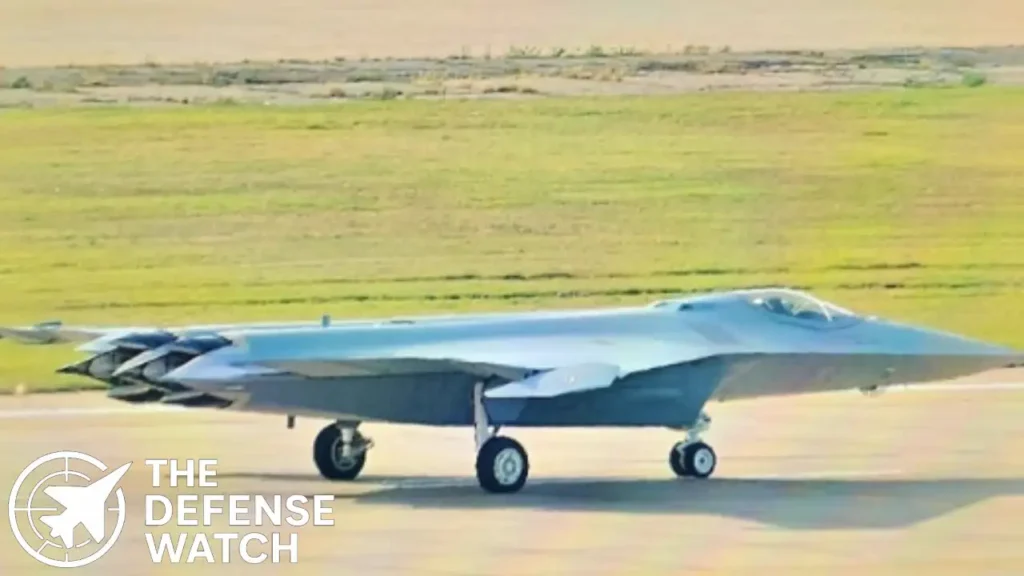
Recent images circulating online show, for perhaps the first time, detailed views of what is believed to be china sixth generation fighter—commonly dubbed the J-50 (also referred to by analysts as J-XD or J-XDS). The photographs reveal a striking tailless configuration, swiveling wingtip control surfaces, twin divergent intakes, plus thrust vectoring nozzles—all hallmarks of a radically new design philosophy.
While the Chinese government has not officially confirmed the aircraft’s designation or capabilities, these images provide the most complete external views yet of a jet that may represent Beijing’s push to field a true sixth-generation fighter.
What the Leaks Reveal: Features & Design Insights
Tailless Design and Control Surfaces
Foremost among the visual revelations is the absence of vertical stabilizers. Instead, the aircraft appears to rely on full-all-moving wingtip surfaces, which may function as control surfaces for yaw or roll control at lower speeds. Analysts suggest this design optimizes for reduced radar cross-section and lower drag.
Diverterless Supersonic Intakes & Airframe
The images depict twin diverterless supersonic intakes (DSI) feeding the twin engines, arranged in a stealth-friendly layout. The fuselage surface is smooth, with few protruding edges—a sign that stealth shaping is a priority.
Thrust Vectoring Exhausts
Engine exhaust nozzles appear to be equipped with two-dimensional (2D) thrust vectoring, reminiscent of designs like the U.S. F-22, but adapted to a tailless platform. Serrated edges around the exhausts further suggest effort to manage radar signature.
Cockpit, Sensors, and Underbelly Design
The cockpit appears to be intended for a single pilot, with a smooth, blended canopy.Under the nose, an electro–optical targeting system (EOTS) bay is visible, while earlier sightings of a nose-mounted air data boom appear absent in the latest version—perhaps indicating a more advanced internal sensor suite or reconfigured instrumentation.
Two belly weapon bays and side panels also appear on the airframe. The side panels’ function (whether weapon bays or access panels) remains unclear.
Landing Gear and Airframe Scale
One clear image shows a twin-wheeled nose landing gear, perhaps hinting at higher weight or robust structural demands. Some analysts speculate that this may even suggest carrier capability aspirations, though a tailless design introduces challenges at high angles of attack and in yaw control during low-speed operations.
Relative to other Chinese fighters, the china sixth generation fighter J-50 appears smaller than designs like the heavier J-36, suggesting a “low” component in a two-track development strategy.
Strategic Implications & Caveats
A Two-Track Sixth-Gen Approach
China appears to be pursuing parallel designs: the lighter, more agile J-50 by Shenyang and a larger, heavier J-36 by Chengdu. The J-36 may prioritize range, payload, and strike capabilities, while the J-50 could serve as a high-survivability air superiority fighter. Such a “hi-lo” mix mirrors strategies being considered in the U.S. Next Generation Air Dominance (NGAD) effort.
Stealth vs. Agility Tradeoffs
Dropping vertical tails reduces radar cross-section but complicates stability and control. The use of swiveling wingtips and thrust vectoring may mitigate some control losses, but agility—especially in yaw—could be constrained. The reliance on advanced flight control systems will be critical.
Timing and Operational Prospects
Given the rapid imagery updates over 2024–2025, some analysts project China might aim to begin limited deployment of china sixth generation fighter J-50 variants by circa 2030. However, major unknowns remain: sensor fusion, engine performance, electronic warfare integration, and full stealth attributes.
Conclusion
The leaked images of China’s alleged J-50 sixth-generation stealth fighter mark a compelling advance in public insight into Beijing’s next step in aerial warfare. The tailless architecture, swiveling wingtips, thrust vectoring, and stealth shaping cohere into a bold design that seeks to push stealth and control technologies in new directions.
Yet, many questions remain: how mature the systems are, whether the design can deliver in agility and combat resilience, and how it will compare to U.S. NGAD or other emerging sixth-generation efforts. What is clear is that China is signaling a serious ambition to close or surpass the U.S. lead in future fighter technology—and that the global balance in airpower may face fresh paradigms in the next decade.
FAQs
No. The aircraft remains unconfirmed by the Chinese government. The designation “J-50 / J-XD / J-XDS” is used by analysts, based on leaked images and speculation.
Removing vertical stabilizers lowers radar cross-section, but presents stability challenges. Designers must rely on control surfaces (such as swiveling tips), thrust vectoring, and flight control computers to maintain controllability.
Some features—such as twin-wheeled nose gear—might hint at carrier adaptation, but a tailless design complicates high-angle attack control, especially in yaw, which is critical for carrier operations.
While speculative, analysts suggest around 2030 for limited deployment, assuming testing and maturation proceed rapidly.
It appears to be the lighter, air superiority component of a dual approach, with the heavier J-36 handling strike roles. Together, they could form a next-gen force structure to challenge regional powers and contest U.S. aerial dominance.
New Photos Shed Light on China’s J-50 Design
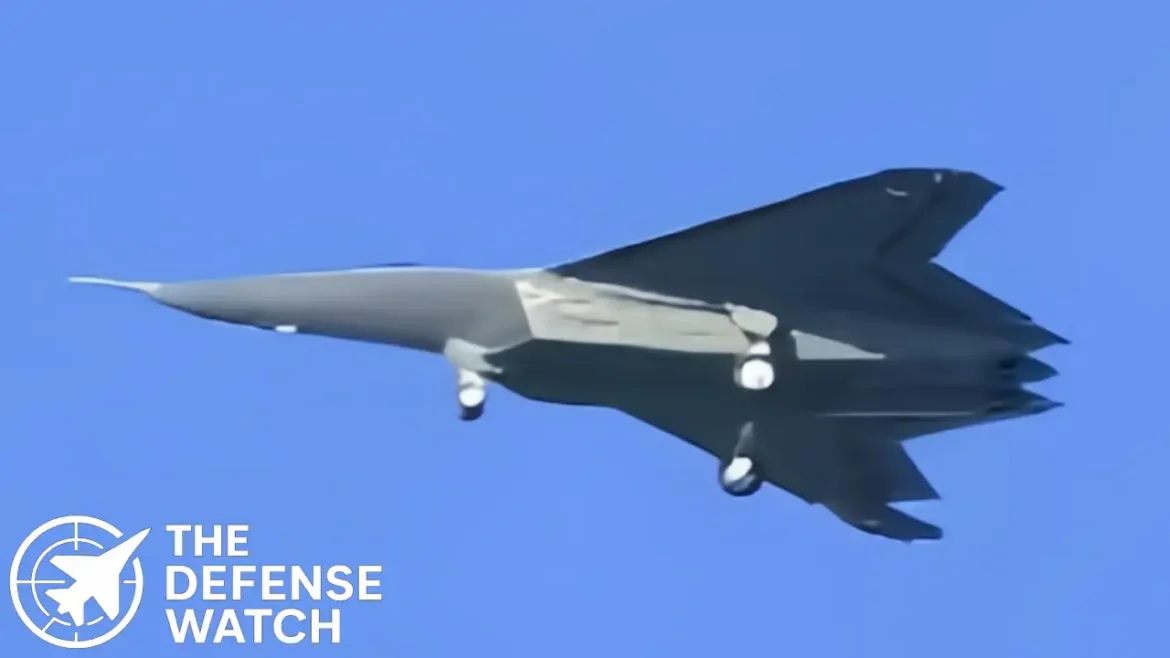
Recent images emerging from Chinese social media and aviation watchers offer a clearer view of Shenyang Aircraft Corporation’s mysterious next‐generation stealth prototype, unofficially dubbed the J-50. First seen in flight on December 26, 2024, the J-50 (also referred to as J-XDS or J-XD in some reports) is one of two tailless heavy fighter designs with stealth features that China is believed to be developing.
These new photos, released in early April 2025, show the J-50 from clearer side and three-quarter angles than previously available. The details revealed provide fresh insights into its aerodynamic layout, stealth considerations, and mission role.
Key Design Features
Lambda Wing & Tailless Configuration
The J-50 continues to exhibit a lambda wing planform—a sharply swept leading edge wing shape that joins with a broken trailing edge forming a triangular extension toward the fuselage. This type of wing, combined with a tailless layout (i.e. no vertical stabilisers or traditional tails), suggests China is pursuing lower radar cross-section and advanced aerodynamic efficiency.
Canopy and Cockpit
Earlier ambiguity over whether the J-50 was crewed has now been largely resolved: the new imagery shows a streamlined, bubble-like canopy blending into the fuselage. It remains difficult to determine from the photos whether the cockpit is for a single pilot or tandem crews, but the presence of a distinct canopy suggests a manned aircraft.
Inlets, Engine Layout, & Movable Features
- The photos show side inlets that appear to use diverterless supersonic inlet (DSI) design, similar to that seen on other modern Chinese stealth platforms.
- Also visible are articulating wing tips, which might be movable to aid maneuverability or control at different flight regimes.
- The engine exhausts appear to have 2-dimensional (possibly vectored) nozzles, which may help with agility and control while preserving stealth characteristics.
Weapons Bays & Sensor Bulges
New imagery confirms what appear to be side weapons bays—internal storage space for armaments to reduce radar signature and drag. There is also a pronounced bulge under the nose that likely houses an electro-optical targeting or sensor system, comparable to systems seen under the J-20 and F-35.
Landing Gear & Physical Size
The landing gear visible in the photos includes a twin-wheel nose gear and single wheels on the main gear. This contrasts with heavier “very large” designs (like the J-36) that have more robust gear configurations. From comparison, the J-50 appears smaller than the J-36, more medium-weight in scale.
Analysis: What Implications Does the J-50 Project Carry?
China’s unveiling of the J-50 (or at least its details via imagery) sends several signals to both observers and potential rivals:
- Stealth & Advanced Airpower Race: The combination of tailless design, internal weapons bays, DSI intakes, EOTS-type sensors, and possible thrust vectoring places the J-50 solidly in the stealth / low observability category. These are not just show features; they align with what many analysts consider hallmarks of “sixth-generation” fighter expectations.
- Prototype Versus Operational Reality: While what is visible in the photos is impressive, many critical performance parameters remain unknown—range, service ceiling, stealth effectiveness, avionics, pilot systems, integration into force structure, maintainability, etc. It is still early in the test flight / prototype phase. As with many advanced aircraft programs globally, scaling up from prototype to production is challenging.
- Comparative Strategy with the J-36 & Other Projects: The J-50 seems configured for medium weight roles; possibly more agile, with roles in air superiority or multi-role missions where stealth is primary. The larger J-36 – heavier, trijet, perhaps more heavy strike or regional power projection – may be filling a complementary niche. China may be aiming for a family of stealth platforms rather than a single solution.
Context & Strategic Implications
- The J-50’s development underscores China’s accelerating aerospace industry efforts. It is increasingly clear that China is not merely iterating existing fighter designs, but experimenting with novel aerodynamic forms.
- For regional security dynamics, neighbors and rival air forces will be paying close attention. Effective stealth or low-observability capability can shift balance in contested airspaces, especially over the Taiwan Strait or in contested islands.
- In global terms, the J-50 adds to discussions around how China’s sixth-generation aircraft efforts compare to U.S. Next Generation Air Dominance (NGAD) / F-47, European Future Combat Air System (FCAS), and other advanced programs. Image reveals don’t give full performance, but they demonstrate rapid progress.
What Remains Unknown
- Engine performance, reliability, and how thrust vectoring will be integrated.
- Precise avionics suite, sensor fusion, radar cross-section (RCS) values, IR signature, and stealth in operational conditions.
- Whether the aircraft will enter serial production, how many units, when, and what roles it’ll perform (air superiority, interceptor, multi-role, etc.).
- How it will integrate with AI, unmanned wingman systems, networked sensors, and Chinese doctrine.
FAQs
It’s not officially confirmed, but many in the defense analysis community treat it as part of China’s sixth-generation development efforts due to its stealth features, tailless design, advanced sensors, and novel aerodynamic features.
The new photos confirm the presence of a canopy, strongly indicating it is a crewed aircraft. That said, the possibility of optionally manned or unmanned variants cannot be ruled out in the future.
J-36 is larger, heavier, and believed to have three engines with a different air intake layout. The J-50 seems smaller, twin-engine, possibly more agile, and focusing on a medium-weight class of missions.
No firm timeline is available. The aircraft is in prototype / flight-test stage. Production, testing of systems, certification, and integration into service could still take several years.
Based on its design, possible roles include air superiority, interception, stealth strike or suppression roles, and possibly escort for larger stealth or unmanned platforms.