atOptions = { ‘key’ : ‘e7d18db8b7513fb2a224cf4c3f18bbf0’, ‘format’ : ‘iframe’, ‘height’ : 90, ‘width’ : 728, ‘params’ : {} };Executive Summary:
The U.S. Department of State has approved a possible $1.96 billion Foreign Military Sale to Saudi Arabia for up to 20,000 Advanced Precision Kill Weapon System II (APKWS-II) guidance sections and associated equipment. The proposed package is intended to strengthen Saudi Arabia’s precision engagement capabilities while enhancing interoperability with U.S. and allied forces across the Gulf region.
U.S. Approves $1.96 Billion APKWS-II Sale To Saudi Arabia
The Advanced Precision Kill Weapon System II (APKWS-II) is at the center of a newly approved U.S. Department of State Foreign Military Sale (FMS) notification that could significantly expand Saudi Arabia’s precision air combat capabilities. The proposed sale, valued at approximately $1.96 billion, was announced through the Defense Security Cooperation Agency (DSCA), which formally notified Congress of the potential transaction.
- U.S. Approves $1.96 Billion APKWS-II Sale To Saudi Arabia
- Saudi Arabia Requests Up To 20,000 APKWS-II Guidance Kits
- BAE Systems Named As Principal Contractor
- Why APKWS-II Matters
- Expanding Saudi Air Combat Options
- Supporting U.S. Regional Security Objectives
- Strategic Analysis: Why The Sale Matters
- Congressional Review Process
- Outlook
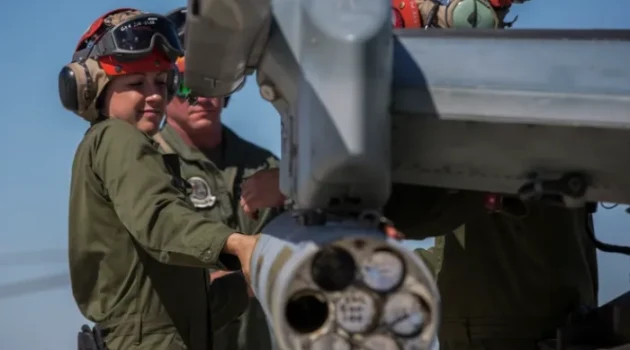
If finalized, the package will provide the Kingdom of Saudi Arabia with thousands of precision guidance kits capable of converting standard 70 mm Hydra rockets into low-cost precision-guided munitions for both air-to-air and air-to-ground missions.
- (adsbygoogle = window.adsbygoogle || []).push({});
Saudi Arabia Requests Up To 20,000 APKWS-II Guidance Kits
According to the U.S. notification, Saudi Arabia has requested:
Equipment Quantity APKWS-II Air-to-Air Guidance Sections Up to 10,000 APKWS-II Air-to-Ground Guidance Sections Up to 10,000 LAU-131 A/A Rocket Launchers Included Mk-152 High Explosive Warheads Included Mk66 Rocket Motors Included Proximity Fuzes Included Practice Warheads Included Inert Rocket Motors Included Test Equipment Included Spare Parts & Logistics Support Included Training & Technical Documentation Included The package also includes engineering support, logistics services, transportation, publications, training equipment, and long-term maintenance support.
BAE Systems Named As Principal Contractor
The proposed sale identifies BAE Systems, based in Nashua, New Hampshire, as the principal contractor responsible for supplying the APKWS-II systems.
The U.S. government stated that no offset agreements have been identified at this stage. Any industrial participation arrangements would be negotiated separately between Saudi Arabia and the contractor.
Implementation of the program is expected to require approximately:
- 15 additional U.S. Government representatives
- 15 contractor personnel
These personnel would deploy to Saudi Arabia for extended periods to provide technical assistance, maintenance support, training, and program management.
Why APKWS-II Matters
Originally developed as a cost-effective method of transforming unguided Hydra 70 rockets into precision-guided weapons, the APKWS-II uses a laser guidance section installed between the rocket motor and warhead.
Rather than replacing existing rocket inventories, the system upgrades them into precision munitions capable of engaging targets with significantly greater accuracy while reducing collateral damage.
Key characteristics include:
- Semi-active laser guidance
- Compatibility with existing Hydra 70 rockets
- Air-to-ground precision strike capability
- Increasing use in air-to-air counter-drone engagements
- Lower cost than many conventional guided missiles
Because it leverages existing rocket inventories and launch systems, APKWS-II has become an attractive solution for air forces seeking affordable precision weapons without procuring entirely new missile families.
(adsbygoogle = window.adsbygoogle || []).push({});Expanding Saudi Air Combat Options
Although APKWS-II was initially fielded for precision ground attack missions, recent operational use has demonstrated its growing role in aerial engagements.
The inclusion of both air-to-air and air-to-ground guidance sections suggests Saudi Arabia intends to expand operational flexibility across multiple mission sets.
Potential applications include:
- Counter-unmanned aircraft operations
- Close air support
- Precision strikes against lightly armored vehicles
- Border security missions
- Maritime security operations
- Infrastructure defense
The Kingdom already operates advanced combat aircraft including the F-15SA and Eurofighter Typhoon, both capable of employing precision-guided weapons.
Supporting U.S. Regional Security Objectives
The State Department said the proposed sale supports U.S. foreign policy and national security objectives by strengthening the defense capabilities of a major non-NATO ally.
According to the notification, the package will:
- Improve Saudi homeland defense
- Enhance interoperability with U.S. forces
- Increase compatibility with regional and NATO partners
- Strengthen air-to-air and air-to-ground self-defense capabilities
Officials also stated that the proposed transaction will not alter the basic military balance in the region, a standard assessment included in Foreign Military Sale notifications.
Strategic Analysis: Why The Sale Matters
Beyond the equipment itself, the proposed sale reflects several broader trends in modern air warfare.
Precision At Lower Cost
Modern air operations increasingly require commanders to balance capability with affordability. High-end air-to-air missiles can cost hundreds of thousands or even millions of dollars per round, making them inefficient against inexpensive drones or lightly protected targets.
APKWS-II fills this capability gap by providing precision effects at a fraction of the cost of larger guided missiles while allowing operators to retain existing Hydra rocket inventories.
Countering The Drone Threat
One of the most notable developments in recent years has been APKWS-II’s adaptation for air-to-air missions against unmanned aerial systems.
As drones continue to proliferate across the Middle East, affordable precision interceptors have become increasingly valuable. Using APKWS-II against lower-cost aerial threats enables air forces to conserve more expensive missile stocks for higher-priority targets.
Interoperability Across Allied Forces
Saudi Arabia maintains one of the largest U.S.-equipped air forces in the Middle East. Standardizing weapons compatible with U.S. logistics, training, and operational concepts simplifies coalition operations and improves long-term sustainment.
The inclusion of training, technical documentation, logistics support, and contractor assistance underscores that the sale extends beyond hardware to encompass operational integration.
Congressional Review Process
The Defense Security Cooperation Agency’s notification represents a proposed Foreign Military Sale rather than a finalized contract.
Congress now has the opportunity to review the proposed transaction under established U.S. arms export procedures. If no legislative action blocks the sale during the review period, negotiations between Saudi Arabia and the contractor may proceed.
The final contract value could differ from the estimated $1.96 billion depending on final requirements, procurement quantities, and negotiated terms.
Outlook
The proposed APKWS-II package represents one of the largest recent precision-guided rocket sales approved for Saudi Arabia and highlights the continued U.S. emphasis on strengthening allied air capabilities through Foreign Military Sales.
Beyond expanding Saudi Arabia’s precision strike inventory, the package supports broader U.S. objectives of enhancing regional interoperability, improving homeland defense, and providing cost-effective precision weapons suited to evolving operational environments, including the growing challenge posed by unmanned aerial systems.