• Home
  • About
  • Defense Systems
  • Manufacturer
  • Comparisons
  • Compare 
  • Tools
TheDefenseWatch.com
  • Aerospace & Aviation
  • Military & Ordnance
  • Naval & Maritime
  • Cyber & Space Defense
  • Policy & Strategy
  • Global News
  • Tools Library
    • Smart Calculator
    • Drone Flight Time Calculator
    • Drone Range Calculator
    • Counter-Drone Jammer Effective Range Calculator
    • Counter-Battery Radar Detection Calculator
    • Artillery Fire Correction Calculator
    • Thermal Camera Detection Range Calculator
    • Missile Range & Time-of-Flight Calculator
    • Radar Detection Range Calculator
    • FPV Strike Drone Payload vs Range Calculator
    • Loitering Munition Endurance Calculator
    • Sniper Ballistic Drop & Windage Calculator
    • Bullet Drop Calculator
    • U.S. Army Combat Fitness Test (ACFT) Calculator
    • Military Pension Calculator
    • Military Retirement Calculator
    • Military Pension Calculator
    • Large Number Calculator
Font ResizerAa

TheDefenseWatch.com

The Defense Watch | U.S. & Global Defense News, Analysis & Military Updates

Search
  • Home
  • About
  • Defense Systems
  • Manufacturer
  • Comparisons
  • Compare 
  • Tools

Stay Updated

Get the latest update

Subscribe

Explore

  • Drone
  • Fighter Jets & Military Aircraft
  • Hypersonic Weapons
  • Aircraft Carriers
  • Strategic History & Missions
  • Tools Library
Home » British Army Races To Deploy First Operational UGV Fleet Amid Push For Autonomous Warfare
Military & OrdnanceTanks & Armored Vehicles

British Army Races To Deploy First Operational UGV Fleet Amid Push For Autonomous Warfare

Samuel Drake | Defense Analyst
Last updated: June 2, 2026 12:20 am
Samuel Drake | Defense Analyst
Share
6 Min Read
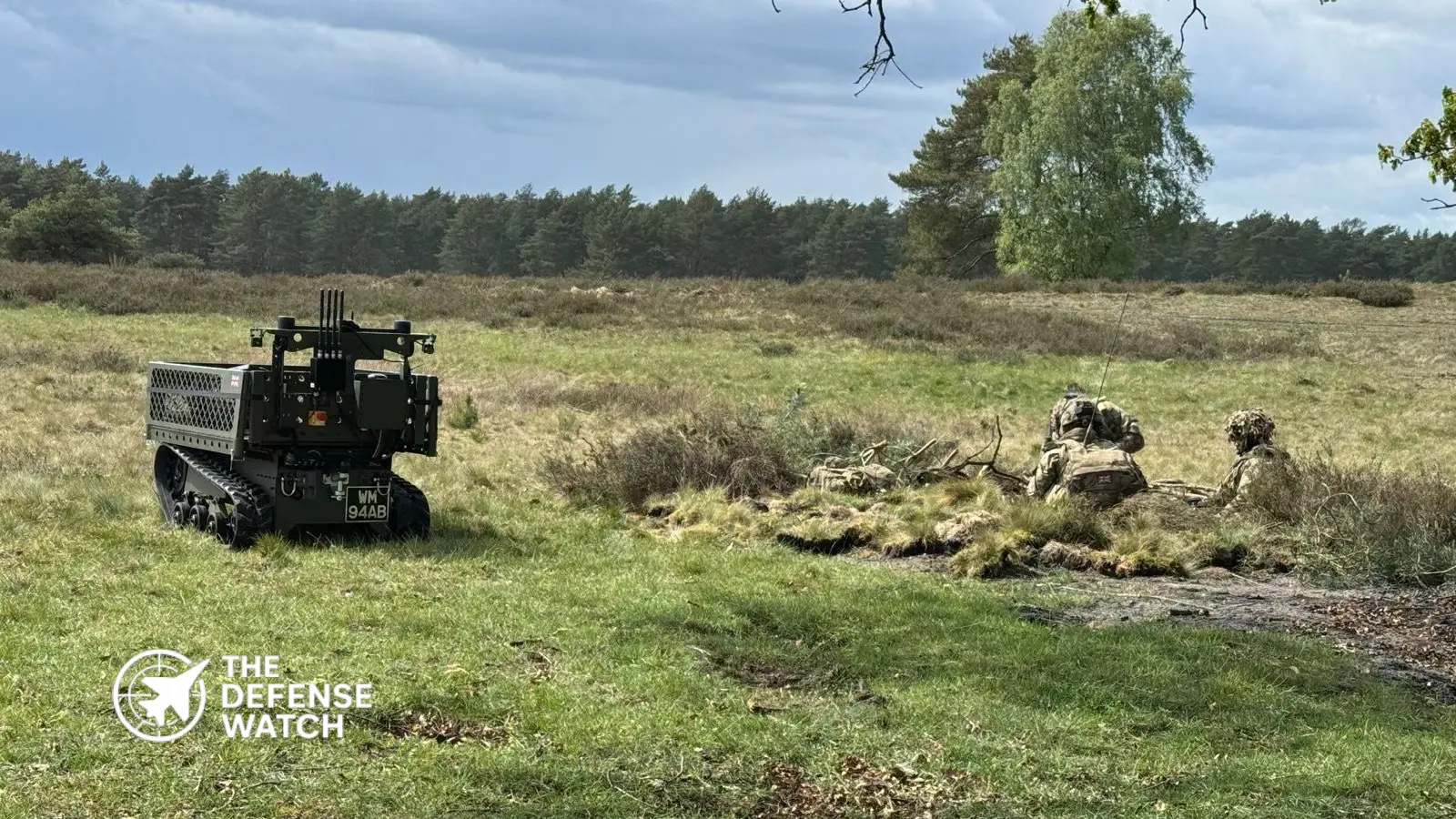
Digital Concepts Engineering autonomous ground vehicle operating during British Army field trials in support of logistics and reconnaissance missions.
SHARE

Executive Summary:

The British Army has selected Digital Concepts Engineering (DCE) to provide its first operational fleet of unmanned ground vehicles (UGVs), marking a significant milestone in the UK’s military robotics program.

The move transitions British Army ground robotics efforts from experimentation into operational service, reflecting growing demand for autonomous logistics, reconnaissance, and force protection capabilities.

British Army Selects DCE For First Operational UGV Fleet

The British Army UGV fleet program has reached a major milestone with the selection of Digital Concepts Engineering (DCE) to supply the service’s first operational unmanned ground vehicle capability.

Contents
  • British Army Selects DCE For First Operational UGV Fleet
  • From Trials To Operational Service
  • Why Unmanned Ground Vehicles Matter
  • Part Of A Larger UK Defense Robotics Strategy
  • Analysis: A Significant Shift In British Army Modernization
  • Looking Ahead

The decision signals a shift from years of trials and technology demonstrations toward the fielding of deployable robotic ground systems capable of supporting military operations. The development comes as NATO militaries increasingly pursue autonomous and semi-autonomous systems to improve battlefield effectiveness while reducing risks to personnel.

The procurement represents the first operational UGV fleet acquired by the British Army, establishing a formal capability rather than an experimental or developmental program.

From Trials To Operational Service

The British Army has spent years evaluating robotic and autonomous systems through a range of experimentation efforts, including Army Warfighting Experiments, logistics demonstrations, and heavy UGV trials.

- Advertisement -

DCE has been closely involved in many of these activities. The company previously developed autonomous and remotely operated ground systems for British military experimentation and has demonstrated capabilities ranging from logistics support to deception operations and reconnaissance missions.

The firm’s X-Series robotic vehicles have evolved through multiple development cycles. The latest X3 platform features a modular design capable of carrying payloads, towing equipment, and operating across difficult terrain including mud, sand, rubble, and steep gradients.

The British Army’s decision to move forward with an operational fleet suggests confidence that the technology has matured sufficiently for military service.

Why Unmanned Ground Vehicles Matter

The introduction of a British Army UGV fleet reflects broader changes in modern warfare.

Recent conflicts have demonstrated the growing value of unmanned systems across land, air, and maritime domains. While aerial drones have received significant attention, ground robots are increasingly viewed as critical tools for logistics, casualty evacuation, reconnaissance, engineering support, and force protection.

Military planners see several advantages:

  • Reduced exposure of soldiers to enemy fire.
  • Increased operational endurance.
  • Improved logistics support in contested environments.
  • Enhanced reconnaissance capabilities.
  • Greater flexibility in dispersed operations.

These advantages align with the British Army’s ongoing modernization efforts, which emphasize digital integration, human-machine teaming, and increased battlefield survivability.

Part Of A Larger UK Defense Robotics Strategy

The contract also reflects years of investment by the UK Ministry of Defence in autonomous ground systems.

- Advertisement -

Earlier initiatives such as Project Theseus and the Autonomous Last Mile Challenge explored the use of robotic vehicles for battlefield resupply missions. Those efforts sought to understand the capabilities and limitations of autonomous logistics systems while reducing risk to frontline personnel.

The UK’s Defence Science and Technology Laboratory (Dstl) and Defence Equipment & Support (DE&S) have repeatedly tested unmanned ground vehicles to determine how they can be integrated into future force structures.

The DCE selection appears to be a direct continuation of that long-term effort.

Analysis: A Significant Shift In British Army Modernization

The importance of this contract extends beyond the number of vehicles involved.

For years, Western militaries treated unmanned ground vehicles primarily as experimental technologies. The British Army’s move toward an operational fleet indicates that robotic systems are increasingly viewed as deployable military assets rather than future concepts.

This transition mirrors developments across NATO, where armed forces are examining how autonomous systems can supplement traditional combat formations.

The decision is particularly notable because ground robotics has historically progressed more slowly than aerial drone technology. Terrain complexity, communications challenges, and mobility requirements have made land-based autonomy difficult to operationalize.

By selecting DCE for an operational capability, the British Army is effectively acknowledging that certain UGV missions have matured enough for routine military use.

The move may also influence future procurement decisions involving logistics robots, reconnaissance platforms, engineering support vehicles, and potentially armed robotic systems.

As lessons from Ukraine continue to highlight the growing role of unmanned technologies on the battlefield, Western armies are under increasing pressure to accelerate robotic integration across their force structures. Recent operational trends suggest that human-machine teaming is becoming a core element of modern military doctrine rather than a niche capability.

Looking Ahead

The introduction of the first operational British Army UGV fleet represents a significant step in the service’s modernization roadmap.

While details regarding fleet size, deployment timelines, and specific operational roles remain limited, the procurement demonstrates a clear commitment to expanding robotic capabilities within the Army.

For DCE, the contract represents a major achievement after years of involvement in British military robotics development. For the British Army, it marks the beginning of operational ground robotics as a permanent part of its force structure.


TAGGED:Defense contractsdrones & UAVsTanks & Armored Vehicles
Share This Article
Facebook Copy Link Print
BySamuel Drake | Defense Analyst
Follow:
Samuel Drake is a defense analyst at TheDefenseWatch.com covering naval warfare, military ordnance, maritime technology, fleet modernization, and defense procurement. His reporting focuses on documented capabilities, procurement programs, and military technology.
Leave a Comment

Leave a Reply Cancel reply

Your email address will not be published. Required fields are marked *

Latest Defense Systems

  • Tomahawk Block V Missile Tomahawk Block V Missile
  • Tomahawk Block IV Missile Tomahawk Block IV Missile
  • SU-57 Felon Stealth Fighter SU-57 Felon Stealth Fighter
  • Boeing F/A-XX Fighter Boeing F/A-XX Fighter
  • JF-17 Thunder Fighter Jet JF-17 Thunder Fighter Jet
  • Gaurav Glide Bomb Gaurav Glide Bomb
  • F-47 Fighter Jet F-47 Fighter Jet
  • Spirit UAS Spirit UAS
  • GBU-43/B MOAB Bomb GBU-43/B MOAB Bomb

Recent Compares

  • J-10C vs JF-17 Thunder: Which Fighter Is More Capable? J-10C vs JF-17 Thunder: Which Fighter Is More Capable? View Comparison →
  • Tejas vs Gripen: Key Differences and Capabilities Tejas vs Gripen: Key Differences and Capabilities View Comparison →
  • Tejas vs MiG-21 Bison: How India Replaced Its Iconic Supersonic Fighter Tejas vs MiG-21 Bison: How India Replaced Its Iconic Supersonic Fighter View Comparison →
  • F-35 vs F-16: Stealth, Sensors and Combat Roles F-35 vs F-16: Stealth, Sensors and Combat Roles View Comparison →
  • Tejas Fighter Jet vs F-16 Fighting Falcon: Capability Compared Tejas Fighter Jet vs F-16 Fighting Falcon: Capability Compared View Comparison →
  • Rafale Fighter Jet vs F-16 Fighting Falcon : Which Fighter Has the Edge? Rafale Fighter Jet vs F-16 Fighting Falcon : Which Fighter Has the Edge? View Comparison →
  • Su-57 Fighter Jet vs J-20 Fighter Jet: Stealth and Air Combat Compared Su-57 Fighter Jet vs J-20 Fighter Jet: Stealth and Air Combat Compared View Comparison →
  • Mirage 2000 vs Tejas Mk1A: Legacy Combat Power vs Indigenous Modernization Mirage 2000 vs Tejas Mk1A: Legacy Combat Power vs Indigenous Modernization View Comparison →
  • Rafale Fighter Jet vs F-22 Raptor: Which Air Dominance Fighter Has the Edge? Rafale Fighter Jet vs F-22 Raptor: Which Air Dominance Fighter Has the Edge? View Comparison →
  • Tejas Fighter Jet vs. Rafale Fighter Jet: India’s Indigenous Fighter Meets France’s Proven Multirole Combat Aircraft Tejas Fighter Jet vs. Rafale Fighter Jet: India’s Indigenous Fighter Meets France’s Proven Multirole Combat Aircraft View Comparison →

Recent Posts

  • P-800 Oniks Missile: Range, Speed and BrahMos Comparison
  • Ukrainian Drone Unit Caused 70% of Simulated U.S. Brigade Casualties in Germany Exercise
  • OCCAR Marks 25 Years of European Defense Cooperation With 28 Programs
  • Saab Q3 2026 Results Show 30.6% Organic Sales Growth as Orders Surge
  • How Much Does a Tomahawk Missile Cost? Price, Range and Blocks

You Might Also Like

Top 5 air defense systems in the world
Military & OrdnanceMissile Defense Systems

Top 5 Air Defense Systems in the World: The Most Powerful Shield Technologies of 2026

September 12, 2026
Blackbeard hypersonic missile
Hypersonic WeaponsMilitary & Ordnance

US Navy Races To Deploy Blackbeard Hypersonic Missile Amid Rising Maritime Threats

September 7, 2026
Meteor missile cost
Artillery & Missile SystemsMilitary & Ordnance

European MBDA Meteor Missile Unit Cost Marks Major Benchmark at Approximately €2 Million

September 8, 2026
Chunmoo missile integration
Artillery & Missile SystemsMilitary & Ordnance

Hanwha Aerospace And Thales Integrate Chunmoo Missiles With X-Fire Launchers To Expand Long-Range Precision Strike Capability

September 7, 2026

Logo

Copyright © 2026 TheDefenseWatch.com

Helpful Links

  • Home
  • About Us
  • Privacy Policy
  • Terms of Use / Disclaimer
  • U.S. Privacy Notice – CCPA Compliance

Defense Systems

  • Defense Systems
  • Comparisons 
  • Manufacturer
  • Tactical Calculators

Popuplar

Which 5 Air Forces Possess the Costliest Fighter Jet Fleets in the World
Evolving Strategic Value: Carrier Strike Groups in the Indo-Pacific’s Future Security Architecture
Autonomous Weapon Systems Spark U.S. Ethics Debate Amid Rapid Military AI Integration

We report on developments involving military forces, governments, defense companies, research organizations, and security institutions around the world. 

Welcome Back!

Sign in to your account

Username or Email Address
Password

Lost your password?