• Home
  • About
  • Defense Systems
  • Manufacturer
  • Comparisons
  • Compare 
  • Tools
TheDefenseWatch.com
  • Aerospace & Aviation
  • Military & Ordnance
  • Naval & Maritime
  • Cyber & Space Defense
  • Policy & Strategy
  • Global News
  • Tools Library
    • Smart Calculator
    • Drone Flight Time Calculator
    • Drone Range Calculator
    • Counter-Drone Jammer Effective Range Calculator
    • Counter-Battery Radar Detection Calculator
    • Artillery Fire Correction Calculator
    • Thermal Camera Detection Range Calculator
    • Missile Range & Time-of-Flight Calculator
    • Radar Detection Range Calculator
    • FPV Strike Drone Payload vs Range Calculator
    • Loitering Munition Endurance Calculator
    • Sniper Ballistic Drop & Windage Calculator
    • Bullet Drop Calculator
    • U.S. Army Combat Fitness Test (ACFT) Calculator
    • Military Pension Calculator
    • Military Retirement Calculator
    • Military Pension Calculator
    • Large Number Calculator
Font ResizerAa

TheDefenseWatch.com

The Defense Watch | U.S. & Global Defense News, Analysis & Military Updates

Search
  • Home
  • About
  • Defense Systems
  • Manufacturer
  • Comparisons
  • Compare 
  • Tools

Stay Updated

Get the latest update

Subscribe

Explore

  • Drone
  • Fighter Jets & Military Aircraft
  • Hypersonic Weapons
  • Aircraft Carriers
  • Strategic History & Missions
  • Tools Library
Home » Australia Moves To Acquire Three Used Virginia-Class Submarines As AUKUS Program Faces Industrial Pressure
Naval & MaritimeNaval Strategy & Maritime Security

Australia Moves To Acquire Three Used Virginia-Class Submarines As AUKUS Program Faces Industrial Pressure

Samuel Drake | Defense Analyst
Last updated: May 31, 2026 7:29 am
Samuel Drake | Defense Analyst
Share
3 Min Read
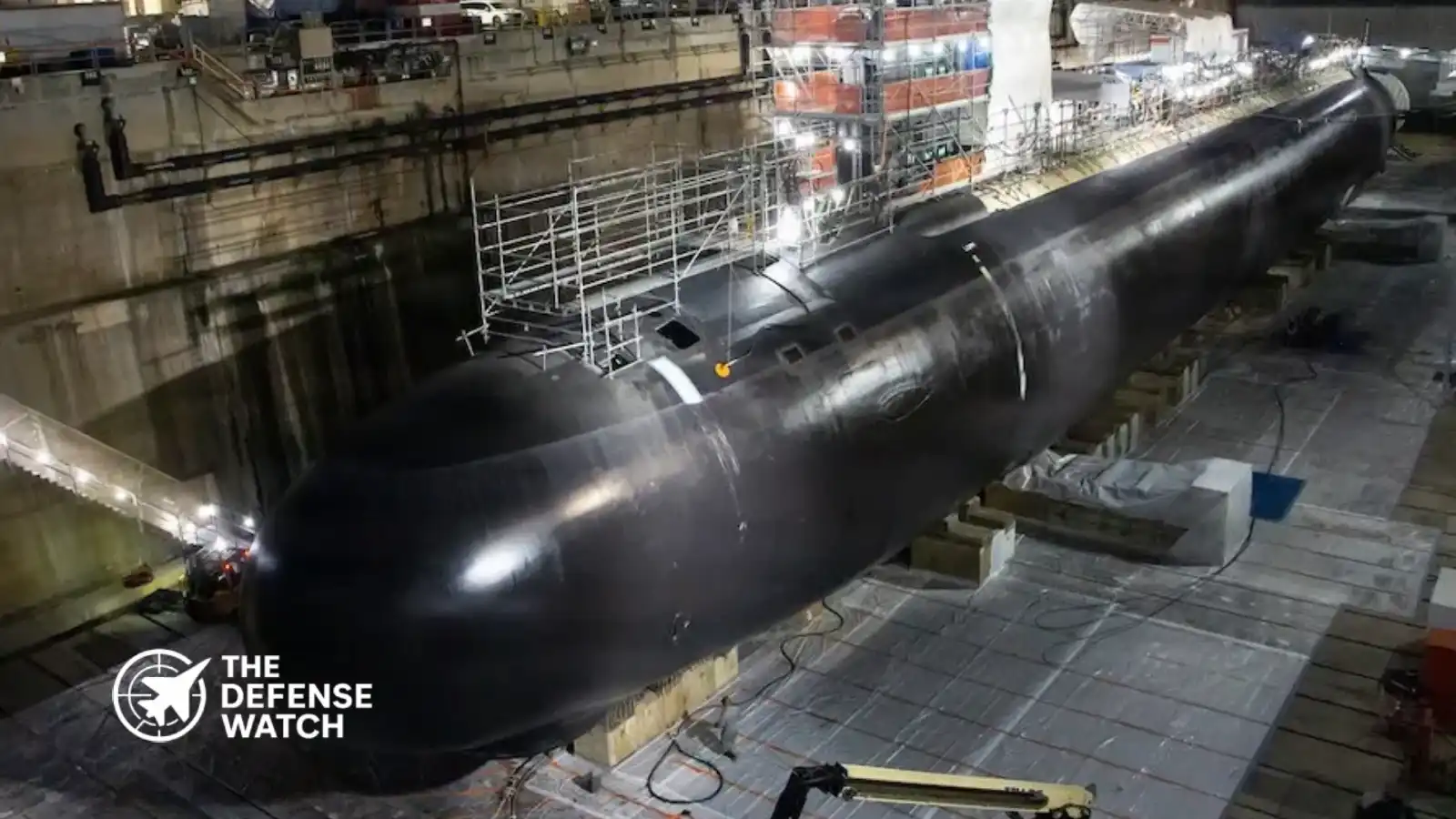
U.S. Navy Virginia-class nuclear-powered attack submarine operating in the Indo-Pacific as Australia prepares to acquire three in-service boats under the AUKUS agreement.
Image Source: U.S. Navy.
SHARE
Follow The Defense Watch on Google:

Executive Summary:

Australia has confirmed it will acquire three in-service U.S. Navy Virginia-class nuclear-powered attack submarines under a revised AUKUS acquisition framework announced on May 31, 2026. The change replaces an earlier plan that included a newly built submarine and is intended to simplify fleet management, training, maintenance requirements, and long-term sustainment while reducing program complexity.

Australia Revises AUKUS Virginia-Class Submarine Acquisition Plan

Australia will purchase three used Virginia-class submarines from the United States under a revised AUKUS pathway that reflects growing emphasis on fleet standardization and operational simplicity.

Contents
Australia Revises AUKUS Virginia-Class Submarine Acquisition PlanWhy Canberra Is Pursuing A Simpler Fleet StructureIndustrial Constraints Continue To Shape AUKUS OutcomesStrategic Importance Of Virginia-Class SubmarinesOperational Benefits And Trade-OffsWhat This Means For The Future Of AUKUS

The announcement was made during the IISS Shangri-La Dialogue in Singapore, where Australian Deputy Prime Minister and Defence Minister Richard Marles outlined the updated approach alongside broader AUKUS discussions involving the United States and the United Kingdom. According to the joint trilateral statement, the revised acquisition model is intended to streamline supply chains, reduce maintenance complexity, and improve cost efficiency across the program.

Under the original AUKUS framework unveiled in 2021, Australia was expected to receive at least two used Virginia-class submarines and one newly constructed vessel from U.S. production lines. The revised plan eliminates the new-build component and instead focuses on acquiring three submarines from the same production block.

Marles described the change as a practical effort to reduce the burden of operating multiple submarine variants simultaneously.

- Advertisement -
  • Virginia-class SSN-774 Submarine

    Virginia-class SSN-774 Submarine

    • Power: Nuclear (S9G Reactor)
    • Stealth: Advanced acoustic quieting, anechoic coating
    • Weapons: Mk-48 torpedoes, Tomahawk missiles
    • Sensors: Large Aperture Bow Sonar, TB-29 arrays
    • View Details →
    8.0

    Why Canberra Is Pursuing A Simpler Fleet Structure

    A central challenge facing Australia’s submarine transition strategy has been managing overlapping generations of undersea platforms.

    Without changes to the acquisition model, the Royal Australian Navy could have been required to operate:

    Planned Fleet ElementsStatus
    Collins-class submarinesExisting fleet undergoing life-extension
    Used Virginia-class submarinesTransitional AUKUS capability
    New-build Virginia-class submarineOriginally planned acquisition
    SSN-AUKUS submarinesFuture long-term fleet

    According to Australian officials, managing four distinct submarine categories would have significantly increased training requirements, logistics demands, maintenance planning, spare parts inventories, and workforce specialization needs.

    By receiving three submarines from the same Virginia-class production block, Australia expects to standardize crew training, sustainment procedures, and maintenance infrastructure.

    The decision also aligns with broader efforts to prepare Australian industry and naval personnel for eventual operation of the future SSN-AUKUS design expected to enter service during the 2040s.

    Industrial Constraints Continue To Shape AUKUS Outcomes

    The revised arrangement also highlights ongoing pressure on the U.S. submarine industrial base.

    American shipyards have struggled for several years to increase production rates for Virginia-class attack submarines while simultaneously supporting development of the Columbia-class ballistic missile submarine program. Defense analysts have repeatedly warned that production targets remain below levels required to satisfy both U.S. Navy force structure goals and AUKUS commitments.

    Several Australian defense analysts argue that industrial realities may have influenced Washington’s willingness to transfer new-build submarines.

    Dr. Malcolm Davis of the Australian Strategic Policy Institute noted that the United States must still determine whether sufficient submarine numbers will be available for transfer. Other analysts suggested that retaining newer submarines for U.S. Navy requirements remains a strategic priority amid rising Indo-Pacific tensions.

    The decision therefore represents both a fleet simplification effort and a reflection of the production challenges confronting the U.S. naval shipbuilding sector.

    • Virginia-class SSN-774 Submarine

      Virginia-class SSN-774 Submarine

      • Power: Nuclear (S9G Reactor)
      • Stealth: Advanced acoustic quieting, anechoic coating
      • Weapons: Mk-48 torpedoes, Tomahawk missiles
      • Sensors: Large Aperture Bow Sonar, TB-29 arrays
      • View Details →
      8.0

      Strategic Importance Of Virginia-Class Submarines

      Despite being transferred as in-service vessels, the Virginia-class remains among the world’s most capable nuclear-powered attack submarine platforms.

      Key capabilities include:

      • Long-endurance nuclear propulsion
      • Advanced acoustic stealth features
      • Intelligence, surveillance, and reconnaissance missions
      • Anti-submarine warfare operations
      • Anti-surface warfare missions
      • Special operations support
      • Long-range strike capabilities through cruise missile deployment

      The class has become a cornerstone of U.S. undersea power projection across the Indo-Pacific, Atlantic, and Middle East theaters.

      For Australia, the acquisition provides an opportunity to establish a sovereign nuclear-powered submarine capability decades before domestic production of SSN-AUKUS vessels becomes available.

      Operational Benefits And Trade-Offs

      While the revised plan simplifies fleet management, analysts note that it also introduces operational compromises.

      Unlike newly constructed submarines, transferred boats will already have accumulated operational service life before entering Australian service. This could shorten the overall period they remain available compared with new-build vessels.

      Some defense experts argue that newer Virginia-class variants offer enhanced capabilities and lower maintenance demands than older boats. Others contend that the benefits of standardization outweigh the drawbacks, particularly during a complex transition to nuclear-powered submarine operations.

      The debate reflects a broader strategic question facing AUKUS: whether capability delivery speed and program certainty should take precedence over acquiring the most advanced possible platforms.

      What This Means For The Future Of AUKUS

      The submarine pathway remains the most expensive and strategically significant component of AUKUS.

      Beyond submarine acquisition, the partnership encompasses advanced technologies including autonomous systems, artificial intelligence, quantum technologies, cyber capabilities, and undersea warfare systems. During the Shangri-La Dialogue, AUKUS partners also highlighted new efforts focused on underwater autonomous platforms designed to protect critical seabed infrastructure and communication networks.

      The revised submarine plan demonstrates that AUKUS continues to evolve in response to industrial realities and operational requirements.

      • Virginia-class SSN-774 Submarine

        Virginia-class SSN-774 Submarine

        • Power: Nuclear (S9G Reactor)
        • Stealth: Advanced acoustic quieting, anechoic coating
        • Weapons: Mk-48 torpedoes, Tomahawk missiles
        • Sensors: Large Aperture Bow Sonar, TB-29 arrays
        • View Details →
        8.0

        From a U.S. perspective, helping Australia field nuclear-powered attack submarines strengthens allied undersea presence across the Indo-Pacific without requiring permanent expansion of American force structure.

        For Canberra, the revised acquisition offers a more predictable transition path while preserving the long-term objective of operating domestically produced SSN-AUKUS submarines.

        The broader strategic significance extends beyond fleet numbers. The agreement represents one of the deepest defense technology integration efforts ever undertaken among the United States, Australia, and the United Kingdom, with undersea warfare remaining a central element of allied deterrence strategy in the Indo-Pacific.

Enjoying our coverage?

Make The Defense Watch a preferred source on Google to see more of our geopolitical and defense insights when relevant to you.

TAGGED:AUKUSVirginia-class Submarine
Share This Article
Facebook Copy Link Print
BySamuel Drake | Defense Analyst
Follow:
Samuel Drake is a defense analyst at TheDefenseWatch.com covering naval warfare, military ordnance, maritime technology, fleet modernization, and defense procurement. His reporting focuses on documented capabilities, procurement programs, and military technology.
Leave a Comment

Leave a Reply Cancel reply

Your email address will not be published. Required fields are marked *

Search Defense Systems

Latest Defense Systems

  • KN-23 Ballistic Missile KN-23 Ballistic Missile
  • Su-75 Checkmate Fighter Jet Su-75 Checkmate Fighter Jet
  • Ilyushin Il-20 Coot Aircraft Ilyushin Il-20 Coot Aircraft
  • FGM-148 Javelin Anti-Tank Missile FGM-148 Javelin Anti-Tank Missile
  • F-104 Starfighter F-104 Starfighter
  • F-15J Eagle Fighter Jet F-15J Eagle Fighter Jet
  • China’s GJ-21 Stealth Drone China’s GJ-21 Stealth Drone
  • China’s GJ-11 Stealth Drone China’s GJ-11 Stealth Drone
  • F-15EX Eagle Fighter Jet F-15EX Eagle Fighter Jet

Recent Compares

  • J-10C vs JF-17 Thunder: Which Fighter Is More Capable? J-10C vs JF-17 Thunder: Which Fighter Is More Capable? View Comparison →
  • Tejas vs Gripen: Key Differences and Capabilities Tejas vs Gripen: Key Differences and Capabilities View Comparison →
  • Tejas vs MiG-21 Bison: How India Replaced Its Iconic Supersonic Fighter Tejas vs MiG-21 Bison: How India Replaced Its Iconic Supersonic Fighter View Comparison →
  • F-35 vs F-16: Stealth, Sensors and Combat Roles F-35 vs F-16: Stealth, Sensors and Combat Roles View Comparison →
  • Tejas Fighter Jet vs F-16 Fighting Falcon: Capability Compared Tejas Fighter Jet vs F-16 Fighting Falcon: Capability Compared View Comparison →
  • Rafale Fighter Jet vs F-16 Fighting Falcon : Which Fighter Has the Edge? Rafale Fighter Jet vs F-16 Fighting Falcon : Which Fighter Has the Edge? View Comparison →
  • Su-57 Fighter Jet vs J-20 Fighter Jet: Stealth and Air Combat Compared Su-57 Fighter Jet vs J-20 Fighter Jet: Stealth and Air Combat Compared View Comparison →
  • Mirage 2000 vs Tejas Mk1A: Legacy Combat Power vs Indigenous Modernization Mirage 2000 vs Tejas Mk1A: Legacy Combat Power vs Indigenous Modernization View Comparison →
  • Rafale Fighter Jet vs F-22 Raptor: Which Air Dominance Fighter Has the Edge? Rafale Fighter Jet vs F-22 Raptor: Which Air Dominance Fighter Has the Edge? View Comparison →
  • Tejas Fighter Jet vs. Rafale Fighter Jet: India’s Indigenous Fighter Meets France’s Proven Multirole Combat Aircraft Tejas Fighter Jet vs. Rafale Fighter Jet: India’s Indigenous Fighter Meets France’s Proven Multirole Combat Aircraft View Comparison →

Recent Posts

  • Is the US Planning a 7th-Generation Fighter Jet?
  • NATO Jets Scrambled After Drone Breaches Latvian Airspace
  • North Korea Reportedly Suspends Missile and Artillery Deliveries to Russia
  • U.S. Navy Conducts Hovercraft Operations With USS Boxer in Middle East
  • Russia Shows Possible Su-75 Checkmate Prototype Progress at KnAAZ Aircraft Plant

You Might Also Like

Type 004 Aircraft Carrier
Naval & MaritimeNaval Strategy & Maritime Security

China Expands Far-Sea Power Projection As Liaoning Carrier Group Completes Major Western Pacific Training Mission

September 7, 2026
German F126 frigate concept linked to Rheinmetall takeover discussions amid major naval modernization delays
Naval & MaritimeNaval Strategy & Maritime Security

Rheinmetall Moves To Rescue Germany’s Troubled F126 Frigate Program With €12 Billion Proposal

September 7, 2026
MILDEN submarine
Naval & MaritimeSubmarines

Turkey Launches Construction of First Indigenous MILDEN Submarine, Marking Major Naval Milestone

December 8, 2025
US forces disable cargo ship
Naval & MaritimeNaval Strategy & Maritime Security

US Forces Disable Cargo Ship Attempting to Evade Iran Blockade

October 14, 2026

Logo

Copyright © 2026 TheDefenseWatch.com

Helpful Links

  • Home
  • About Us
  • Privacy Policy
  • Terms of Use / Disclaimer
  • U.S. Privacy Notice – CCPA Compliance

Defense Systems

  • Defense Systems
  • Comparisons 
  • Manufacturer
  • Tactical Calculators

Popuplar

Which 5 Air Forces Possess the Costliest Fighter Jet Fleets in the World
Evolving Strategic Value: Carrier Strike Groups in the Indo-Pacific’s Future Security Architecture
Autonomous Weapon Systems Spark U.S. Ethics Debate Amid Rapid Military AI Integration

We report on developments involving military forces, governments, defense companies, research organizations, and security institutions around the world. 

Welcome Back!

Sign in to your account

Username or Email Address
Password

Lost your password?

Enjoying our coverage?

Make The Defense Watch a preferred source on Google to see more insights.