

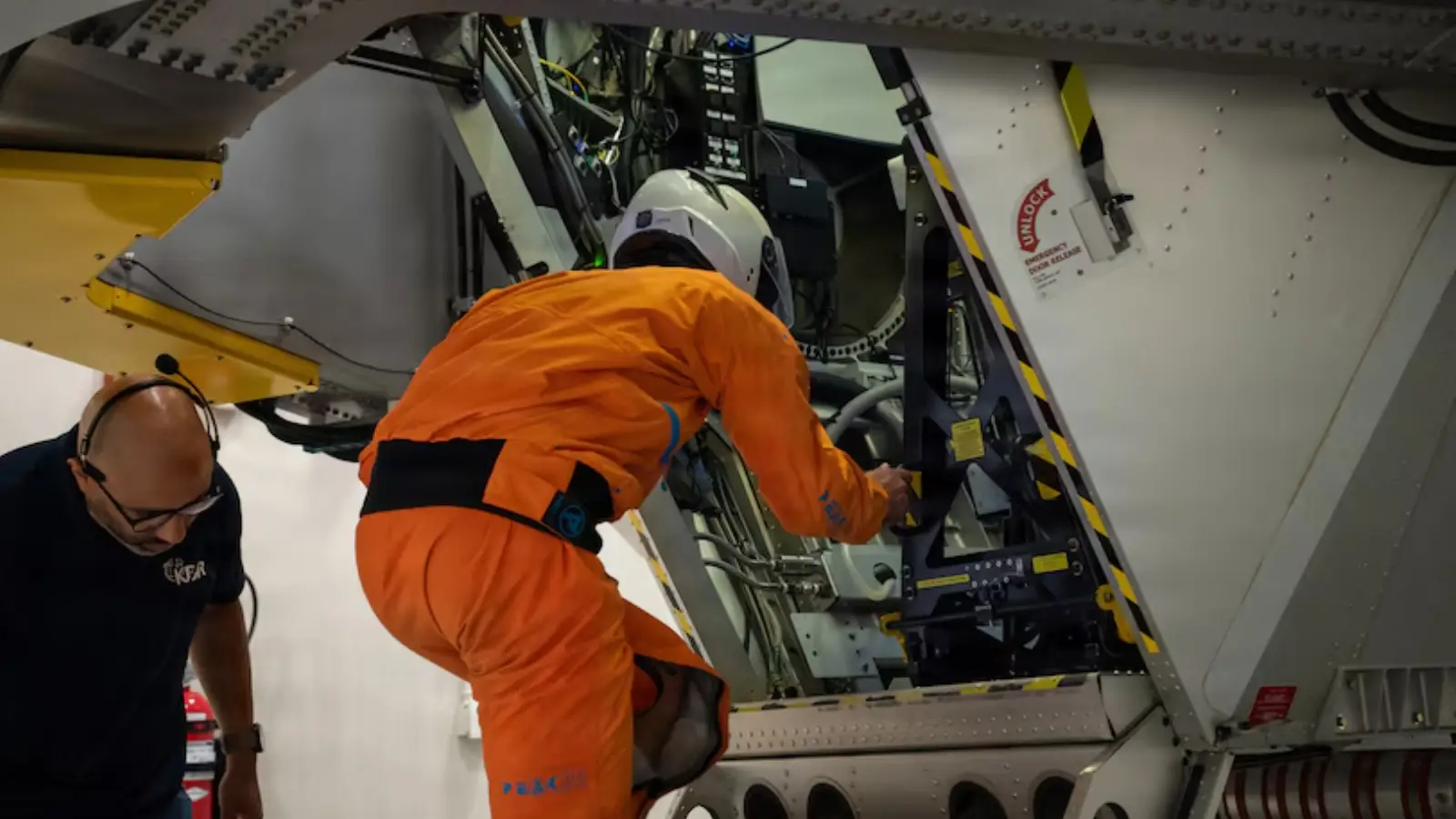
Navy Researchers Recruit Volunteers for Space Motion Sickness Study Tied to Artemis Lunar Return
Space motion sickness poses one of the least-publicized but operationally critical threats to NASA’s Artemis program, and a multi-service military research team is now actively recruiting volunteers to address it. Scientists at Wright-Patterson Air Force Base, Ohio, are running the SWAN study — a collaborative program designed to map how the human vestibular system degrades under spaceflight conditions and how that degradation can be countered before astronauts step onto the lunar surface.
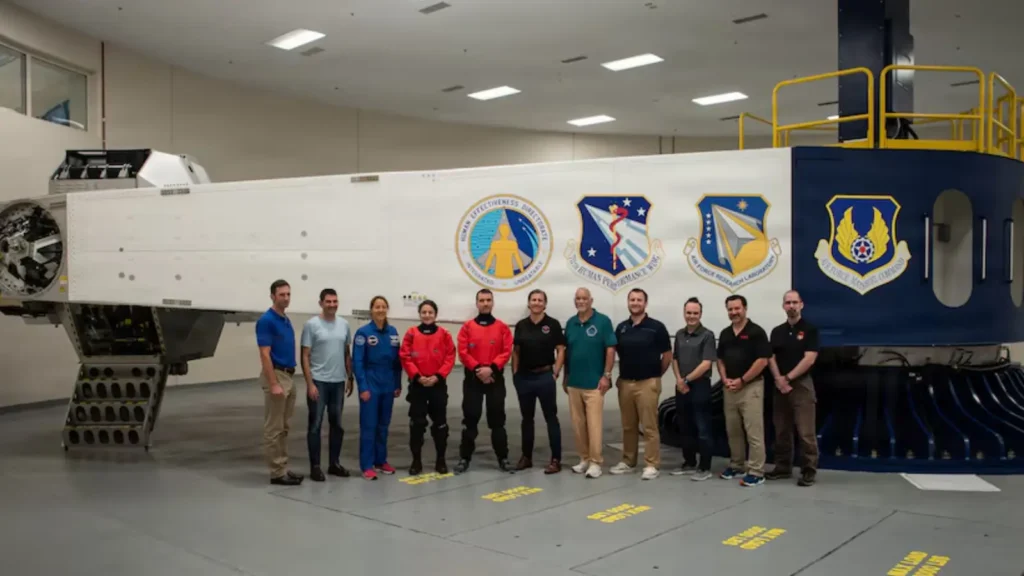
- The SWAN (StableEyes with Active Neurophysiology Monitoring) study is a joint effort by the Navy, Air Force Research Laboratory, Johns Hopkins University School of Medicine, and NASA’s Human Research Program.
- Volunteers are exposed to 3G acceleration inside a centrifuge to simulate spaceflight deconditioning effects on balance and coordination systems.
- The research directly supports NASA’s Artemis program, which aims to return U.S. astronauts to the lunar surface for the first time since 1972.
- Artemis II, a crewed mission, launched April 1, 2026, with the crew traveling farther from Earth than any humans in history during a 10-day lunar orbital flight.
- Eligible volunteers must be active-duty military or TRICARE beneficiaries with current aviation medical clearance, aged 18–55, and not susceptible to moderate-to-severe motion sickness.
The Big Picture
NASA’s Artemis campaign is not simply a return to the moon — it is a long-duration operational commitment. Unlike the Apollo missions, which involved brief surface stays, Artemis envisions a sustained human presence on and around the moon, including a planned Gateway orbital station and repeated crewed landings. That ambition raises a problem that engineers cannot solve with hardware alone: the human body.
Astronauts traveling to the moon must navigate three distinct gravitational environments — Earth’s 1G, the near-zero-G of transit, and the moon’s 0.165G surface. Each transition triggers a sensory conflict in the vestibular system, the inner-ear structure responsible for spatial orientation and balance. The resulting disorientation, commonly called space motion sickness, can impair crew performance at exactly the moments when precision matters most — entry, landing, and early surface operations.
Solving this problem requires understanding not just what happens to the vestibular system in space, but how quickly it can be reconditioned and what interventions actually work. That is what the SWAN study is designed to answer.
What’s Happening
Naval Medical Research Unit Dayton, working alongside the Air Force Research Laboratory’s 711th Human Performance Wing, Johns Hopkins University School of Medicine, and NASA’s Human Research Program, is conducting the SWAN study at Wright-Patterson Air Force Base.
Volunteers enter a centrifuge and experience a controlled acceleration profile that reaches three times the force of Earth’s gravity. This exposure simulates the deconditioning effect spaceflight imposes on balance and coordination. Immediately after the centrifuge run — while that temporary deconditioning effect is active — participants perform a series of tasks wearing goggles that track head-and-eye movements, capturing real-time motion sickness data. All participants then complete additional balance assessments.
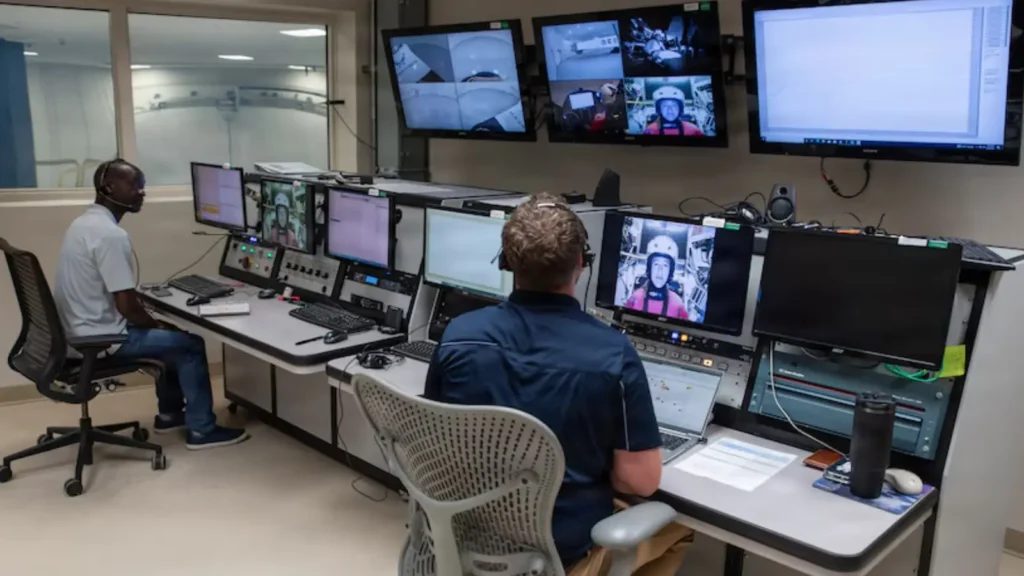
The full testing protocol runs up to eight hours across two days. To qualify, volunteers must be active-duty military or TRICARE beneficiaries between the ages of 18 and 55, stand between five feet and six feet four inches, weigh between 88 and 245 pounds, hold a current aviation medical clearance, and not have undergone centrifuge training within the prior 72 hours.
The requirement for aviation medical clearance is deliberate. SWAN project manager Rich Folga stated that the clearance ensures candidates have the physical readiness required for the demanding centrifuge exposure and represent a credible analog for the astronaut population. Secondary screening further filters for motion sensitivity, since subjects who are already highly susceptible to motion sickness would skew the dataset.
Why It Matters
Space motion sickness is not a minor inconvenience. Historical data from Apollo, Shuttle, and International Space Station missions consistently shows that vestibular disruption affects crew performance during critical mission phases. NASA’s own Human Research Program identifies sensorimotor adaptation — the ability to rapidly re-calibrate balance and spatial orientation — as one of the primary human health risks for deep space exploration.
[Suggested Internal Link — Add link to related article on TheDefenseWatch.com covering NASA Human Research Program priorities or Artemis crew health challenges]
The SWAN study is notable because it moves beyond passive observation. By using a centrifuge to actively induce a controlled deconditioning state, researchers can study the vestibular system’s response in a reproducible, measurable way on the ground. The goggles tracking head-and-eye movements capture neurophysiological data that would be difficult or impossible to gather during actual spaceflight at the scale and resolution needed for countermeasure development.
This type of ground-based analog research is the foundation of aerospace medicine. The U.S. military developed much of its human performance science through exactly this kind of controlled centrifuge work, and that infrastructure — concentrated at Wright-Patterson — now directly serves NASA’s crewed spaceflight program.
Strategic Implications
The military-NASA collaboration embedded in SWAN reflects a deliberate cross-domain investment. Wright-Patterson has hosted aerospace medicine research since the early days of powered flight, and its centrifuge facilities supported astronaut preparation during Mercury, Gemini, and Apollo. Reactivating and expanding that pipeline for Artemis signals institutional commitment to treating lunar return as a national defense and strategic priority, not merely a science mission.
That framing matters. Artemis is not operating in a vacuum. China’s crewed lunar program — with Beijing targeting a crewed lunar landing before 2030 — has introduced a competitive dimension to the moon that did not exist during the Apollo era. The United States is not simply returning to the moon for scientific prestige; it is attempting to establish operational capability and norms on and around the lunar surface before strategic competitors do.
Human performance is a direct enabler of that objective. An astronaut crew that cannot function effectively during the first hours on the lunar surface — due to vestibular disorientation, impaired balance, or motion sickness — represents a genuine operational liability. Countermeasures developed through SWAN could reduce crew vulnerability during the highest-risk phases of a lunar mission and expand the mission envelope for surface operations.
The broader military benefit should not be overlooked. Aviation motion sickness costs the U.S. military training hours, medical disqualifications, and operational readiness. Insights from SWAN that improve the vestibular adaptation models currently used in military aviation medicine would represent a dual-use return on the research investment.
Competitor View
China’s People’s Liberation Army operates its own aerospace medicine research infrastructure and has invested heavily in taikonaut selection, training, and human performance science as part of its Shenzhou and future lunar programs. Beijing watches U.S. military-NASA collaboration closely, particularly research that strengthens the operational performance of American crews in space environments.
Russian aerospace medicine, historically among the world’s most advanced given the Soviet Union’s long-duration spaceflight legacy, continues to inform cosmonaut training — though Russia’s current space program faces significant resource and industrial constraints following international sanctions tied to the war in Ukraine.
Neither competitor currently possesses a comparable ground-based, multi-service research ecosystem that bridges military aviation medicine and crewed spaceflight at the scale of Wright-Patterson. That institutional depth represents a genuine U.S. asymmetric advantage in the emerging era of great-power lunar competition.
What To Watch Next
The immediate milestone is Artemis II mission data. The crewed Artemis II flight, which launched April 1, 2026, provides NASA’s Human Research Program with real physiological data from actual lunar-trajectory crew members for the first time since Apollo 17 in 1972. That data will likely inform SWAN’s research parameters and validate or refine the centrifuge analog protocols being used at Wright-Patterson.
Looking further ahead, Artemis III — the first crewed lunar landing under the Artemis program — will be the true test of vestibular countermeasures developed through studies like SWAN. If crew members can land, egress, and conduct surface operations without significant vestibular impairment, it will validate years of ground-based human performance research.
[Suggested Internal Link — Add link to related article on TheDefenseWatch.com covering Artemis II mission launch or crewed deep space flight milestones]
Researchers will also be monitoring whether SWAN findings translate into updated protocols for military aviators transitioning to high-G environments following periods of inactivity or illness — a parallel application with direct readiness implications.
Capability Gap
The core gap SWAN addresses is the absence of validated, mission-proven countermeasures for rapid vestibular adaptation across multiple gravity transitions. Current mitigation approaches — including pre-mission conditioning, pharmacological interventions, and structured physical rehabilitation — have shown limited effectiveness during the critical landing and early surface phases of lunar missions.
A key limitation of the SWAN methodology is that centrifuge-induced deconditioning, while a useful analog, does not fully replicate the complex sensory environment of actual spaceflight. Microgravity affects the entire musculoskeletal and neurological system over time in ways that a short centrifuge run cannot simulate. The researchers acknowledge this gap through their focus on “analog subjects” rather than operational astronauts, and the study findings will require validation against actual in-flight data.
Nevertheless, the value of high-resolution, reproducible ground-based data — particularly the neurophysiological monitoring component captured through the tracking goggles — is that it can generate the statistical sample sizes that real spaceflight research, constrained by the small number of astronauts and mission opportunities, cannot produce.
The Bottom Line
As the United States races to establish sustained human operations on the moon before strategic competitors, the work being done in a centrifuge at Wright-Patterson may prove as decisive as any piece of hardware in determining whether American astronauts can actually perform when they get there.
