

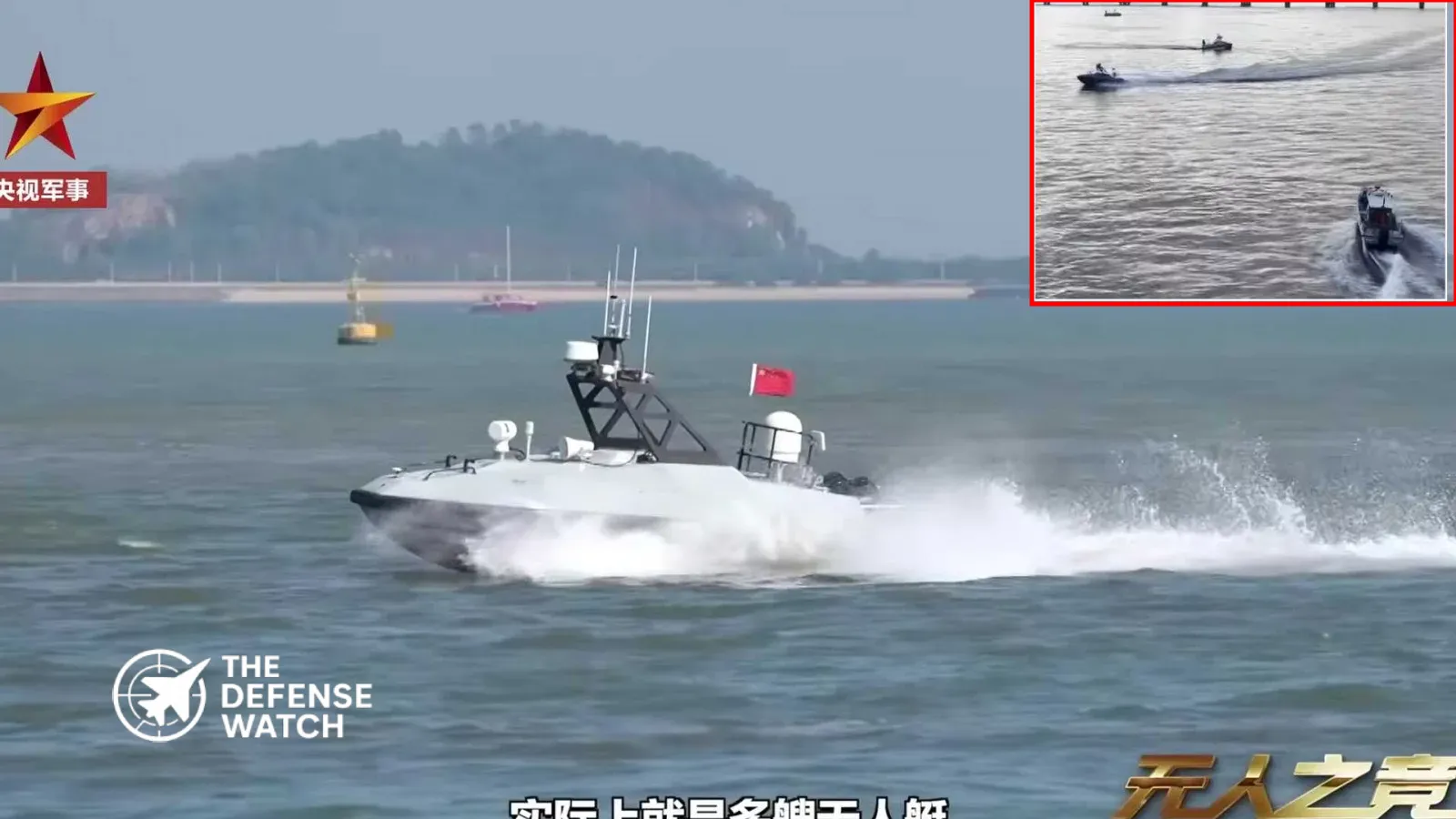
- China has tested an autonomous maritime drone swarm designed for coordinated naval operations.
- The system features multiple unmanned surface vessels operating with AI-driven coordination.
- The drone swarm is intended to counter advanced naval forces, including US carrier strike groups.
- The test reflects China’s growing focus on asymmetric maritime warfare capabilities.
- Analysts see swarm systems as a cost-effective way to challenge high-value naval assets.
China Advances Autonomous Maritime Drone Swarm Capabilities
China’s autonomous maritime drone swarm program is gaining momentum, with recent tests demonstrating coordinated unmanned surface operations aimed at countering future U.S. naval deployments.
The system involves multiple unmanned surface vessels operating together using artificial intelligence, allowing them to coordinate movement, share targeting data, and execute missions with limited human input. This approach reflects a broader shift in naval warfare toward distributed and autonomous systems.
Unlike traditional naval platforms, the drone swarm is designed to overwhelm defenses through numbers and coordination rather than relying on a single high-value platform.
A New Layer Of Naval Warfare
The tested autonomous maritime drone swarm represents a significant evolution in how naval engagements could unfold. Instead of relying solely on large warships, China appears to be investing in scalable, lower-cost unmanned systems capable of operating in contested environments.
According to reporting, the swarm can perform reconnaissance, surveillance, and potentially strike missions. These drones can disperse across a wide area, making detection and targeting more difficult for adversaries.
This model aligns with modern naval doctrine trends, where distributed lethality and networked systems are becoming central concepts. The ability to deploy dozens or even hundreds of small autonomous vessels creates a new operational challenge for traditional fleets.
Strategic Focus On Countering US Naval Power
The development of the autonomous maritime drone swarm is widely viewed as part of China’s broader effort to counter the technological and operational advantages of the U.S. Navy.
Carrier strike groups, long considered the backbone of U.S. naval power, are designed to project force globally. However, swarm systems could complicate their operations by introducing saturation attacks that strain defensive systems.
In a potential conflict scenario, even a relatively low-cost swarm could force high-value assets to expend expensive interceptors or reposition defensively. This dynamic shifts the cost equation, favoring the attacker.
Operational Advantages And Limitations
From an operational standpoint, autonomous maritime drone swarm systems offer several advantages:
- Reduced risk to personnel
- Lower production and deployment costs
- Scalability for mass operations
- Flexibility across mission types
However, limitations remain. Communication links, electronic warfare vulnerabilities, and environmental conditions can affect performance. Maintaining reliable coordination among multiple autonomous units in contested electromagnetic environments is still a technical challenge.
Despite these constraints, continued testing suggests that China is making steady progress in refining these systems.
Broader Implications For Naval Strategy
The emergence of autonomous maritime drone swarm technology signals a broader transformation in naval strategy. Traditional dominance based on large, heavily armed vessels is increasingly being supplemented by distributed, unmanned systems.
For the United States and its allies, this trend underscores the need to invest in counter-swarm technologies, including:
- Advanced electronic warfare systems
- Directed energy weapons
- Improved detection and tracking capabilities
The U.S. Navy has already begun exploring similar concepts, but China’s recent testing highlights the accelerating pace of development in this domain.
Analysis: Shifting The Balance At Sea
The autonomous maritime drone swarm concept reflects a clear strategic calculation. Rather than matching the U.S. Navy ship for ship, China is focusing on asymmetric capabilities that exploit cost and scale advantages.
This approach mirrors trends seen in other domains, including aerial drone warfare, where relatively inexpensive systems have proven effective against more advanced platforms.
If successfully operationalized, swarm systems could complicate U.S. naval planning, particularly in regions like the South China Sea and Western Pacific, where geography already favors distributed operations.
At the same time, the effectiveness of such systems in high-intensity conflict remains unproven. Real-world conditions, including electronic warfare and countermeasures, will ultimately determine their impact.
