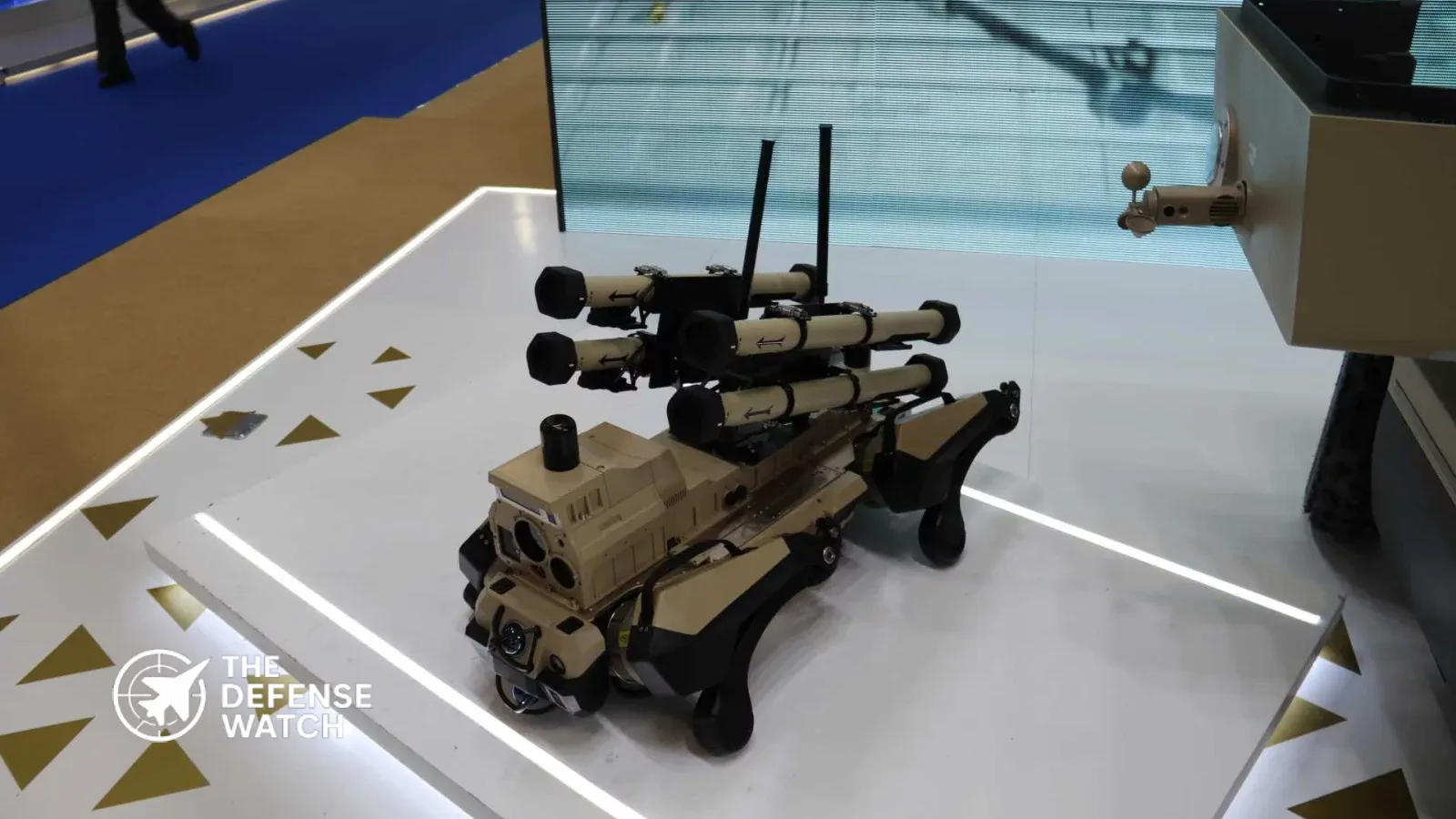
China Shows Missile-Armed Robotic Dog At World Defense Show 2026
At the World Defense Show 2026 in Riyadh, a Chinese state-linked defense firm publicly displayed a new robotic dog equipped with four compact anti-tank guided missiles, marking a significant expansion of China’s unmanned ground combat offerings.
The system comprised a medium-sized quadruped unmanned ground vehicle (UGV) with two twin-launch missile pods mounted on its back. Company representatives at the show described it as a mobile remote fire-support asset tailored for high-risk urban and complex terrain missions.
System Design And Missile Capability
The robotic dog retained the agile stance and low profile seen in earlier Chinese UGV prototypes, but its new missile integration moves it beyond reconnaissance roles. The four launch tubes are believed to be compatible with lightweight short-range anti-tank guided missiles adapted from existing Chinese man-portable systems.
Each launcher can fire fire-and-forget or semi-automatic guided missiles, depending on configuration. Industry observers at the event suggested the maximum effective range could lie between 2 and 4 kilometers, aligning with typical infantry anti-armor engagement distances.
The front end carries an electro-optical targeting suite with day and thermal imaging sensors plus a laser rangefinder. A stabilized sensor head allows target tracking while the platform is stationary or moving at slower speeds. An autonomous navigation package supports waypoint movement, obstacle avoidance, and remote teleoperation.
Operational Role And Tactical Use
Chinese engineers emphasized semi-autonomous combat modes with a human operator in the loop for weapons release. The missile-armed dog could add new options for infantry units in confined environments where larger armored vehicles are less effective.
Compared with traditional anti-armor teams, a remote UGV can operate forward of troops with lower risk to personnel. Its small size and quieter profile may make detection and targeting by adversaries more difficult than larger tracked vehicles.
Broader Context
The unveiling reflects broader trends in China’s unmanned systems development, where robotics increasingly figure in army modernization plans alongside aerial and maritime autonomous systems. Earlier Chinese robotic dogs have been shown with small arms or grenade launchers in drills.
In exercises with the People’s Liberation Army, quadruped robots have been used for reconnaissance and, in some cases, equipped with rifles to support infantry movements.
Global Market And Export Potential
At the World Defense Show, delegations from Middle Eastern and Asian countries examined the system closely. No export contracts were announced publicly, but industry sources indicated that unarmed configurations might be offered for border security and counter-terror roles, while armed variants would require government export approvals.
Implications For UGV Development
The development highlights ongoing global interest in integrating autonomy and precision strike for ground combat. The Chinese system’s missile armament moves robotic dogs farther into direct combat roles from earlier reconnaissance and support tasks.