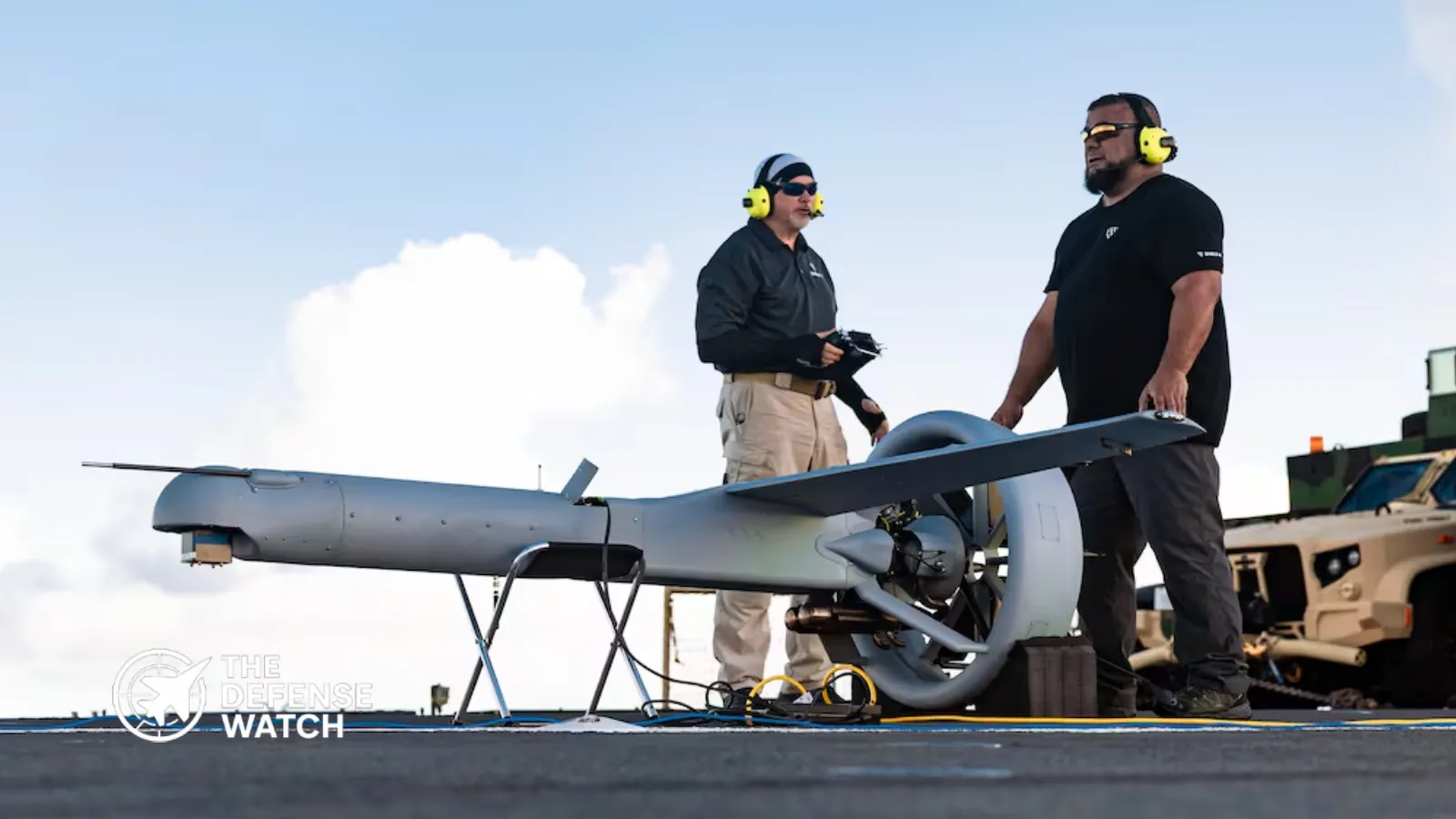
US Navy Strike Drones Program Signals Major Shift In Naval Aviation
The US Navy is actively seeking ship-launched strike drones that can operate from virtually any warship, reflecting a broader push to expand distributed maritime strike options and reduce reliance on aircraft carriers.
According to a recent report, Navy officials are evaluating unmanned aircraft concepts that could be launched from surface combatants, amphibious ships, and potentially logistics vessels, without the need for catapults, arresting gear, or extensive ship modifications. The effort aligns with the service’s long-term vision of distributed maritime operations and unmanned force integration.
The initiative comes as the Navy faces growing challenges in contested environments, particularly in the Indo-Pacific, where long-range precision fires, dense air defenses, and anti-ship missile threats complicate traditional carrier-centric operations.
Expanding Strike Power Beyond Aircraft Carriers
Aircraft carriers remain central to US naval power, but they are high-demand and high-risk assets. Navy leaders increasingly view unmanned systems as a way to spread offensive capability across the fleet while complicating adversary targeting.
The strike drones under consideration would be capable of taking off from standard ship decks or compact launch systems. Navy officials emphasized flexibility over size, favoring systems that could be deployed from destroyers, cruisers, amphibious assault ships, and potentially even smaller combatants.
Unlike existing carrier-based unmanned aircraft programs, the focus is not on replacing crewed aircraft, but on augmenting fleet-wide strike capacity. These drones would conduct missions such as maritime strike, land attack, intelligence collection, and targeting support.
Defense News reported that the Navy is particularly interested in systems that require minimal shipboard integration, allowing rapid adoption across multiple ship classes.
Technical Requirements And Operational Concept
While detailed specifications have not been publicly released, Navy officials outlined several core requirements for future ship-launched strike drones.
Key attributes include vertical or short takeoff capability, autonomous or semi-autonomous flight control, and the ability to carry a meaningful payload of sensors or weapons. Endurance and survivability in contested environments are also central considerations.
The Navy is also prioritizing compatibility with existing command and control networks. Strike drones would need to integrate seamlessly with naval combat systems, including Cooperative Engagement Capability and other joint targeting frameworks.
Officials noted that these systems are expected to operate in coordination with crewed aircraft, surface combatants, and undersea platforms, reinforcing the Navy’s emphasis on multi-domain operations.
Lessons From Ongoing Conflicts And Experiments
The Navy’s interest in ship-launched strike drones reflects lessons drawn from recent conflicts, particularly the extensive use of unmanned systems in Ukraine and the Middle East. Armed drones have demonstrated their value as low-cost, adaptable strike and reconnaissance platforms capable of operating under persistent threat.
Within the US Navy, experimentation with unmanned surface and air systems has accelerated in recent years. Programs such as the MQ-25 Stingray tanker drone and various unmanned surface vessel initiatives have helped mature autonomous technologies and operational concepts.
However, the ship-launched strike drone effort differs in scale and intent. Rather than supporting carrier air wings, these drones are designed to give individual ships independent strike options, even when operating far from air cover.
Industry Engagement And Acquisition Path
The Navy is engaging with industry to explore a wide range of concepts, from expendable strike drones to recoverable platforms designed for repeated use. Officials have signaled openness to both traditional defense contractors and non-traditional suppliers with experience in commercial unmanned systems.
According to Defense News, the service is using early-stage market research and experimentation to refine its requirements before committing to a formal acquisition program. This approach reflects a broader shift toward rapid prototyping and iterative development within the Department of Defense.
No timeline has been announced for fielding an operational capability, but Navy leaders indicated that near-term experimentation could lead to limited deployments later this decade.
Strategic Implications For Naval Warfare
If successful, ship-launched strike drones could significantly alter how the US Navy projects power at sea. By enabling more ships to conduct offensive operations, the Navy could complicate adversary planning and reduce the operational burden on carrier strike groups.
Such systems would also enhance deterrence by increasing the number of platforms capable of delivering precision effects. In high-end conflicts, distributed strike drones could play a critical role in saturating enemy defenses and supporting joint force operations.
Analysts note that adversaries, including China and Iran, are investing heavily in unmanned and missile technologies. The Navy’s push for flexible strike drones suggests an effort to stay ahead in an increasingly contested and technology-driven maritime battlespace.