Table of Contents
Royal Fleet Auxiliary Tanker Returns Home After Record Deployment
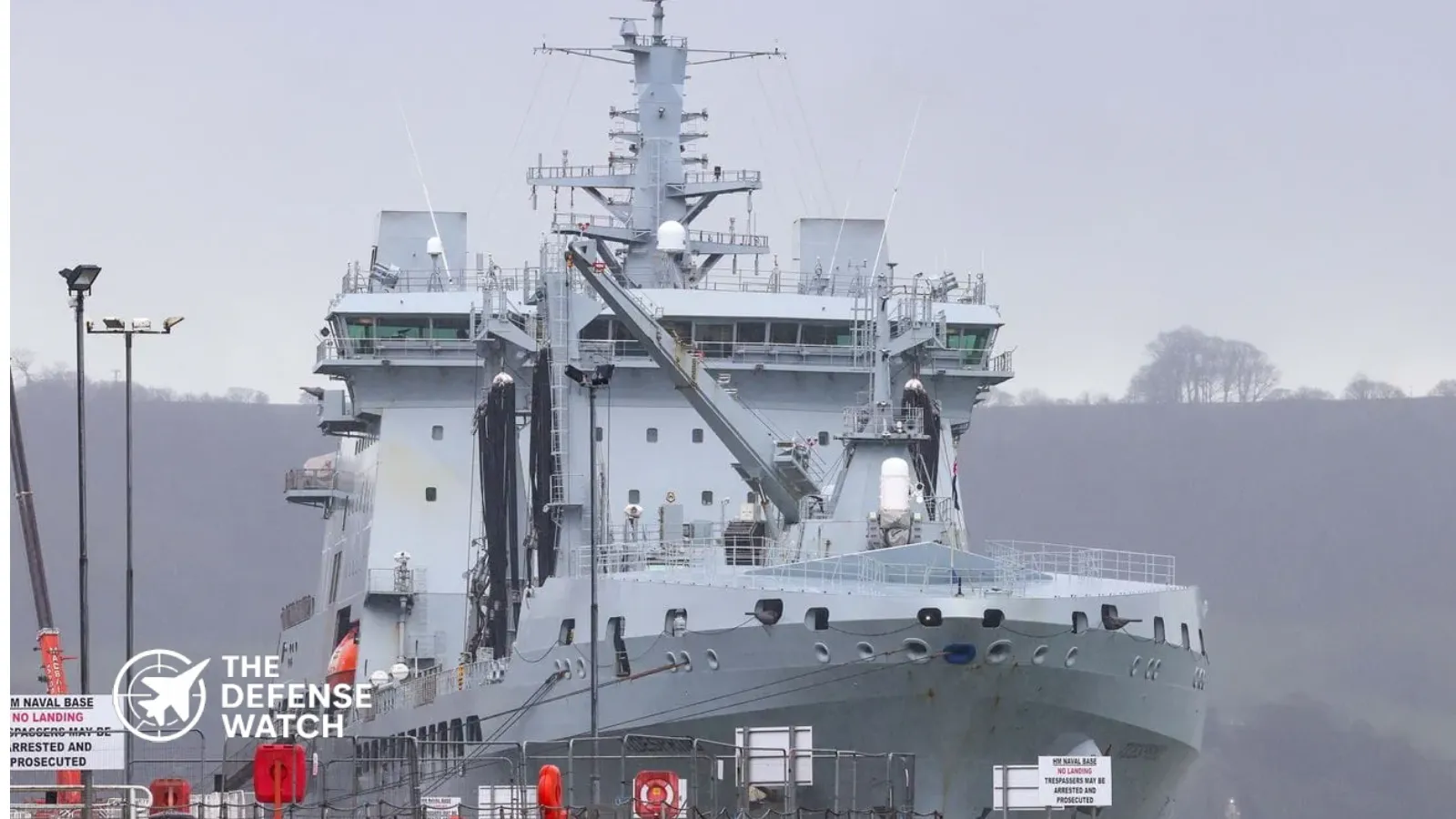
RFA Tidespring sailed into Plymouth on February 6, 2026, marking the conclusion of a 291-day deployment that saw the Royal Fleet Auxiliary tanker travel 45,954 nautical miles while providing critical logistics support to the UK Carrier Strike Group’s Operation Highmast.
The Tide-class fast fleet tanker was the final vessel from the 2025 deployment to return to the United Kingdom, arriving two months after flagship HMS Prince of Wales and escorts HMS Richmond and HMS Dauntless completed their homecoming in late November 2025.
According to the Royal Navy, Tidespring’s extended mission demonstrated the essential role of naval logistics in sustaining modern carrier operations across global theaters.
Unprecedented Replenishment Operations
During the nine-and-a-half-month deployment, RFA Tidespring conducted 79 replenishments at sea, averaging approximately three refueling operations per week while attached to the carrier strike group.
The vessel delivered more than 30,000 cubic meters of diesel fuel—equivalent to filling 12 Olympic-sized swimming pools—and 4,200 cubic meters of aviation fuel to Royal Navy, NATO, and international allied vessels operating alongside HMS Prince of Wales.
Beyond fuel, Tidespring provided critical supplies including food and fresh water to sustain the multinational force during extended operations far from shore-based logistics infrastructure.
Global Route and Strategic Significance
Operation Highmast represented the UK’s second major carrier strike group deployment to the Indo-Pacific region, following the 2021 deployment led by HMS Queen Elizabeth. The eight-month operation involved warships and personnel from 13 nations, including Australia, France, India, Italy, Japan, Malaysia, New Zealand, Singapore, South Korea, and the United States.
After the core strike group returned to UK waters in November 2025, Tidespring broke away from the formation at the end of October and transited around the Cape of Good Hope en route to Gibraltar. The tanker made a brief stop at the British territory of St. Helena before arriving at Gibraltar, where she underwent maintenance and hosted senior officers and VIPs.
Following Gibraltar’s New Year celebrations, Tidespring departed for the final leg of her journey home, navigating through stormy conditions in the Bay of Biscay before sailing up the Hamoaze into Plymouth on February 5, 2026.
Tide-Class Capabilities Enable Extended Operations
The RFA Tidespring is one of four Tide-class fast fleet tankers that form the backbone of the Royal Fleet Auxiliary’s replenishment capabilities. At 37,000 tons displacement, these vessels represent the largest ships currently serving in the RFA fleet.
Built by Daewoo Shipbuilding & Marine Engineering in South Korea and commissioned in 2017, the Tide-class tankers measure 200.9 meters in length with a beam of 28.6 meters. The vessels feature double-hull construction, significantly improving safety and environmental protection compared to their single-hulled predecessors.
Each Tide-class tanker is equipped with three abeam replenishment at sea stations for diesel fuel, aviation fuel, and fresh water, plus an additional astern replenishment rig. The vessels also feature flight decks capable of accommodating Chinook-sized helicopters, enabling vertical replenishment operations.
With a maximum speed of 26.8 knots and a range of 18,200 nautical miles, these tankers can keep pace with modern carrier strike groups during high-tempo operations. The ships can carry 19,000 cubic meters of liquid cargo, with tanks configurable between diesel and aviation fuel depending on operational requirements.
(adsbygoogle = window.adsbygoogle || []).push({});Operation Highmast Achievement
Operation Highmast marked several historic milestones for the Royal Navy and its international partners. The deployment saw HMS Prince of Wales achieve Full Operational Capability, qualifying the carrier for NATO frontline duties.
For the first time, the UK deployed 24 F-35B Lightning II stealth fighters during an operational carrier deployment, with aircraft from RAF No. 617 Squadron “The Dambusters” and Royal Navy 809 Naval Air Squadron embarked aboard Prince of Wales.
The strike group participated in major exercises including NATO’s Neptune Strike in the Mediterranean and the Australia-hosted Exercise Talisman Sabre, where HMS Prince of Wales became the first non-U.S. aircraft carrier to participate. In August 2025, a British F-35B made history by landing on the Japanese aircraft carrier JS Kaga, marking the first time a British jet had operated from a Japanese carrier.
The deployment also featured the first-ever joint maritime exercises between British and Indian carrier strike groups, reinforcing strategic partnerships across the Indo-Pacific region.
Royal Fleet Auxiliary Personnel Challenges
While Tidespring’s successful deployment demonstrates the critical capabilities of the RFA fleet, the service continues to face significant personnel shortages that have impacted operational readiness across the auxiliary force.
As of late 2024, the RFA reported severe manpower challenges, with only six of the then-11 vessels able to be crewed on a regular basis. Sister ship RFA Tiderace entered extended readiness in June 2024 due to insufficient crew, remaining inactive for over 16 months despite having no technical faults.
These personnel challenges stem from recruitment and retention difficulties exacerbated by competitive private sector opportunities, extended deployment periods, and compensation concerns. In late 2024, 79 percent of RFA officers reportedly voted for strike action over employment terms.
However, recent reports indicate efforts to return Tiderace to active duty following crew augmentation, suggesting some progress in addressing workforce shortages.
Next Phase of Operations
Now in the hands of the Devonport Alongside Services team, RFA Tidespring will undergo routine maintenance and resupply before resuming Royal Navy support operations in the near future.
(adsbygoogle = window.adsbygoogle || []).push({});The vessel’s 291-day deployment—equivalent to 42 weeks and three days—and circumnavigation of more than twice around the world underscores the sustained operational tempo required to support modern carrier strike group operations in contested global environments.
As geopolitical tensions continue in both European and Indo-Pacific theaters, the Royal Fleet Auxiliary’s replenishment capabilities remain essential to enabling the Royal Navy’s global presence and power projection.
The successful completion of Operation Highmast, supported by Tidespring’s extended logistics mission, demonstrates the UK’s commitment to maintaining maritime security and upholding international order alongside allied and partner nations.