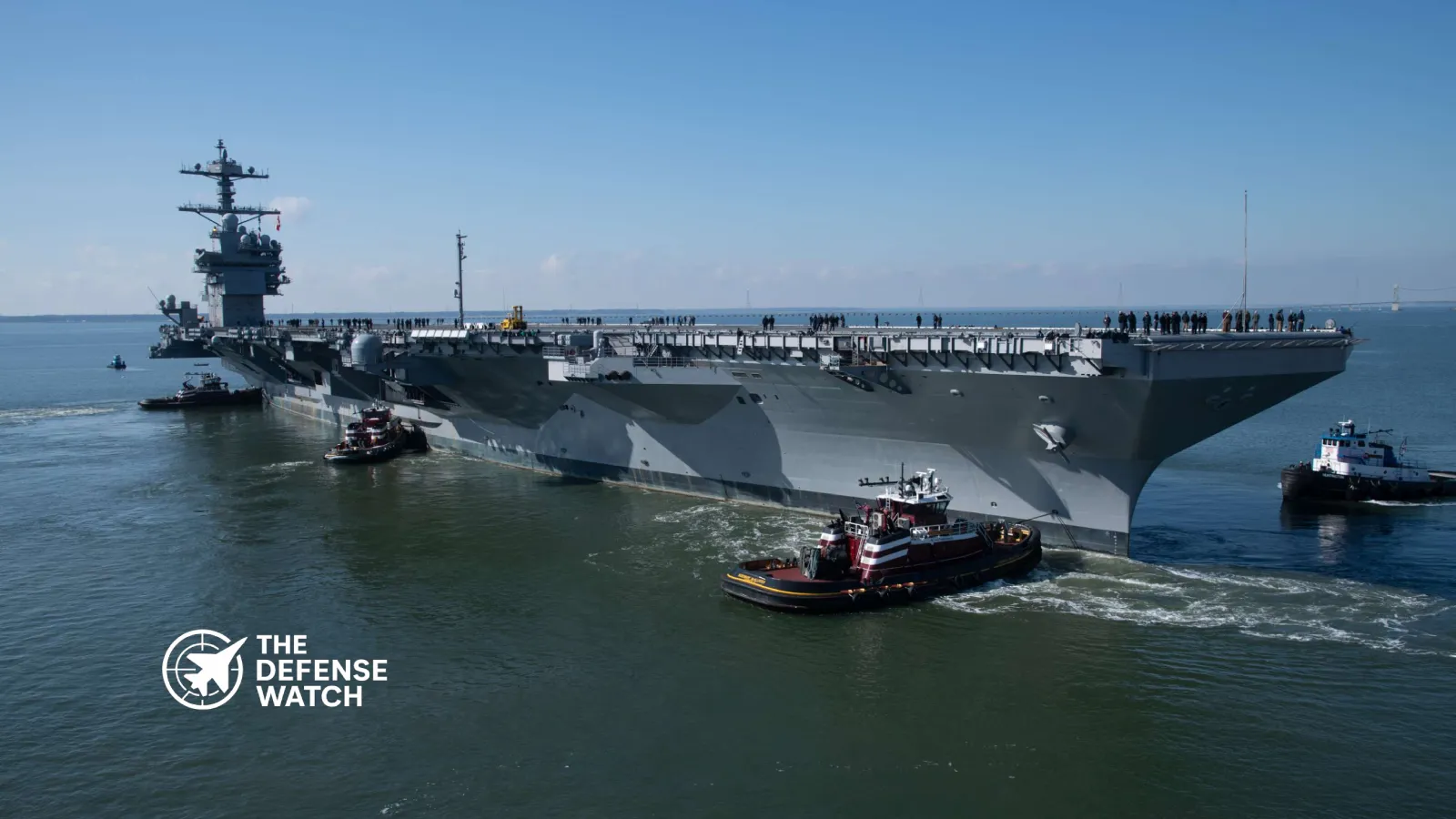
USS John F Kennedy Begins Sea Trials
The future USS John F Kennedy (CVN-79) began its first builder sea trials on January 28, departing Huntington Ingalls Industries’ Newport News Shipbuilding in Virginia and moving into open water testing ahead of delivery to the US Navy, according to multiple reports.
Sea trials mark the first time the vessel will operate at sea under its own power, with key systems and components examined in real conditions before further acceptance trials.
What Sea Trials Cover
Builder sea trials are conducted by the shipbuilder, Huntington Ingalls Industries (HII), with oversight from the Navy. They focus on evaluating the carrier’s propulsion, navigation, electrical systems, and other major ship functions at sea. These trials follow extensive dockside testing and initial propulsion checks performed in the James River.
Carrier Background and Construction
The USS John F Kennedy is the second ship of the Gerald R Ford class, following the lead ship USS Gerald R Ford (CVN-78). Construction began with keel laying in 2015 at Newport News Shipbuilding. The ship was launched in 2019 and has since undergone outfitting and system integration.
Ford-class carriers incorporate newer technologies compared with the older Nimitz class, including the Electromagnetic Aircraft Launch System (EMALS), redesigned flight deck, improved weapons handling, and increased electrical power generation. These changes aim to support a higher sortie rate and future technologies.
(adsbygoogle = window.adsbygoogle || []).push({});Delivery Timeline and Program Shifts
Delivery of CVN-79 is now projected for March 2027, according to US Navy budget documentation. The date was pushed from an earlier target in 2025 to allow completion and certification of key systems, including the Advanced Arresting Gear (AAG) and Advanced Weapons Elevators (AWE).
The Navy revised its delivery strategy in 2020 from a two-phase approach to a single-phase model, increasing the scope of work completed before delivery and affecting the overall schedule.
Fleet Impact
Delays to CVN-79’s delivery have implications for carrier force levels. With the scheduled retirement of USS Nimitz (CVN-68) in 2026, the active supercarrier count will temporarily fall. The gap underscores the challenge of aligning complex nuclear carrier construction with fleet requirements, though all carriers must continue meeting strategic commitments.
What Comes Next
After builder sea trials, the Kennedy will enter additional testing and acceptance trials, including Navy-led assessments at sea. Following successful completion, the carrier will move toward commissioning and full operational capability. These steps typically involve integrated system tests, weapons checks, and flight operations with embarked squadrons.