
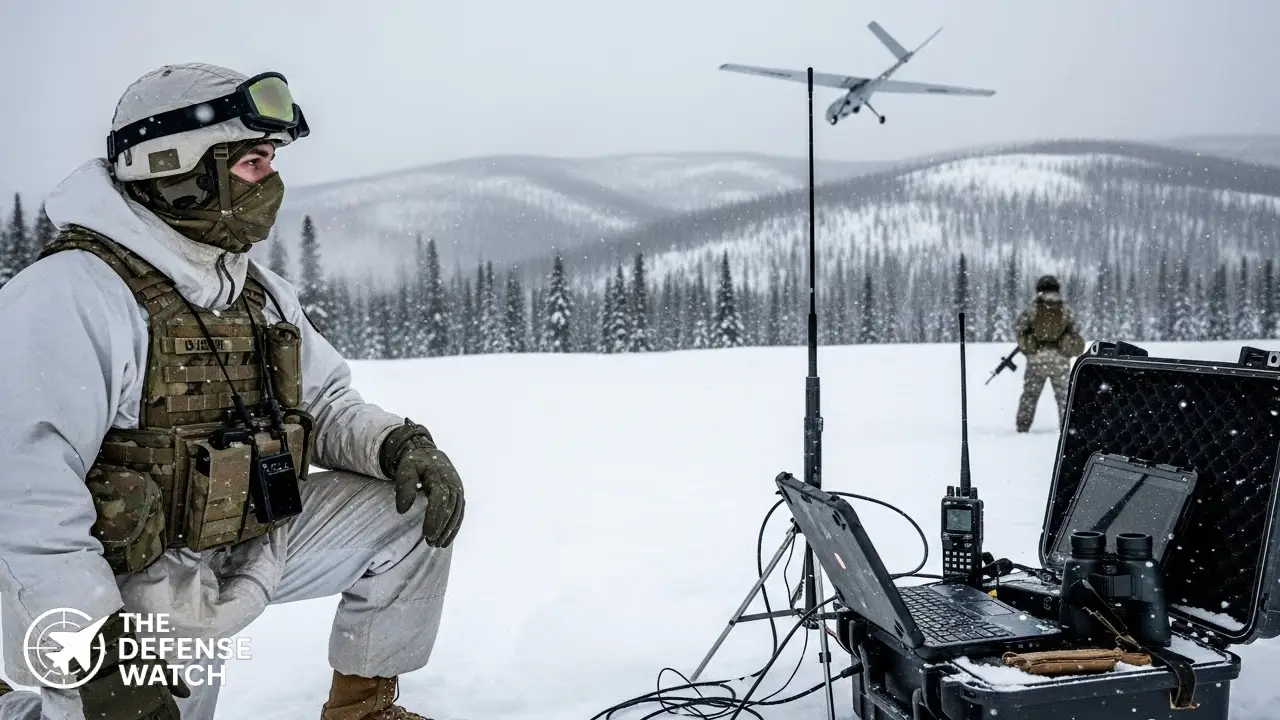
The U.S. Army’s Arctic Division has completed a series of drone and sensor integration trials in Alaska aimed at informing future electromagnetic doctrine for Arctic operations, according to a recent Army Recognition report published in late 2025. Conducted across training areas in the state’s northern terrain, the evaluations focused on how unmanned aerial systems (UAS) and electronic capabilities function in extreme cold, degraded communications environments, and magnetic interference common to high-latitude regions.
Background: Modernizing for the Arctic Operating Environment
The U.S. Army has increasingly prioritized Arctic readiness as part of its broader shift toward large-scale combat operations and strategic competition. The release of the Army’s Arctic Strategy emphasized operational mobility, resilience, and situational awareness in polar climates, where navigation, communications, and sensing technologies face unique limitations. The Army’s Arctic Division, headquartered in Alaska, plays a central role in testing equipment and shaping doctrine for forces expected to operate in cold-weather and electromagnetic-challenged environments.
Field Testing and Operational Focus
The Alaska drone trials assessed unmanned platforms for reconnaissance, overwatch, and data relay roles while monitoring the effects of freezing temperatures, battery degradation, and electromagnetic disruption. According to the report, the testing incorporated small UAS assets as well as emerging sensing payloads designed to increase unit-level situational awareness.
Army personnel involved in the trials stated that the primary aim was to understand how electromagnetic factors in the Arctic impact unmanned systems and command-and-control reliability. Unique magnetic variations in northern latitudes can interfere with satellite links, GPS-based navigation, and encrypted tactical communications—capabilities that modern force structures rely upon.
The U.S. Army Arctic Division emphasized that lessons from the Alaska drone trials will directly contribute to shaping future electromagnetic doctrine, enabling formations to operate without degradation in contested or denied environments. Officials noted that the findings will be integrated into training frameworks, capability development pathways, and interoperability planning with joint and allied forces.
Electromagnetic Considerations in Arctic Warfare
Electromagnetic resilience has emerged as a priority for U.S. military forces, given the increasing prevalence of jamming, spoofing, and surveillance targeting in modern conflict zones. Arctic conditions compound these risks, amplifying natural interference while reducing signal propagation and sensor fidelity.
The U.S. Army Arctic Division’s use of Alaska drone trials reflects a growing shift toward combining unmanned platforms with electromagnetic security measures to maintain control of information flows. The Army Recognition report indicated that the tests also supported research into redundancy measures and alternative data transmission pathways suitable for extreme-latitude deployments.
Expert Perspective and Strategic Value
Defense analysts note that the Army’s emphasis on electromagnetic doctrine development aligns with global trends in Arctic militarization. As northern sea routes expand and regional powers increase military presence, reliable communications and reconnaissance capabilities become essential for deterrence, surveillance, and crisis response.
Experts suggest that the integration of unmanned systems into Arctic operations could provide the U.S. Army Arctic Division with persistent situational awareness across remote terrain with reduced logistical burden. However, they also highlight that operational success will require hardened systems that can withstand both environmental stress and adversarial electronic interference.
Outlook and Next Steps
The U.S. Army Arctic Division is expected to continue iterative testing cycles in Alaska throughout upcoming training rotations, with additional focus on cold-weather sustainment, network security, and interoperability across joint forces. Findings from the drone trials will inform doctrine publications, procurement considerations, and future capability upgrades.
The integration of unmanned systems into Arctic formations, combined with emerging electromagnetic doctrine, reflects a broader modernization trajectory aimed at ensuring that U.S. land forces can conduct operations in contested and high-latitude environments. As the Army continues refining its Arctic posture, further developments are anticipated in communications hardening, sensor integration, and cold-weather force design.
Get real time update about this post category directly on your device, subscribe now.

8 comments
[…] defenders are turning to restrictive measures. For example the Ask Sage tool — funded by a U.S. Army contract worth over 11 million USD — isolates sensitive data, limits which datasets can be […]
[…] military planners see Arctic operations as integral to deterrence and rapid response. Exercises in this region help forces rehearse […]
[…] commander’s comments reflect NATO’s growing focus on the High North, where seven of the eight Arctic states are alliance members. Russia stands outside that group, and China remains present through expanding naval and […]
[…] the need for rapid improvement in maintenance throughput and to stress that delivery must match future operational […]
[…] The first MQ‑25 test aircraft flew in 2019 under a Boeing‑Navy partnership, completing early autonomous operations including basic taxi and take‑off during developmental testing. […]
[…] Army plans follow-on operational tests of ER GMLRS before fielding it to units. Performance in these environments will help shape […]
[…] Philipp Kerth and Marc Ewenz said the flight’s results provide valuable data to feed into future test campaigns and eventual operational […]
[…] and autonomy software. Hensoldt will supply advanced radar, optronics, self-protection and electromagnetic warfare systems for the unmanned aircraft. Its MDOcore suite will serve as the mission data backbone, […]