L3Harris Technologies is positioning its business around rising demand for missile systems, space capabilities and advanced defense technologies, as the United States and allied governments seek to strengthen military readiness against increasingly capable adversaries.
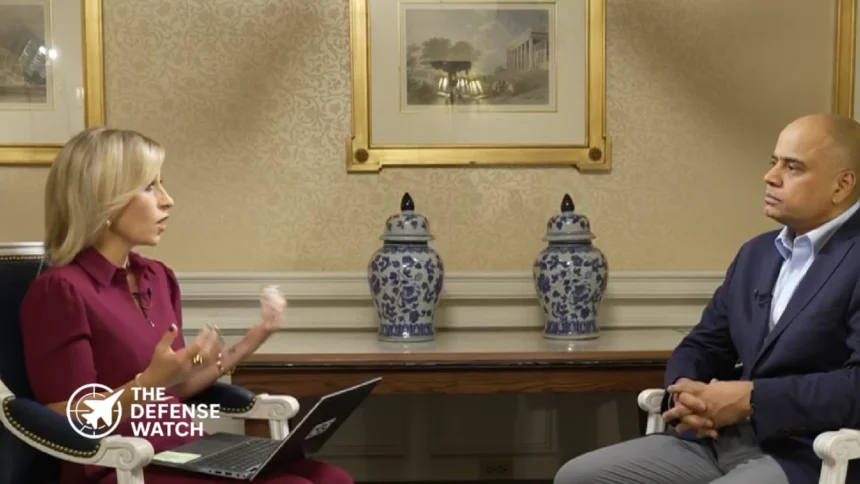
The company’s President and Chief Executive Officer, Sam Mehta, discussed these priorities during an appearance on CNBC’s Morning Call on November 11, 2026. The live broadcast, hosted by Morgan Brennan from Washington, D.C., took place on Veterans Day.
According to L3Harris, Mehta addressed the company’s efforts to deliver defense capabilities at the speed and production scale required by U.S. and allied military customers. He also discussed growing international demand and L3Harris’ expanding role as a prime contractor in the space domain.
The interview comes as defense manufacturers face pressure to increase production capacity, strengthen supply chains and meet demand for missile propulsion, communications and other mission-critical technologies.
Missile Production Capacity Becomes a Major Industrial Priority
Although the CNBC appearance covered several areas of the company’s business, missile production remains one of L3Harris’ most significant industrial priorities.
The company has committed approximately $3 billion to expanding its solid rocket motor manufacturing capacity. The investment is intended to address increasing demand for missile propulsion systems and reduce production constraints affecting the wider U.S. defense industrial base.
L3Harris has been expanding its role in the propulsion market through investments in manufacturing facilities, equipment and supply-chain capacity.
One recent milestone was the October 2026 opening of its Arsenal of Freedom solid rocket motor production facility in Camden, Arkansas. The facility forms part of a wider industrial expansion that the company says includes approximately 60 new facilities.
The company’s third-quarter results also illustrate the scale of its propulsion business.
In October, L3Harris disclosed two major seven-year contracts to expand production of missile propulsion systems:
- A $6.3 billion contract, excluding escalations, to scale propulsion production for the Terminal High Altitude Area Defense (THAAD) system.
- A $4.7 billion contract, excluding escalations, to expand propulsion production for the Patriot Advanced Capability-3 Missile Segment Enhancement (PAC-3 MSE) interceptor.
Both contracts are structured around long-term production expansion rather than a single immediate delivery.
These programs support two important components of U.S. missile defense. THAAD provides protection against ballistic missile threats, while PAC-3 MSE interceptors contribute to the Patriot air and missile defense architecture.
Increasing propulsion output is important because interceptor production depends on more than final assembly. Rocket motors, energetic materials, specialized components and qualified manufacturing processes must also be available at the required scale.
Consequently, expanding production capacity across the propulsion supply chain is an important part of meeting future missile procurement requirements.
L3Harris Sees Growing Demand Beyond the United States
Mehta also addressed the increasing international demand for L3Harris products and services.
The company supplies defense technologies to U.S. military customers and international partners across multiple operational domains.
Its portfolio includes missile propulsion, electronic warfare, tactical communications, intelligence, surveillance and reconnaissance systems, space technologies and integrated mission systems.
International demand is particularly relevant as allied governments reassess their defense requirements and invest in military modernization.
European countries continue to strengthen their air and missile defense capabilities, while governments in the Indo-Pacific are placing greater emphasis on surveillance, communications, electronic warfare and regional deterrence.
For defense contractors, these requirements create opportunities to supply equipment, support existing platforms and participate in longer-term modernization programs.
However, international sales also involve different procurement procedures, export restrictions, industrial participation requirements and customer-specific integration work.
L3Harris has not disclosed a new international contract or a specific sales target in its November 11 announcement. The company’s comments therefore indicate a business priority rather than a newly confirmed procurement agreement.
Space Business Expands the Company’s Defense Role
Another subject discussed during the CNBC appearance was L3Harris’ evolution into a prime contractor in the space domain.
Space-based capabilities have become increasingly important to modern military operations. Satellites support missile warning, communications, intelligence collection, navigation and other functions that underpin military command and control.
The ability to develop and integrate these systems is becoming a significant part of the defense industry’s competitive landscape.
L3Harris operates across space and mission systems, providing technologies for government and commercial customers.
Its involvement in space programs also complements its established work in communications, sensors and electronic systems.
For the U.S. military, maintaining reliable access to space-based capabilities is important as potential adversaries develop counterspace technologies and seek to disrupt satellite communications and other orbital services.
The growing importance of these capabilities creates opportunities for established aerospace and defense companies, although future demand will depend on government budgets, program schedules and procurement decisions.
Financial Results Show the Scale of Current Demand
L3Harris’ latest financial results provide additional context for Mehta’s comments about production and customer demand.
In its third-quarter 2026 results, released on October 29, the company reported revenue of $6.1 billion, representing 7% growth compared with the same period a year earlier.
Orders reached $19.3 billion during the quarter, pushing the company’s total backlog to a record $53.2 billion.
L3Harris third-quarter 2026 performance
The Missile Solutions segment recorded an 11.8x book-to-bill ratio, indicating that orders received substantially exceeded revenue recognized during the quarter.
The company also reported a 1.0x ratio for Space & Mission Systems and 1.9x for Communications & Spectrum Dominance.
L3Harris raised the lower end of its full-year 2026 revenue guidance to $23.5 billion while maintaining its free cash flow guidance at $3 billion.
These figures provide evidence of strong order activity, particularly in missile-related business. However, backlog does not translate automatically into immediate deliveries or revenue. Contract execution, manufacturing capacity, supplier availability and customer funding remain important factors.
Sam Mehta’s Leadership and Industrial Strategy
Mehta became L3Harris president and CEO on August 17, 2026, following the departure of former CEO Christopher Kubasik.
He joined L3Harris in January 2023 and previously led the company’s Space & Mission Systems and Communications & Spectrum Dominance segments.
Before joining L3Harris, Mehta served as president of Advanced Structures at Collins Aerospace, part of RTX, and held leadership positions at Sikorsky Aircraft.
His background includes aerospace manufacturing, business operations and defense industry management.
His leadership comes at a time when L3Harris is managing several overlapping priorities: increasing missile propulsion output, expanding space capabilities, supporting international customers and converting a substantial order backlog into completed deliveries.
The company’s ability to execute these priorities will be an important measure of its industrial performance.
For the wider U.S. defense sector, the central challenge is not simply securing new contracts. It is ensuring that manufacturers can deliver missiles, propulsion systems, communications equipment and other military technologies at the pace required by operational demand.
Mehta’s CNBC appearance offered an overview of how L3Harris sees its position in that market, while the company’s recent financial disclosures show the scale of the production and delivery commitments it must meet.