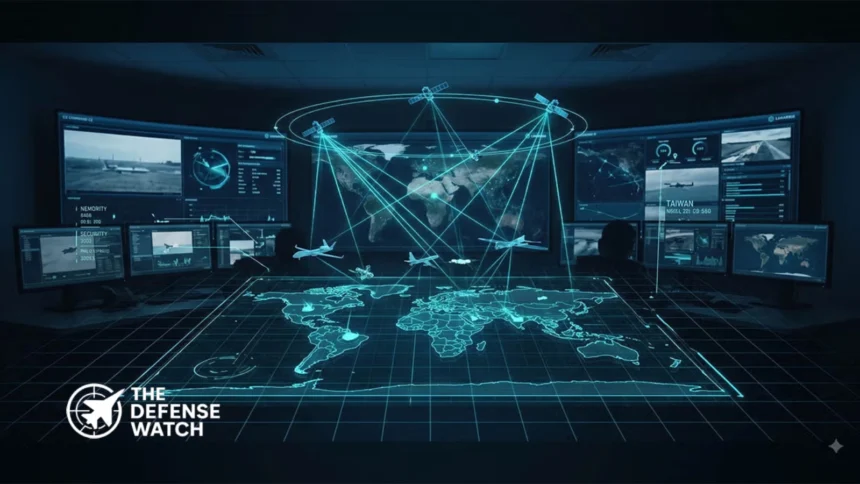
L3Harris Technologies has demonstrated an integrated military defense architecture designed to connect intelligence sensors, tactical communications, counter-drone systems and command networks across multiple operational domains. The demonstration, known as EVEREST: Pacific Vigilance, brought together technologies from several defense and technology companies to illustrate how smaller nations and regional military coalitions could coordinate responses to complex security threats.
Published on November 11, 2026, the demonstration focused on persistent surveillance, early threat detection, coordinated defensive fires, electronic warfare resilience and civil-military communications. L3Harris said the architecture combined existing technologies with artificial intelligence to shorten the time between identifying a threat and coordinating a response.
The announcement is relevant to Indo-Pacific defense planning, where large operating distances, contested communications environments and the growing use of unmanned systems place additional demands on military coordination.
However, EVEREST: Pacific Vigilance was presented as a technology demonstration and operational concept. L3Harris did not announce a military procurement agreement, identify a customer nation or disclose a deployment schedule.
A Network Connecting Sensors, Commanders and Weapon Systems
The central idea behind EVEREST is to connect systems that traditionally operate across separate military networks.
Modern forces depend on information from airborne surveillance platforms, ground-based sensors, electronic warfare units, naval assets and unmanned aircraft. Collecting this information is only part of the challenge. Commanders also need to distribute it quickly enough to coordinate an effective response.
L3Harris presented its software-defined communications equipment as the connecting layer between these different systems.
The demonstration incorporated Palantir’s Maven Smart System, which the company said fused intelligence and sensor information across tactical networks to support faster decision-making. Commercial satellite connectivity from Amazon Leo and military Link 16 tactical data links provided additional communications pathways.
The intended result was a distributed architecture capable of moving information between sensors, intelligence systems, operational headquarters and tactical units.
This approach addresses an important challenge in joint operations: information collected by one service or platform must be usable by other forces without depending on a single communications network.
Artificial Intelligence and the Maven Smart System
Palantir’s Maven Smart System was one of the central software components in the demonstration.
The platform is designed to integrate information from multiple sources into a common operational environment. Its military applications include intelligence analysis, command and control, and support for targeting workflows.
The U.S. Marine Corps previously announced an enterprise license for Maven Smart System in August 2025, providing access across its force structure. The arrangement illustrates that the platform has applications beyond the EVEREST demonstration.
In the Pacific Vigilance scenario, L3Harris described Maven as an AI-enabled system for combining sensor and intelligence data across tactical networks.
The distinction between data integration and autonomous decision-making is important. AI-assisted information processing can help commanders identify patterns, organize incoming information and prioritize potential threats. It does not, by itself, establish that a system can independently authorize or execute military engagements.
L3Harris did not publish independent performance measurements showing how much the demonstration reduced decision times or improved targeting accuracy.
Counter-Drone Defense and Early Warning
Counter-unmanned aircraft systems formed another major part of the demonstration.
Small drones and coordinated unmanned aircraft attacks can challenge traditional air defense arrangements, particularly when military installations, coastal infrastructure and civilian facilities must be protected simultaneously.
EVEREST incorporated several L3Harris capabilities to illustrate how a connected surveillance and response network could address these threats.
These included:
- VAMPIRE: A vehicle-agnostic system designed to launch precision-guided rockets for counter-UAS and other strike missions.
- Drone Guardian: A counter-drone system designed to detect, track and identify unmanned aircraft through multiple sensor inputs.
- Electro-optical and infrared sensors: Systems intended to support visual detection, tracking and identification.
- Wraith Shield: Software designed to extend software-defined radio capabilities into counter-UAS sensing and protection functions.
L3Harris also described an airborne early warning and control capability and a joint electronic warfare center as part of the wider threat-detection architecture.
The combination is intended to connect detection with command-and-control networks and potential defensive responses.
That integration is important because counter-drone defense is not simply a matter of possessing an interceptor. Military operators must identify incoming objects, distinguish hostile systems from friendly or civilian aircraft, distribute threat information and select an appropriate response.
The demonstration did not disclose the detection ranges, interception probabilities or electronic warfare performance of the combined architecture. It therefore should not be interpreted as evidence that the network has demonstrated protection against every type of coordinated drone attack.
Resilient Communications in Contested Environments
Communications resilience was a central technical theme of Pacific Vigilance.
Military networks operating across the Indo-Pacific face geographical challenges, including long distances between islands, dispersed installations and maritime forces. They must also account for electronic interference, jamming and potential disruption to satellite or terrestrial communications.
L3Harris highlighted its Wraith Mobile Ad Hoc Network (MANET) waveform as one component of the architecture.
MANET technology allows network participants to communicate through distributed connections rather than relying exclusively on a fixed communications infrastructure. L3Harris described Wraith as providing anti-jam voice and data communications.
The demonstration also incorporated Link 16, a tactical data-link standard used to exchange information between compatible military platforms and command systems.
Its interoperability role is supported by U.S. military standard MIL-STD-6016, which defines requirements for Link 16 message compatibility between U.S. and coalition forces.
Satellite connectivity added another communications layer.
Amazon Leo, formerly known as Project Kuiper, is Amazon’s low Earth orbit satellite broadband network. Its inclusion in the demonstration illustrates the potential role of commercial satellite infrastructure in supporting distributed military communications.
However, commercial broadband and dedicated military tactical data links serve different purposes. Their inclusion in one architecture does not establish that they offer equivalent security, availability or resistance to electronic attack.
A resilient military network therefore needs multiple communications pathways, appropriate security controls and the ability to operate when individual links become unavailable.
Connecting Military and Civilian Response Networks
One of the more distinctive elements of EVEREST was its focus on civil-military coordination.
The demonstration included a Tactical Operations Center-Light (TOC-L) supplied by Booz Allen and a next-generation C5ISR shelter from Champion Auto.
The TOC-L was presented as a bridge between military tactical communications and Project 25 (P25) civilian radio networks.
P25 is a communications standard used by public safety organizations, including police, fire and emergency services. Connecting compatible civilian and military networks can support coordination during national emergencies, infrastructure protection and other situations requiring multiple agencies.
The scenario also incorporated night-vision equipment and communications between military personnel and civilian emergency responders.
L3Harris described this approach as hybrid resilience, particularly for smaller countries that may need to coordinate military forces, reserve personnel, police and emergency services during a national security crisis.
The concept has practical relevance beyond conventional combat operations. Communications failures during natural disasters, attacks on critical infrastructure or major security incidents can complicate coordination between government agencies.
Nevertheless, technical interoperability alone does not resolve questions about command authority, information-sharing restrictions, civilian privacy or rules of engagement. Those issues require institutional arrangements and agreed procedures alongside compatible equipment.
Why the Demonstration Matters for Indo-Pacific Defense Planning
The significance of EVEREST lies less in any individual product than in the attempt to connect multiple capabilities within a common operational architecture.
For smaller military forces, purchasing advanced aircraft, ships, radar systems and missile defenses is only one part of developing credible defensive capabilities. They also need networks that allow these assets to exchange information and coordinate their activities.
This is particularly relevant to the Indo-Pacific, where maritime surveillance, air defense, coastal protection and communications across dispersed territories can involve multiple military services and partner nations.
A connected architecture could help a country make better use of existing equipment without requiring every sensor, command post and weapon system to be replaced.
It could also support cooperation between regional partners, provided their communications equipment, security arrangements and operational procedures are compatible.
There are, however, important limitations.
First, network integration depends on access to reliable data and compatible interfaces. Different suppliers, military services and national security organizations may use systems with different technical and security requirements.
Second, AI-assisted decision-making depends on the quality and timeliness of incoming information. Incorrect sensor data, disrupted communications or misidentified targets can affect the output of even sophisticated command systems.
Third, a distributed network creates additional cybersecurity and electronic warfare requirements. Every connected platform and communications pathway must be protected against unauthorized access, disruption and manipulation.
These challenges mean that successful demonstrations do not automatically translate into operational capability. Testing under realistic electronic warfare conditions, interoperability assessments, operator training and sustained maintenance would be necessary before such an architecture could be relied upon in a crisis.
What Remains Undisclosed
L3Harris has provided a description of the technologies and participating companies, but several important details remain unavailable.
The company has not publicly identified the participating Asia-Pacific countries, the precise demonstration location, the military organizations involved or the number of platforms connected during the event.
It has also not disclosed whether the demonstration involved live operational equipment, simulated engagements or a combination of both across all scenarios.
No contract award, procurement commitment or formal deployment decision was announced alongside the November 11 publication.
The next important measure of progress will therefore be whether the architecture moves beyond demonstration into customer evaluations, operational testing or procurement programs.
For now, EVEREST: Pacific Vigilance provides an example of how defense companies are approaching a growing military requirement: connecting sensors, communications, artificial intelligence and defensive systems into a network that can function across a geographically dispersed battlespace.