Raytheon JR3 Rocket: History, Design and Military Role
Rocket artillery is only as ready as the crews who fire it, and crews cannot train on ammunition the Army needs for combat. The Raytheon JR3 rocket, branded DeepStrike JR3, is a reduced-range, live-fire training rocket paired with a reusable 24-round launch pod, developed for the U.S. Army’s Joint Reduced Range Rocket program. It is meant to let M142 High Mobility Artillery Rocket System (HIMARS) and M270 Multiple Launch Rocket System (MLRS) crews qualify without expending combat rockets. This guide covers its origins, design, intended users, rival, limits and outlook, as part of our rocket artillery guide.
What Is the Raytheon JR3 Rocket?
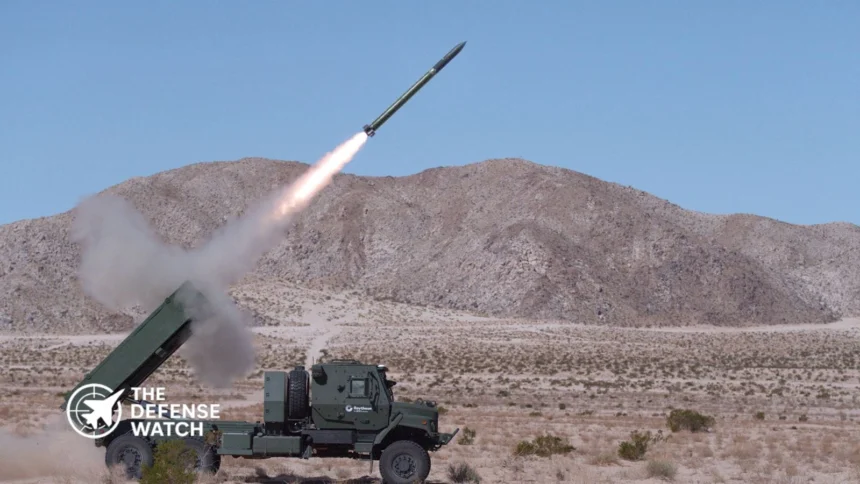
The Raytheon JR3 rocket is a surface-to-surface practice rocket, not a combat munition. JR3 is short for Joint Reduced Range Rocket, a program managed by the Army’s Strategic and Operational Rockets and Missiles (STORM) Project Management Office. Raytheon, an RTX business, markets its entry as DeepStrike JR3 and describes it as a reusable pod paired with an affordable rocket.
Its core mission is live-fire qualification. Launcher crews must fire real rockets to certify, and the JR3 lets them do so on shorter ranges and at lower cost than a combat round. The Army wants it to replace the Reduced Range Practice Rocket (RRPR), also written as the Low Cost Reduced Range Practice Rocket (LCRRPR).
Raytheon’s industrial team includes Combined Systems Inc., Corvid Technologies, L3Harris Technologies, Northrop Grumman and the government-owned Letterkenny Munitions Center. A note on naming: Raytheon also used the DeepStrike name for a separate long-range surface-to-surface missile, so the brand overlaps with, but does not describe, the training round’s role.
JR3 At a Glance
| Attribute | Detail |
|---|---|
| Type | Reduced-range live-fire training rocket with reusable 24-round pod |
| Manufacturer | Raytheon (RTX), with Combined Systems, Corvid, L3Harris, Northrop Grumman, Letterkenny Munitions Center |
| Country of Origin | United States |
| Entered Service | Not yet in service |
| Status | Prototype; third flight test announced Nov. 9, 2026; qualification pending |
| Primary Role | Crew training and qualification on M142 HIMARS and M270 launchers |
Where Did the Joint Reduced Range Rocket Come From?
The program grew out of an obsolescence problem. The legacy RRPR has been in service since the early 1990s, was produced by Lockheed Martin, and reaches roughly 15 kilometers. Army planning documents, as summarized by Army Recognition, say it relies on M28A2 rocket motors last built in the mid-1990s.
| Period | Milestone |
|---|---|
| Early 1990s | Legacy RRPR enters service for MLRS crews |
| Sources-sought notice | Army Contracting Command–Redstone, for the STORM office, seeks vendors for a prototype all-up JR3 round, with production-level maturity targeted by fiscal year (FY) 2028 |
| July 2024 | Lockheed Martin says it received an Army consortium agreement to pursue a practice rocket |
| August 2025 | Lockheed Martin’s first JR3 flight demonstration at White Sands Missile Range |
| August 2026 | Lockheed Martin’s second flight test at Yuma Proving Ground, Arizona |
| Nov. 9, 2026 | Raytheon announces its third successful DeepStrike JR3 flight test at Yuma |
Raytheon built its design through a rapid prototyping initiative. Its latest test fired multiple rounds in quick succession and examined pod reusability and maintainability, range, trajectory, accuracy and the visibility of the marking solution. The sources reviewed do not detail Raytheon’s first two flight tests, and they do not describe design failures or redesigns, so the technical hurdles overcome remain largely undisclosed. For the event-level account, see our earlier report on the third flight test.
How the DeepStrike JR3 Works and Key Specifications
A rocket artillery pod is a sealed container of launch tubes that slots into the launcher. The JR3 uses the same outer envelope as the Multiple Launch Rocket System Family of Munitions (MFOM) pod, so existing launchers and handling equipment need no modification. The Army requires each pod to match the volume, mechanical interfaces and center-of-gravity limits of current MLRS and Guided MLRS (GMLRS) pods.
The rocket itself is solid-propellant. As a general principle, not a Raytheon disclosure, a practice round gets its shorter reach from less propulsive energy and more drag, which shrinks the danger area on a range. The Army allows either free-flight (unguided) or trajectory-corrected fire. A marking payload shows where each round lands through flash, bang and smoke signatures, so crews see the result without a combat warhead.
The Army also wants the launcher’s software to treat the JR3 like current and future MFOM munitions, and to work with the Advanced Field Artillery Tactical Data System. Readers exploring how range limits change flight time can use our missile range and time-of-flight calculator.
| Parameter | Value | Basis |
|---|---|---|
| Pod capacity | 24 rockets | Raytheon design |
| Pod interface | MFOM pod envelope | Raytheon and Army requirement |
| Launchers | M142 HIMARS, M270 MLRS | Army program description |
| Impact range | 7.5–8 km minimum; no more than 15 km maximum at sea level | Army requirement, not a demonstrated figure |
| Accuracy | Within 25–30 m of the target point | Army requirement, not a demonstrated figure |
| Fire support safety distance | 2 km over friendly troops | Army requirement |
| Shelf life | At least 10 years | Army requirement |
| Reliability | At least 0.95 across launch, flight and warhead activation | Army requirement |
| Motor and payload details | Not disclosed | Raytheon has not published them |
Raytheon has not released numerical range or accuracy results from its tests, so the table’s performance rows describe what the Army demands, not what the rocket has shown.
Where Is the JR3 Used? The HIMARS Training Rocket Role
The JR3 is not fielded, so it has no operators yet. The intended customer is the U.S. Army, whose Active and National Guard units use practice rockets for annual qualification and pre-deployment training. The program documents also name global partners as potential users, though no foreign buyer has been identified.
| Category | Detail |
|---|---|
| Host launchers | M142 HIMARS (wheeled) and M270 MLRS (tracked); see our M270 MLRS profile |
| Intended operator | U.S. Army; global partners cited as a target market |
| Test location | Yuma Proving Ground, Arizona (Raytheon’s third test) |
| Competing design | Lockheed Martin JR3, also built around a 24-rocket pod |
| Legacy system | RRPR, six rockets per pod, still procured in the interim |
As a HIMARS training rocket, the JR3’s value is volume: a 24-round pod gives crews four times the rounds of the legacy six-rocket pod before a reload.
Why Was a New Reduced Range Practice Rocket Built?
Three pressures drove the requirement. The first is supply. The Army’s FY2026 research budget justification says remaining launch-pod containers and rocket motors cannot sustain legacy production beyond FY2030, and Army Recognition reports inventories running out by FY2032.
The second is cost. Combat rockets are expensive: on the Army’s FY2027 basis, a GMLRS rocket averages about $219,000, according to Army Recognition. Burning such rounds for routine drills would drain the stockpile. Our report on GMLRS production passing 100,000 rockets shows how heavily that stockpile is already drawn on.
The third is doctrine. Crews qualify through platoon, battery and battalion tables under Training Circular 3-09.8, in varied weather, ranges and hours. Reduced-range rounds let units use more of the constrained ranges they actually have, and the Army’s pod requirement of 6 to 48 rockets in multiples of three keeps loading drills realistic.
Why Does the JR3 Matter?
The JR3 matters because readiness is a throughput problem. Rocket artillery demand has risen, and the Army’s FY2027 budget lists GMLRS capacity at 14,004 rockets a year, with a market study examining 19,002. Every combat rocket saved from a drill is available for a mission.
Industrially, the program is a test of competition. Lockheed Martin builds both the legacy RRPR and GMLRS, so a second qualified source, if the Army pursues one, would reduce dependence on a single supplier. That is analytical inference, since the Army has not announced a selection. Raytheon’s team also leans on non-traditional suppliers and government facilities, which could widen the training-munition base.
Who benefits are launcher crews, unit commanders and allies who share the HIMARS family. The JR3 counters no adversary directly. Its strategic effect is indirect: it sustains crew proficiency, and proficiency sustains the credibility of long-range fires.
How the JR3 Compares to Its Rival and Predecessor
| Attribute | Raytheon DeepStrike JR3 | Lockheed Martin JR3 | Legacy RRPR |
|---|---|---|---|
| Status | Development, pre-qualification | Development, pre-qualification | In service since early 1990s |
| Pod capacity | 24 rockets | 24 rockets | Six rockets |
| Maximum range | Not disclosed (Army cap: 15 km) | Not disclosed (Army cap: 15 km) | About 15 km |
| Pod reuse | Reusable pod container | Reloadable, reusable tubes and pods | Not a stated feature |
| Test record | Third flight test, Nov. 2026 | Second flight test, Aug. 2026; another planned in 2026 | Mature |
The strengths of both JR3 candidates are capacity and sustainability: four times the pod load, reusable hardware and a modular interface between motor and warhead for future payloads. Lockheed has said its architecture could carry over to the Army’s Direct Support Fires Technology effort on low-cost rockets.
The trade-offs are unproven cost and maturity. Neither company has published a per-rocket price, and the legacy RRPR remains the only fielded option. Crews practicing fire correction can pair this with our artillery fire correction calculator.
Strategy-Gaming Parallel: The Practice Mode Economy
Strategy players will recognize the JR3’s logic from practice modes and ladder economics. In most real-time strategy games, the units that win matches are expensive, so veterans rehearse build orders, timings and positioning in custom games where nothing valuable is spent. The JR3 plays that role for rocket artillery. It is the custom-game ammunition that lets a crew rehearse the whole firing sequence on a short range while the Army’s GMLRS rockets stay in the stockpile, like a premium resource held back for a ranked match.
Reusable pods work like a low-upkeep unit that returns to the roster after every drill. The marking payload resembles a replay overlay, showing where a shot would have landed so the crew can correct its technique. The analogy has limits, because real crews train for safety, coordination and survivability, and no game captures the consequences of error. What it does capture is the economic principle that training capacity is itself a strategic resource.
Challenges and Limitations
- Unknown unit cost. Raytheon has not released a per-rocket price, production capacity or quantified savings from reuse, so its affordability claims are company objectives, not independently established results.
- Qualification still ahead. Successful prototype flights are not Army qualification, and no selection or production decision has been announced.
- Schedule discrepancies. Army Technology reports production starting in 2028, while Army Recognition, citing Army documentation, describes development through 2028 and production beginning by 2029, with system flight testing in the third and fourth quarters of 2028. Another account of an earlier Army request cited a 19 km maximum range, whereas the published requirement caps range at 15 km.
- Limited funding. The FY2026 request for JR3 research and development was about $28.9 million, a modest line that leaves little room for schedule slips.
- Maintenance risk. Reusable pods must prove they can survive repeated rapid firing and field handling.
No independent assessment of either company’s design has been published, so criticism so far is limited to these unanswered questions.
Future Outlook
Army documentation, as reported by Army Recognition, calls for component testing from late 2026 through the third quarter of 2028. Raytheon says it is preparing more flight tests before qualification, and Lockheed has another planned in 2026.
Key indicators to watch:
- an Army decision between competing designs, or a dual-source approach
- the first published unit cost
- qualification test results and reliability data
- FY2027 and FY2028 budget lines for JR3 and RRPR
- interest from foreign HIMARS operators
The modular motor-to-warhead interface leaves room for future payload variants, and the Army’s 6-to-48 rocket pod range suggests flexibility in how crews train.
Key Takeaways
Key Takeaways
What to know about Raytheon’s JR3 training rocket
A training rocket, not a weapon
The JR3 is a reduced-range practice round for HIMARS and M270 crews, built to preserve combat rockets.
Driven by obsolescence
The legacy RRPR’s motors and pods are running out, which pushed the Army to seek a replacement before FY2030.
Four times the pod load
Raytheon’s reusable pod holds 24 rockets versus six in the legacy pod, supporting higher training volume.
A competition, not a selection
Lockheed Martin is developing a rival JR3, and the Army has announced no winner or production award.
Performance figures are requirements
Range and accuracy numbers come from Army requirements, since Raytheon has not published test results or pricing.
FAQs
The Raytheon JR3 rocket, branded DeepStrike JR3, is a reduced-range training rocket and reusable 24-round pod developed for the U.S. Army’s Joint Reduced Range Rocket program. It is designed for M142 HIMARS and M270 MLRS crews to practice live firing without using costly combat rockets, and it has not yet been qualified.
No. The JR3 is a practice munition that carries a marking payload to show impact points rather than a combat warhead. Its job is to let launcher crews qualify on constrained ranges while operational rockets such as GMLRS stay available for missions. Raytheon uses the DeepStrike name for a separate missile.
It addresses supply and cost. The legacy practice rocket’s motors and pods are dwindling, and combat rockets are too expensive for routine drills. A reusable, higher-capacity practice system helps the Army keep crews trained and conserve combat stockpiles as rocket artillery demand grows.
It is not yet in service. Raytheon tested it at Yuma Proving Ground in Arizona, and it is intended for U.S. Army M142 HIMARS and M270 MLRS launchers. Program documents also mention global partners as potential users, but no foreign operator has been announced.
No per-rocket price has been published by Raytheon or the Army. For context, the Army’s FY2026 request funded JR3 research and development at about $28.9 million, and a combat GMLRS rocket averages roughly $219,000 on the Army’s FY2027 basis. Practice-round costs are expected to be far lower.
Timing is unsettled. Army Technology reports production starting in 2028, while Army Recognition, citing Army documents, describes development through 2028 and production by 2029. Raytheon must still complete more flight tests and pass Army qualification, and the Army has not announced a selection.