Ukrainian-founded defense technology company UForce has raised $700 million in a Series A funding round, reaching a reported valuation of $6 billion as it prepares to expand production of autonomous military systems for Ukraine and allied armed forces.
Announced on November 12, 2026, the financing was co-led by Valor Equity Partners and the UK’s National Wealth Fund, with participation from the U.S.-Ukraine Reconstruction Investment Fund. The investment is intended to support manufacturing, engineering, research and development, and the company’s expansion into international defense markets.
The scale of the funding reflects growing investor interest in companies developing relatively low-cost autonomous systems, particularly those drawing on operational experience from the war in Ukraine.
British investment gives UForce a larger manufacturing base
The UK’s National Wealth Fund confirmed that it is investing £113 million, equivalent to approximately $150 million, in UForce as part of the wider financing round.
The investment is the fund’s largest defense-sector investment to date. According to the fund, the capital will support expansion of UForce’s British manufacturing, engineering and production capabilities, including work on its MAGURA maritime drone family and NEMESIS systems.
The British government also expects the expansion to create hundreds of skilled jobs across engineering, software development, artificial intelligence and advanced manufacturing.
One notable element is the planned development of a domestic supply chain. The government says more than 70% of the content of each UK-built UForce boat will come from British suppliers, including components such as hulls, engines and electronics.
This gives the investment a broader industrial purpose beyond financing a Ukrainian-founded technology company. It is also intended to strengthen Britain’s ability to manufacture and support autonomous maritime platforms domestically.
From Ukrainian battlefield technology to an international defense business
UForce is headquartered in London and maintains major operational hubs in Kyiv and Washington, D.C. Its business model combines unmanned platforms with software designed to coordinate autonomous systems across different operating environments.
Its publicly identified product families include:
- MAGURA: Uncrewed surface vessels designed for maritime operations.
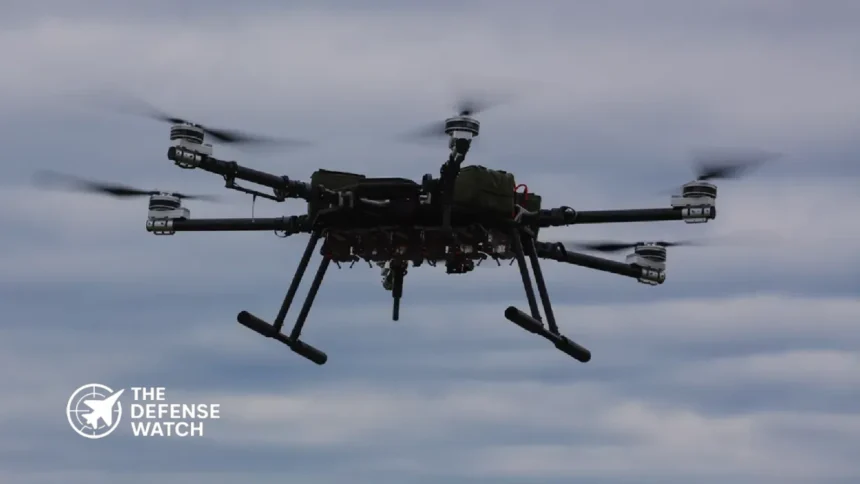
- NEMESIS: A family of aerial strike platforms.
- LIUT: Ground robotic systems.
- PREDATOR: Counter-uncrewed aerial system platforms, including automated turret technology.
- Command-and-control software: Systems intended to coordinate and manage uncrewed platforms.
These product descriptions are based on information published by the company and its financing announcement. Detailed technical specifications, production quantities and delivery schedules have not been fully disclosed.
The company’s development strategy draws heavily on Ukraine’s experience using uncrewed systems against Russian forces. Maritime drones, in particular, have become an important part of Ukraine’s approach to challenging Russian naval operations in the Black Sea.
UForce’s MAGURA family is associated with this operational environment. However, company statements about combat results should be distinguished from independently verified assessments of individual engagements.
The company’s expansion into the UK also suggests an effort to adapt systems developed for Ukrainian battlefield requirements to the needs of other military customers, including NATO countries.
Why autonomous systems are attracting defense investment
The financial backing comes as armed forces increasingly examine how uncrewed platforms can complement conventional aircraft, ships and ground vehicles.
Ukraine’s experience has demonstrated the operational value of relatively inexpensive drones for reconnaissance, surveillance, maritime operations and strike missions. Their ability to be produced and modified more rapidly than many traditional military platforms has also attracted attention from defense planners.
However, the operational value of autonomous systems depends on more than the platforms themselves. Reliable communications, navigation, sensor integration, software security and resistance to electronic warfare remain important requirements.
Command-and-control software is therefore an important part of UForce’s business model. Coordinating different unmanned systems could help military operators manage multiple platforms, but the practical benefits depend on interoperability, network resilience and the level of human supervision required.
The expansion of production will also need to address the challenges of scaling battlefield-tested equipment into repeatable manufacturing programs. Components, skilled labor, testing capacity and supply-chain reliability can all affect delivery schedules.
For allied militaries, the ability to manufacture and maintain these systems closer to their own territory may be as important as the initial purchase price.
UForce’s UK expansion and maritime operations
UForce has already started adapting its maritime technology for operations outside the Black Sea.
In August 2026, the company announced the launch of its first UK-developed MV7 unmanned surface vessel. The platform belongs to the MAGURA family and is being adapted for Atlantic operating conditions, including different temperatures and higher sea states, according to the manufacturer.
The British government has also disclosed a practical demonstration involving the MV7. During an event aboard the aircraft carrier HMS Prince of Wales in Norway, Defence Secretary Wes Streeting remotely piloted a vessel located more than 1,500 miles away in the Atlantic near Portugal.
This demonstration provides evidence of remote operation over a substantial distance. It does not, by itself, establish the vessel’s autonomous navigation performance, operational range or ability to operate reliably under contested communications conditions.
For the UK, the maritime application has particular relevance to the North Atlantic and northern European waters, where naval surveillance, infrastructure protection and monitoring of maritime activity remain important defense priorities.
The British government has identified the Joint Expeditionary Force (JEF) countries as potential beneficiaries of the expanded industrial capability, although specific procurement quantities and delivery schedules have not been announced.
What the $700 million investment means for the defense industry
UForce’s financing is notable for the combination of private venture capital and government-backed investment.
Valor Equity Partners and the UK’s National Wealth Fund co-led the round, while the U.S.-Ukraine Reconstruction Investment Fund also participated. Other investors named in the company’s financing announcement include Menlo Ventures, Xantium and Hiro Capital, alongside existing investors Shield Capital, Ballistic Ventures, Lakestar and Squadra.
The $6 billion valuation places UForce among the more highly valued European technology startups, although its valuation should not be confused with revenue, confirmed orders or the value of equipment already delivered.
For the defense sector, the investment points to increasing interest in businesses that combine hardware manufacturing with software, autonomy and integrated control systems.
It also raises an important industrial question: whether companies developed around wartime production requirements can expand internationally while maintaining the rapid development cycles that made their equipment attractive in the first place.
UForce will need to demonstrate that its expanded manufacturing network can meet the requirements of different military customers, including NATO interoperability, technical certification, maintenance and long-term equipment support.
The funding provides substantial financial backing for that effort, but public information does not yet establish how quickly production will increase or how much equipment will be delivered to individual countries.
For now, the clearest outcome is Britain’s decision to invest directly in a Ukrainian-founded defense technology business while building domestic manufacturing capacity around its autonomous systems.