

UFORCE Predator RWS Tested On French Frigate
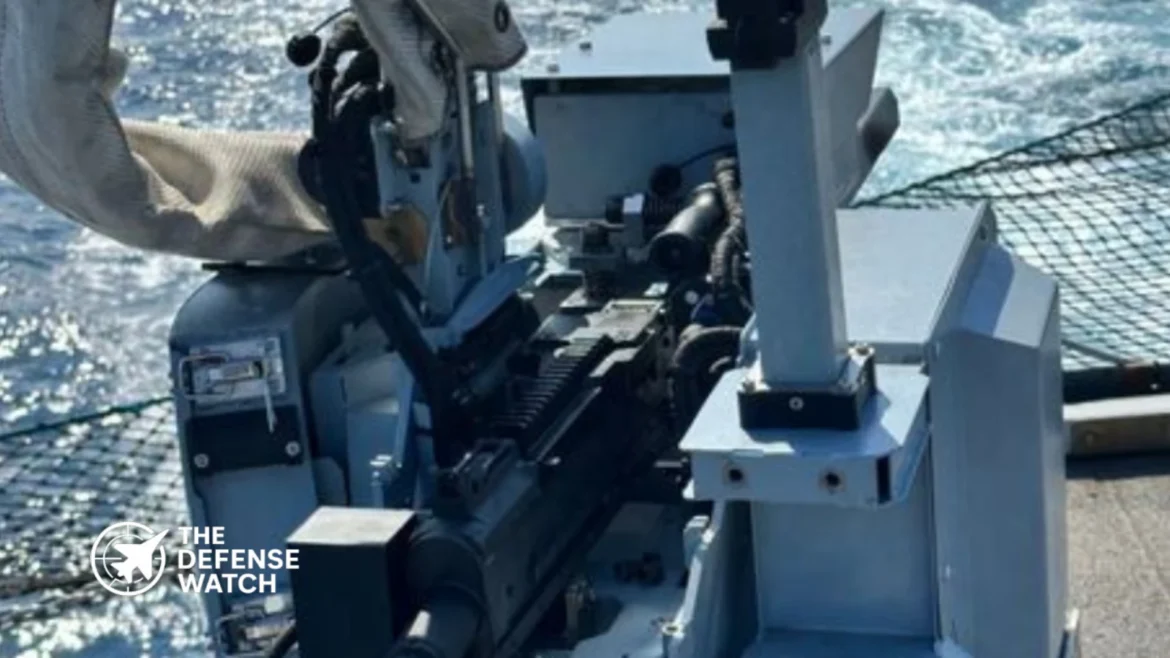
UFORCE Predator RWS testing aboard a French Navy frigate marks a significant step in the integration of relatively compact remote weapon systems with established surface combatants. UFORCE announced on August 11 that the Predator had been successfully tested aboard a frigate belonging to a NATO member, while Janes assessed from imagery that the ship was a French Navy La Fayette-class frigate.
The imagery reportedly shows a French naval pennant, the ship’s mast configuration, a Thales Sea Tiger 2 air and surface search radar, and a Crotale surface-to-air missile launcher. Janes assessed that these features identify the vessel as a La Fayette-class ship, with the RWS positioned on the starboard quarter of the flight deck.
UFORCE has not publicly identified the frigate or confirmed the exact hull. Janes also reported that it was unclear whether additional Predator systems were installed during the trial, making the event best understood as an integration and evaluation activity rather than evidence of an operational fleet-wide fit.
Takeaways
UFORCE is moving combat-proven unmanned technology toward wider naval integration.
1. Predator Tested On A French Frigate
UFORCE says its Predator remote weapon station was successfully tested aboard a NATO member state’s frigate. Janes assesses the vessel as a French Navy La Fayette-class frigate based on imagery from the trial.
2. Counter-UAS And USV Engagement Demonstrated
According to UFORCE, Predator detected, tracked and engaged both an aerial drone and an unmanned surface vessel during the trials.
3. MAGURA V7 Is A Larger Multi-Mission USV
UFORCE lists MAGURA V7 at about 7.1 to 7.3 meters long, with a payload capacity of up to 650 kg, a maximum speed of about 39 knots and a range of about 800 nautical miles.
4. The Same Weapon Architecture Can Support Unmanned Platforms
UFORCE describes Predator as a gyro-stabilized remote combat module that can be configured for weapons from 7.62 mm to .50 caliber and integrated with naval and unmanned platforms.
5. Naval Warfare Is Moving Toward Distributed Sensors And Weapons
The development points toward a maritime model in which crewed warships, armed USVs and counter-UAS systems can operate together, extending surveillance and defensive coverage without putting additional crews directly on every platform.
Predator Adds A Close-In Remote Weapon Layer
The operational value of a remote weapon station on a frigate is closely tied to the changing threat environment around surface combatants.
Modern warships increasingly have to contend with small unmanned aerial systems, unmanned surface vessels and other low-cost threats that can consume disproportionately expensive defensive missiles if they are engaged only through traditional air-defense layers.
UFORCE describes Predator as a gyro-stabilized remote combat module designed for precision fire against ground and aerial targets. Its published architecture supports 7.62 mm and M240-class machine guns, with modularity up to .50 caliber, while the company lists automatic target acquisition and tracking, thermal imaging and a 360-degree traverse.
Those capabilities are relevant to shipboard use because stabilization and automated tracking can reduce the workload associated with engaging small, fast or maneuvering targets. However, the publicly available information does not establish the precise weapon, fire-control configuration or rules of engagement used during the French frigate trial.
The trial therefore matters less as a new weapon category than as an example of how existing naval platforms can be adapted to address a wider range of asymmetric threats.
La Fayette-Class Provides A Relevant Test Platform
The French Navy’s La Fayette-class frigates are relatively compact surface combatants designed around a combination of surveillance, self-defense and maritime security missions.
France’s newer Defence and Intervention Frigate program, by contrast, represents a more modern approach to multirole surface warfare. The French Ministry of the Armed Forces describes the FDI as a 4,500-ton ship equipped with the Sea Fire AESA radar, Aster 15 and Aster 30 surface-to-air missiles, Exocet MM40 Block 3C anti-ship missiles, MU90 torpedoes and 20 mm and 76 mm guns.
That distinction is important. The Predator test does not mean the system is replacing established shipboard air-defense or gun systems. Instead, it illustrates how a remotely operated weapon can potentially complement a larger defensive architecture by providing an additional engagement option against lower-end threats.
For NATO navies, the concept has particular relevance as warships operate in environments where drones can approach from multiple directions and at comparatively low cost.
MAGURA V7 Expands UFORCE’s Maritime Portfolio
The second development highlighted by Janes is the appearance of a newer MAGURA unmanned surface vessel during operations in August 2026. UFORCE’s current product information identifies MAGURA V7 as a modular USV intended for high-tempo operations in contested maritime environments.
UFORCE lists the MAGURA V7 at approximately 7.1 to 7.3 meters in length, with a payload capacity of up to 650 kg, a maximum speed of about 39 knots and a range of approximately 800 nautical miles. The company identifies diesel propulsion in the 250 to 350 hp class and lists waterjet or sterndrive propulsion depending on configuration.
The platform is designed around modular payloads rather than a single mission. UFORCE identifies configurations covering one-way attack, remote weapon stations, short-range air defense, unmanned systems mothership missions, logistics and mine warfare.
That modular approach is central to the military significance of the platform. A USV that can accept different payloads can be adapted to surveillance, strike, counter-UAS or support missions without requiring an entirely new hull for every role.
MAGURA V7 Published Specifications
| Parameter | UFORCE Published Data |
|---|---|
| Platform | MAGURA V7 USV |
| Hull length | Approximately 7.1 to 7.3 m |
| Hull material | HDPE or fiberglass |
| Maximum speed | Approximately 39 knots |
| Range | Approximately 800 nautical miles |
| Payload | Up to 650 kg |
| Engine | Diesel, 250 to 350 hp |
| Propulsion | Waterjet or sterndrive |
| Operational environment | Black Sea, Sea State 2 to 3 according to UFORCE |
Source: UFORCE.
From One-Way Attack Drone To Multi-Mission Naval Platform
The evolution of the MAGURA family reflects a wider change in unmanned maritime warfare.
Early combat USVs were often optimized for a single mission, particularly one-way attacks against larger surface vessels. Larger platforms such as MAGURA V7 provide substantially more payload capacity, creating space for reusable sensors, communications equipment, remote weapon stations and air-defense payloads.
UFORCE states that the broader MAGURA family has been used in hundreds of missions and that its platforms have been configured for area denial, reconnaissance, resupply, anti-surface warfare and counter-air missions. Those are company claims and should be distinguished from independently verified operational results.
The underlying design direction is nevertheless clear. USVs are increasingly being treated as configurable combat nodes rather than expendable boats.
That distinction could influence naval force design because a single crewed combatant may be able to coordinate multiple unmanned platforms, distributing sensors and weapons farther from the parent ship.
The Counter-Drone Problem At Sea
Countering drones at sea presents a different problem from defending a fixed installation.
A warship is mobile, exposed and surrounded by a constantly changing radar and electromagnetic environment. Small drones can exploit low altitude, clutter and complex approach routes, while surface drones can use the sea surface itself to reduce detection opportunities.
This creates demand for layered defenses.
A typical layered architecture can combine electronic warfare, radar detection, optical tracking, missiles and conventional naval guns. A remote weapon station provides another layer, particularly when the target does not justify the use of a high-value missile.
The French trial is therefore relevant beyond the Predator system itself. It demonstrates an approach in which a warship can test additional close-range defensive capabilities without redesigning the entire combat system.
What The Trial Means For U.S. And NATO Navies
For the United States and other NATO members, the development fits into a broader move toward distributed maritime operations and manned-unmanned teaming.
The U.S. Navy and allied fleets are examining how unmanned surface vessels can extend sensing, communications and weapons beyond the immediate reach of crewed ships. The challenge is not simply putting weapons on an autonomous boat. It is integrating those platforms into command-and-control networks while maintaining reliable communications, navigation and identification in contested electromagnetic environments.
UFORCE’s move into the U.S. market is also notable. In July 2026, the company announced a partnership with RECONCRAFT to build autonomous surface vessels in the United States, linking its MAGURA technology with an American production partner.
That development gives the MAGURA family a potential pathway into the U.S. defense industrial base, although the partnership itself does not constitute a U.S. military procurement contract.
Integration Remains The Key Challenge
The technical challenge for systems such as Predator is not limited to mounting a weapon on a ship.
A naval RWS must operate within the ship’s electrical, combat-management, sensor and communications architecture. Target data may originate from radar, electro-optical sensors or external network participants, while engagement decisions must remain subject to the ship’s command-and-control procedures.
For an autonomous or remotely operated USV, the problem becomes even more complex.
The platform must maintain navigation, communications and target discrimination while operating under jamming or degraded connectivity. It also has to distinguish between civilian vessels, friendly forces and legitimate targets in crowded maritime environments.
These requirements make interoperability and autonomy at least as important as the weapon itself.
A Broader Shift In Maritime Combat Power
The combination of the Predator frigate trial and the emergence of the MAGURA V7 points toward a broader transformation in maritime warfare.
Crewed frigates remain the principal high-end combat platforms, but smaller unmanned vessels can provide additional sensors, weapons and forward presence at lower personnel risk. A remotely operated weapon station can similarly add a defensive layer to an existing ship without requiring a major change to the vessel’s fundamental role.
France’s own naval modernization program illustrates the parallel development of increasingly networked and adaptable surface combatants. The French government describes the FDI as a digitally enabled, multirole ship capable of anti-air, anti-surface, anti-submarine, cyber-defense and asymmetric-threat missions.
The UFORCE trials fit within that larger trend. The important development is not simply a new turret or a new USV, but the growing effort to connect crewed ships, remote weapons, autonomous vessels and distributed sensors into a common maritime combat architecture.
Conclusion
UFORCE’s Predator RWS trial aboard a French Navy La Fayette-class frigate provides a concrete example of how naval forces are testing additional defenses against small aerial and surface threats. Janes assessed the ship’s identity from available imagery, while UFORCE confirmed that the system had been tested aboard a NATO member’s frigate and said it successfully detected, tracked and engaged an aerial drone and a USV.
At the same time, MAGURA V7 shows how the same technology ecosystem is expanding toward larger, modular unmanned surface vessels. With a published payload capacity of up to 650 kg, approximately 800 nautical miles of range and a top speed near 39 knots, the platform is positioned by UFORCE for missions ranging from strike and reconnaissance to remote weapons and counter-air operations.
For NATO navies, the strategic question is increasingly how these unmanned systems can be integrated with existing ships rather than whether unmanned vessels will have a role. The French frigate trial offers an early example of that integration process in practice.