
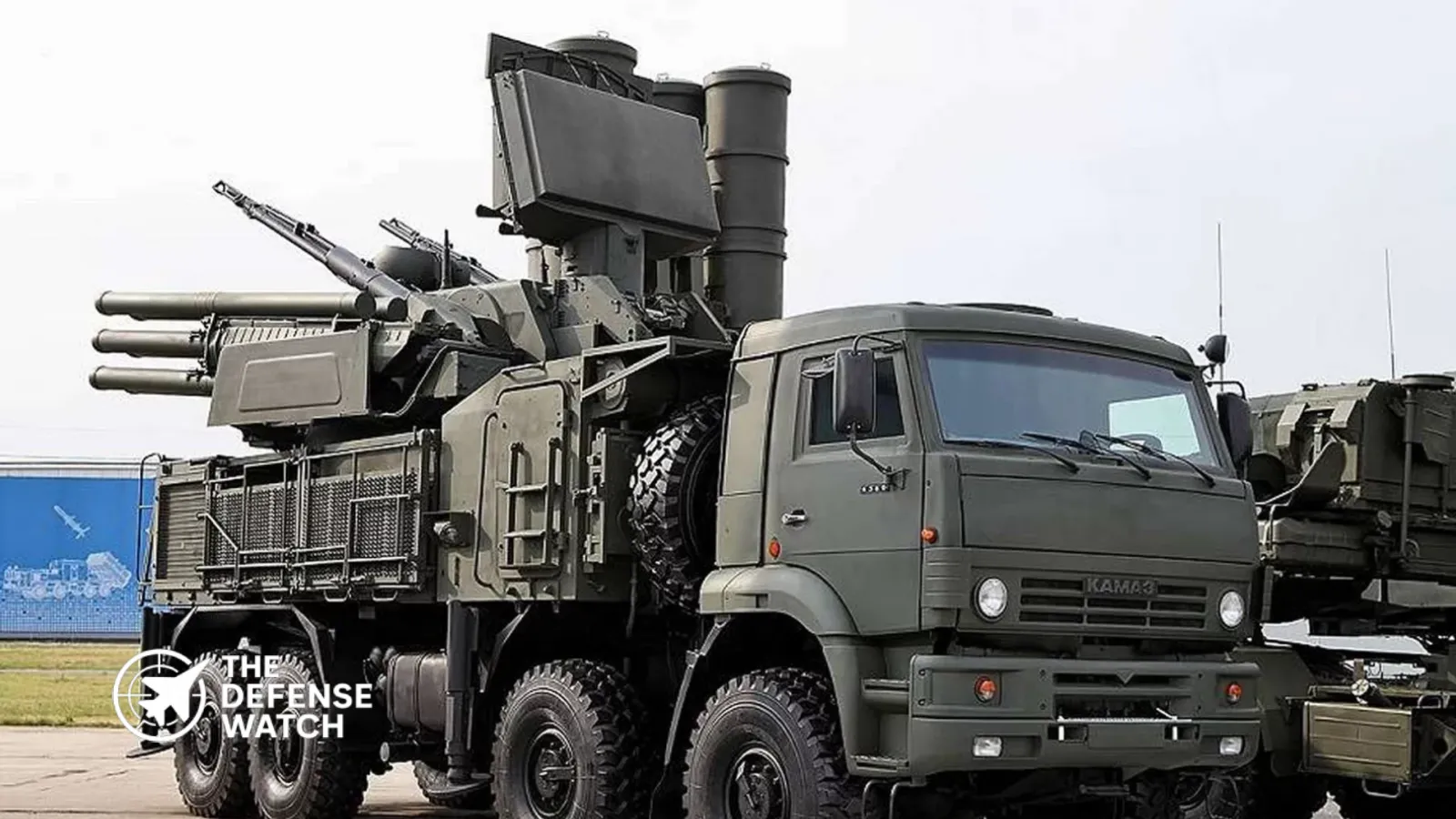
- ► Russia has deployed a 48-missile Pantsir loadout to improve short range air defense against drone swarms.
- ► The configuration replaces or supplements traditional gun and missile arrangements with higher missile density.
- ► Designed to counter low cost UAV saturation attacks observed in recent conflicts.
- ► The Pantsir system integrates radar, electro optical tracking, and surface to air missiles on a mobile chassis.
- ► The adaptation highlights the growing centrality of counter UAV defenses in Russian military modernization.
Russia Deploys 48-Missile Pantsir Loadout To Counter Drone Swarm Battlefield Saturation
The Russia 48-missile Pantsir loadout marks a significant adjustment in Moscow’s short range air defense posture, aimed directly at countering drone swarm saturation on today’s battlefield.
Russian forces have introduced a modified configuration of the Pantsir-S1 featuring up to 48 ready-to-fire missiles. The new loadout is designed to increase engagement capacity against massed unmanned aerial vehicles, a threat that has reshaped modern air defense doctrine.
The move reflects lessons drawn from ongoing combat operations, where low cost drones have been used to overwhelm traditional air defense systems through sheer volume.
A Shift In Short Range Air Defense Doctrine
The Russia 48-missile Pantsir loadout represents more than a technical upgrade. It signals a doctrinal response to the rise of inexpensive, networked drones used in coordinated attacks.
Traditional short range air defense systems such as the Pantsir-S1 were built to counter aircraft, helicopters, cruise missiles, and limited UAV threats. However, recent conflicts have demonstrated that small drones, often deployed in waves, can saturate defensive systems by exhausting missile inventories.
By expanding the ready missile count to 48, Russian forces appear to be prioritizing engagement volume over mixed weapon flexibility. Earlier Pantsir variants typically carried 12 surface to air missiles supported by dual 30 mm autocannons. The revised configuration increases missile density, potentially trading gun capability for sustained interception capacity.
This approach reflects battlefield realities. Drone swarms, including first person view attack drones and loitering munitions, are frequently used to target artillery, armored vehicles, logistics hubs, and air defense assets themselves.
Technical Characteristics Of The Pantsir Platform
The Pantsir-S1, developed by KBP Instrument Design Bureau and produced by Russia’s defense industry, combines target acquisition radar, tracking radar, electro optical sensors, and vertically launched surface to air missiles mounted on a wheeled or tracked chassis.
The system is designed to protect strategic sites and maneuvering formations from low altitude threats. Depending on the missile variant, engagement ranges typically extend up to 20 kilometers, with effective interception against small UAVs at shorter distances.
The expanded 48-missile configuration suggests either the integration of smaller interceptors or a modular canister approach that increases the number of ready rounds. While detailed technical specifications have not been fully disclosed, the reported design emphasizes counter UAV efficiency rather than long range air defense.
Battlefield Lessons Driving Modernization
The Russia 48-missile Pantsir loadout must be viewed within the broader evolution of air defense seen across multiple theaters.
Drone swarm tactics aim to create target saturation. Even advanced systems can be overwhelmed if forced to engage large numbers of low cost aerial threats simultaneously. Each interceptor missile often costs significantly more than the attacking drone, creating economic asymmetry.
By increasing onboard missile capacity, Russia appears to be addressing two operational challenges:
First, reducing reload frequency under fire.
Second, sustaining defensive coverage during prolonged swarm attacks.
This shift mirrors global trends. Western militaries are also investing in layered defenses that include electronic warfare, directed energy weapons, and rapid fire interceptors to manage drone saturation. The emphasis is on resilience and depth rather than single shot capability.
Strategic Implications
The deployment of the Russia 48-missile Pantsir loadout underscores how drone warfare is reshaping force protection requirements.
Short range air defense systems are no longer niche enablers. They are central to survivability on the modern battlefield. Units lacking robust counter UAV capability risk rapid attrition from persistent aerial surveillance and precision strikes.
For Russia, reinforcing Pantsir batteries with higher missile density could improve protection of artillery formations, logistics corridors, and high value infrastructure. It may also enhance layered defenses around strategic facilities.
However, missile based interception alone may not fully solve the drone swarm problem. Integrated approaches combining kinetic interceptors, electronic warfare jamming, and potentially laser systems are increasingly seen as necessary to manage cost and scale.
The Russia 48-missile Pantsir loadout therefore represents a tactical adaptation within a broader strategic shift toward counter saturation warfare.
Get real time update about this post category directly on your device, subscribe now.
