
Pakistan Introduces Advanced Hypersonic Strike Capability
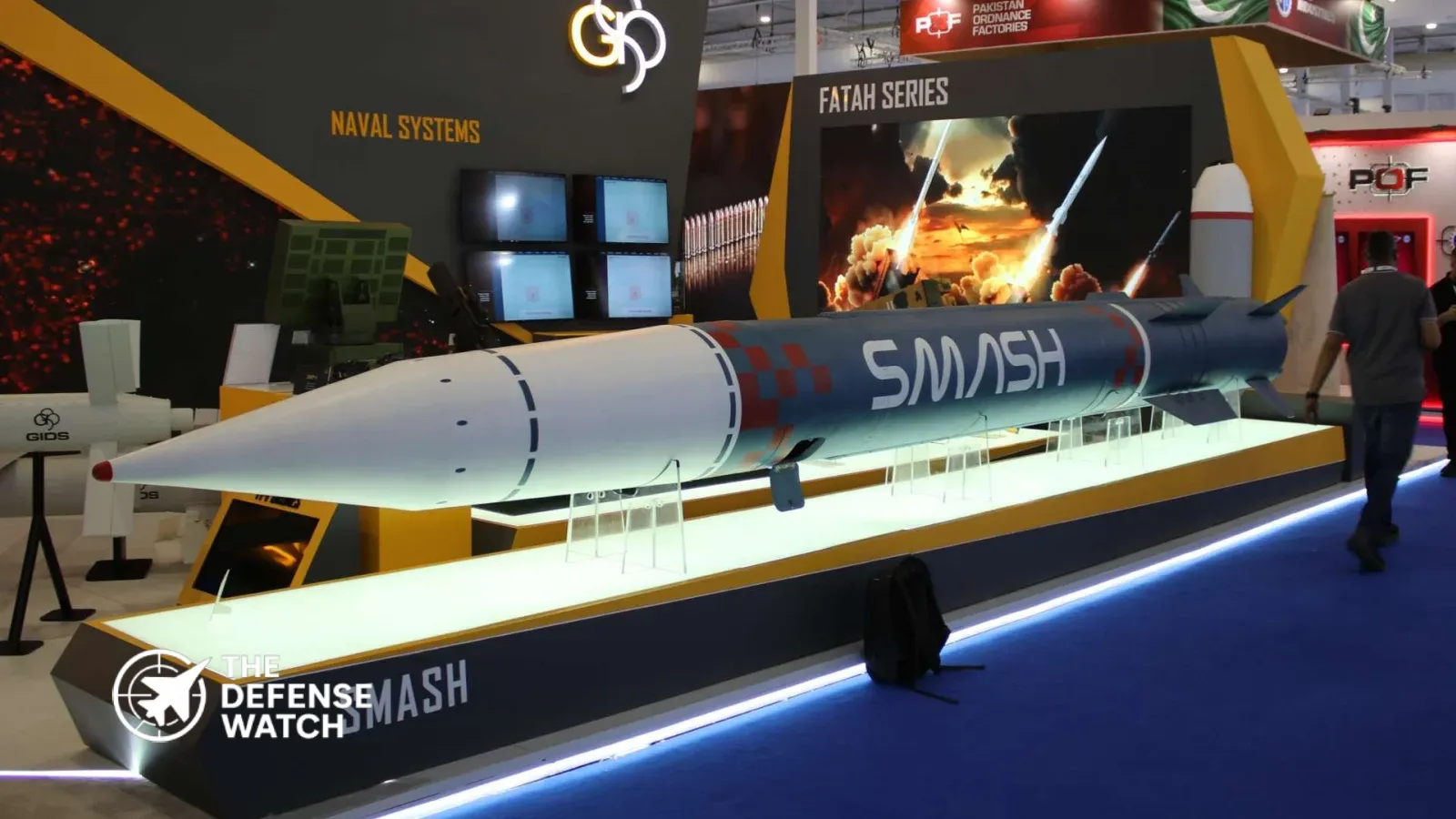
Pakistan’s Global Industrial & Defence Solutions (GIDS) has unveiled the SMASH hypersonic anti-ship ballistic missile at the World Defense Show 2026 in Riyadh, Saudi Arabia, marking a significant advancement in the nation’s precision strike capabilities. The Pakistan SMASH hypersonic missile system represents a dual-role weapon platform designed for both maritime strike and land attack missions, addressing growing regional demand for long-range precision weapons capable of penetrating modern defensive systems.
The introduction of the hypersonic anti-ship ballistic missile Pakistan at one of the Middle East’s premier defense exhibitions positions GIDS as a serious contender in the global market for advanced strike systems. According to company specifications presented at World Defense Show 2026 Pakistan, the SMASH system combines high-speed terminal performance with precision guidance architecture tailored to defeat layered air and missile defenses.
The SMASH missile system employs a modular design philosophy that allows operators to configure the weapon for sea-denial operations or land-attack missions while maintaining common propulsion and core systems. This approach reflects contemporary military procurement priorities that emphasize operational flexibility without multiplying logistical requirements.
Technical Specifications and Performance Parameters
The GIDS maritime strike missile variant features a published range of 290 kilometers and carries a unitary blast and blast-fragmentation warhead weighing 384 kilograms. The weapon achieves terminal velocities exceeding Mach 2 and maintains a circular error probable (CEP) of 10 meters or less, according to manufacturer data presented at the exhibition.
Guidance for the anti-ship configuration relies on HDGNS-assisted inertial navigation integrated with an active radar seeker. This dual-mode approach enables mid-course flight stabilization against electronic warfare while providing terminal discrimination capability in complex maritime environments. The active radar seeker allows target acquisition against maneuvering vessels and reduces susceptibility to coastal clutter that can degrade passive guidance systems.
Propulsion is provided by a single-stage, dual-thrust solid rocket motor that delivers the high acceleration profiles necessary for hypersonic flight regimes. The solid-fuel design eliminates cryogenic handling requirements and supports rapid deployment from dispersed launch positions, key attributes for mobile coastal defense batteries operating under threat of preemptive strikes.
The land-attack variant maintains the 290-kilometer range envelope while increasing payload capacity to 444 kilograms. This configuration substitutes the active radar seeker with pure HDGNS-assisted inertial guidance, optimizing the system for engagement of fixed or semi-hardened infrastructure targets. The stated CEP for land operations is 15 meters or less, maintaining precision adequate for high-value point targets while the increased warhead weight enhances effects against hardened structures.
Strategic Context and Operational Doctrine
The Pakistan dual-role hypersonic weapon system arrives amid intensifying regional focus on long-range precision strike capabilities. Naval forces throughout the Indo-Pacific and Middle East regions face expanding anti-access/area-denial (A2/AD) challenges that require survivable weapons capable of holding surface action groups at risk from standoff distances.
The SMASH system’s steep terminal attack profile complicates intercept solutions for ship-based and land-based air defense systems. High-angle descent trajectories reduce engagement timelines for terminal-phase interceptors while exploiting radar horizon limitations. Combined with terminal velocities exceeding Mach 2, these characteristics potentially stress defensive architectures optimized against subsonic cruise missiles or aircraft-delivered ordnance.
For maritime strike missions, the 290-kilometer range enables launch platforms to remain outside the threat rings of most surface combatant air defense systems while maintaining target coverage across strategically significant sea lanes. The integration of active radar terminal guidance allows autonomous target selection in multi-ship environments, reducing dependence on external targeting networks that may be degraded during high-intensity conflict.
Land-attack applications appear optimized for theater-level strike missions against logistics hubs, command facilities, and critical infrastructure nodes. The increased payload capacity and pure inertial guidance suggest targeting methodologies focused on pre-surveyed coordinates rather than moving or relocatable assets. This mission profile aligns with operational concepts emphasizing destruction of adversary sustainment infrastructure to degrade force projection capabilities.
Defense Industry Analysis and Market Positioning
The unveiling at World Defense Show 2026 represents Pakistan’s broader strategy to position indigenous defense manufacturers as viable alternatives to established Western and Eastern suppliers. GIDS has systematically expanded its portfolio across guided munitions, electronic warfare systems, and precision strike platforms, with SMASH representing the high end of this capability spectrum.
Market analysis suggests strong regional demand for weapons that combine affordability with performance sufficient to challenge adversary defensive investments. The dual-role architecture potentially appeals to procurement authorities seeking to maximize capability returns on limited defense budgets, a consideration particularly relevant for medium-tier military powers throughout the Middle East and South Asia.
Technical comparisons with analogous systems suggest SMASH occupies a performance envelope between traditional supersonic anti-ship missiles and true hypersonic glide vehicles. The Mach 2+ terminal velocity, while impressive, falls short of the Mach 5+ sustained speeds characteristic of hypersonic cruise missiles currently under development by major powers. However, the combination of ballistic trajectory, steep terminal approach, and active guidance may provide adequate penetration capability against contemporary naval air defense systems not optimized for high-angle threats.
The emphasis on solid-propulsion technology offers logistical advantages over liquid-fueled alternatives that require specialized handling infrastructure. Solid motors support extended storage without degradation, enable rapid reaction timelines, and simplify field maintenance requirements—attributes critical for mobile launch platforms operating in austere environments.
Regional Security Implications
The introduction of the Pakistan SMASH hypersonic missile system carries implications for regional deterrence calculations and force posture planning. Naval strategists monitoring Indian Ocean and Arabian Sea developments must now account for land-based anti-ship systems capable of holding surface combatants at risk across extended engagement zones.
For coalition naval operations, the proliferation of long-range precision strike systems complicates freedom-of-navigation missions and necessitates enhanced defensive measures aboard surface vessels operating in littoral waters. The active radar seeker capability specifically challenges traditional naval tactics that rely on emission control and radar cross-section reduction to avoid detection and targeting.
Land-attack capabilities introduce additional complexities for theater air and missile defense architectures. The weapon’s ballistic trajectory and Mach 2+ terminal velocity require layered defensive solutions integrating early-warning radars, fire control systems, and high-performance interceptors. Countries throughout the region may face pressure to invest in upgraded air defense networks capable of engaging high-speed ballistic threats, driving additional defense spending cycles.
Comparative Assessment and Technology Benchmarks
Industry assessments place SMASH within a growing category of medium-range precision strike systems that bridge traditional cruise missile capabilities and emerging hypersonic technologies. The weapon shares conceptual similarities with anti-ship ballistic missiles fielded by other regional powers, though specific performance parameters vary based on propulsion choices, guidance architectures, and warhead optimization.
The stated 10-meter CEP for maritime missions exceeds accuracy requirements for large naval targets but suggests advanced terminal guidance algorithms capable of maintaining lock through ship defensive maneuvers. For comparison, contemporary anti-ship cruise missiles typically achieve CEP values between 5 and 15 meters, placing SMASH within competitive benchmarks for its class.
Terminal velocity specifications indicate performance suitable for complicating point-defense engagement timelines without achieving the extreme speeds associated with scramjet-powered or boost-glide hypersonic weapons. This positioning may reflect pragmatic engineering choices balancing technical risk, development costs, and operational requirements against available industrial capabilities.
The integration of HDGNS (High Differential Global Navigation System) technology suggests incorporation of GPS/GLONASS receivers with inertial navigation for mid-course guidance updates. This hybrid approach provides resilience against navigation satellite jamming while maintaining precision adequate for strategic strike missions. The specific implementation details remain proprietary, though similar systems typically employ Kalman filtering techniques to blend satellite positioning data with inertial measurements.
Export Potential and International Interest
Defense industry observers note that Pakistan’s decision to showcase SMASH at the World Defense Show 2026 signals export ambitions beyond domestic procurement. The Middle East market represents a significant opportunity for weapons systems that combine advanced capabilities with favorable pricing relative to Western alternatives.
Potential customer nations include countries seeking to enhance coastal defense postures against naval threats or to acquire precision strike options for regional contingencies. The dual-role architecture potentially simplifies procurement decisions by addressing both maritime denial and land-attack requirements through a common system, reducing total acquisition costs and training burdens.
However, international sales face regulatory obstacles including missile technology control regime restrictions and geopolitical sensitivities surrounding missile proliferation. Export customers must navigate these frameworks while evaluating whether SMASH’s capabilities align with their specific operational requirements and defense strategies.
Technical support, training, and technology transfer arrangements will likely influence purchasing decisions. GIDS must demonstrate industrial capacity to support multi-year production runs and provide lifecycle sustainment services comparable to established defense exporters. These factors often prove as decisive as raw performance specifications when procurement authorities evaluate competing systems.
Future Development Trajectories
The baseline SMASH configuration provides a foundation for potential evolutionary upgrades as missile technologies mature. Possible enhancement paths include improved propulsion systems for extended range, enhanced guidance packages incorporating infrared or electro-optical sensors, and warhead modifications for specialized target sets.
Industry trends suggest future iterations may explore terminal maneuverability features to further complicate defensive engagement solutions. Thrust-vectoring technologies or aerodynamic control surfaces could enable evasive maneuvers during final approach, though such capabilities would require sophisticated flight control software and potentially increase system complexity.
Integration with networked targeting architectures represents another development vector. Connectivity to intelligence, surveillance, and reconnaissance (ISR) platforms could enable dynamic retargeting during flight, expanding operational flexibility against mobile or relocatable targets. Such capabilities would require secure datalink technologies resistant to jamming and interception.
For land-attack applications, warhead variant development could address bunker penetration or area effects against soft targets. Fragmenting submunitions or enhanced blast designs would diversify the target set addressable by SMASH platforms, increasing overall system utility across mission profiles.
Get real time update about this post category directly on your device, subscribe now.

1 comment
Our Mission Cell Dren Anti-Cellulite Draining Wraps is a brand new
remedy that improves the harmony of the physique,
giving the pores and skin a redefined look and counteracting the visibility of cellulite appearance, excess fluid (water retention).