
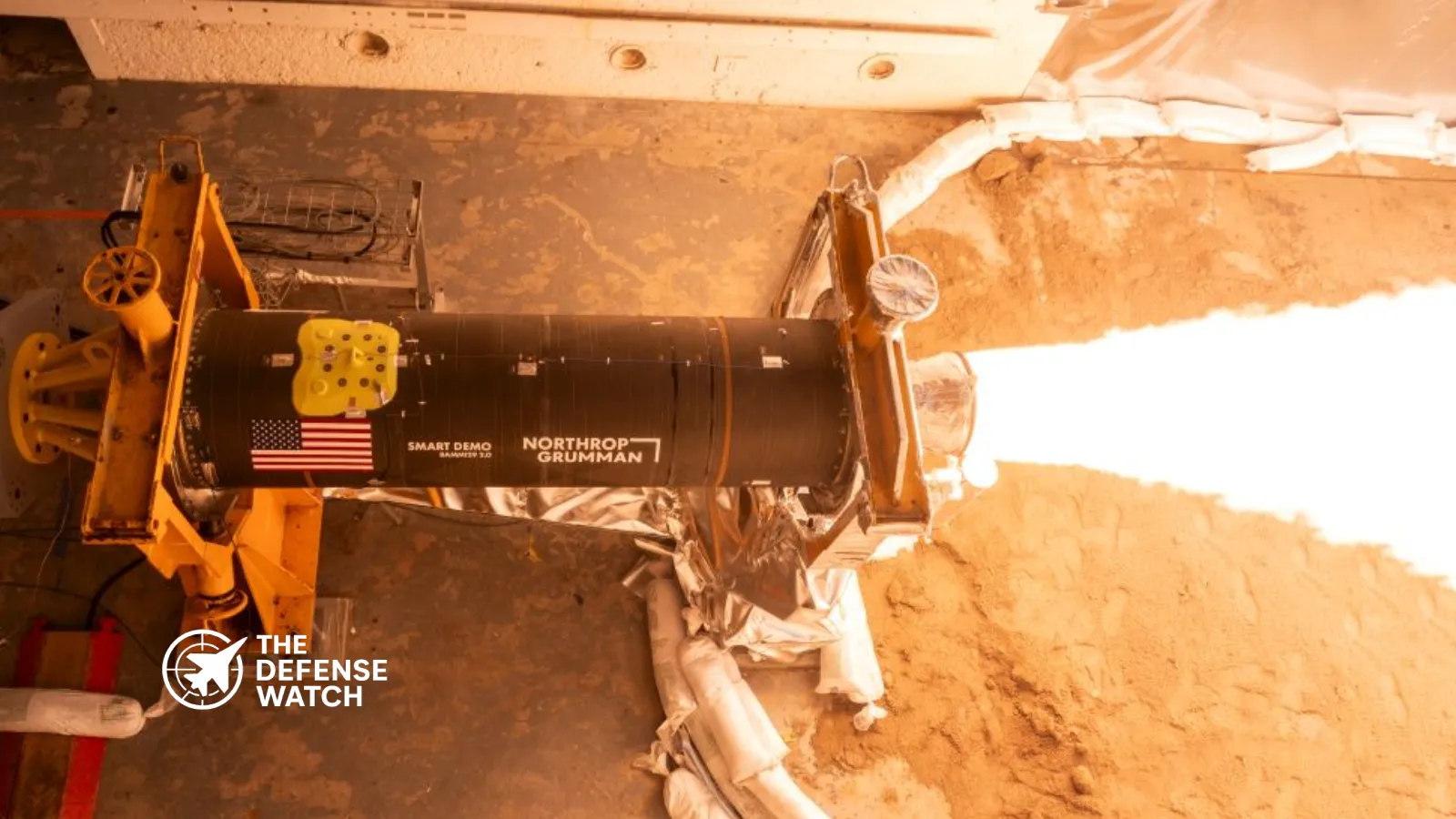
Northrop Grumman Validates Advanced Manufacturing Approach with BAMM!29 2.0 Static Fire
PROMONTORY, Utah — Northrop Grumman Corporation successfully conducted a static fire test of its second advanced solid rocket motor in two months, demonstrating the defense contractor’s accelerated development approach under the Solid Motor Annual Rocket Technology Demonstrator program.
The company tested the 29-inch diameter BAMM!29 2.0 (Bombardment Attack Missile Motor) on January 29, 2026, at its Promontory, Utah facility. This followed the successful December 2025 static fire of the SMASH!22 motor, both developed and manufactured in under 12 months.
The rapid succession of tests validates Northrop Grumman’s strategy to compress traditional multi-year development timelines through advanced manufacturing techniques, alternative materials, and streamlined supply chain integration.
SMART Demo Program Demonstrates Industry-Leading Development Speed
The SMART Demo initiative represents a company-funded effort to design, develop, build, and test new solid rocket motors with their associated advanced tooling on an annual basis. The program allows Northrop Grumman to accept higher technical risk while validating innovative technologies for potential incorporation into existing production programs.
According to Jim Kalberer, vice president of Northrop Grumman’s propulsion systems business unit, the BAMM!29 motor could support applications in strike weapons and hypersonic missions. The 29-inch diameter configuration integrates next-generation carbon fiber casing with advanced additively manufactured tooling and components.
The company’s development approach compresses what traditionally requires three years of work into approximately eight months from initial design to critical design review. This acceleration addresses supply chain bottlenecks that have affected defense industrial base capacity in recent years.
Advanced Manufacturing Technologies Drive Cost and Schedule Reduction
The BAMM!29 2.0 motor incorporates several technological innovations designed to reduce production costs and lead times. The test motor featured additive manufacturing for primary nozzle structures and long-lead tooling components, demonstrating the viability of 3D-printed metal components in high-stress propulsion applications.
Northrop Grumman also integrated a cost-effective propellant formulation with broad temperature tolerance, enabling operation across various launch platforms and mission profiles. The motor design incorporates materials from alternative suppliers to alleviate supply chain constraints affecting traditional solid rocket motor production.
The company employed robotic manufacturing processes during motor construction to increase reliability while reducing both production time and cost. These automated systems handle precision tasks such as applying liner materials inside motor casings, replacing manual operations that previously required extensive skilled labor hours.
December SMASH!22 Test Established Development Baseline
The SMASH!22 motor tested in December 2025 established the development baseline for the 2025 SMART Demo program. The 22-inch diameter motor, designated as Solid Motor Adaptable, Scalable, Half Time/Cost, fired for approximately 30 seconds during its static test at the Promontory facility.
That motor utilized a steel case produced with new welding and manufacturing methods, along with complex additively manufactured components. The configuration matches the size profile of motors used in interceptor missiles and sounding rockets, though Northrop Grumman has not designated it for any specific product application.
The company has already identified opportunities to insert technologies validated through earlier SMART Demo tests into existing production programs. A low-cost propellant formulation demonstrated in a previous program year is being evaluated for incorporation into current product lines.
Program Supports Missile Defense and Space Launch Requirements
The technologies demonstrated through SMART Demo could support large-scale production requirements for systems including the Golden Dome for America missile defense initiative. The program’s focus on qualifying alternative suppliers and materials manufactured through efficient processes aims to strengthen the solid rocket motor industrial base.
Northrop Grumman has invested over $1 billion in the past seven years to significantly increase solid rocket motor production capacity. The company has delivered 1.3 million motors to date and maintains nearly 100,000 employees across more than 30 million square feet of manufacturing space.
The SMART Demo program provides a flight-relevant scale platform for testing new technologies and processes before committing them to operational production programs. By annually demonstrating advanced technologies and process improvements aligned with industry demands, Northrop Grumman aims to rapidly mature new materials and manufacturing approaches.
Industry Context and Implications
The successful completion of two major solid rocket motor tests in under 60 days represents a significant acceleration from traditional defense industry development timelines. Conventional solid rocket motor programs typically require 36 months or more from initial design to static fire testing.
This compressed schedule demonstrates the potential for defense contractors to address urgent capability requirements more rapidly through focused internal research and development programs. The approach allows for higher technical risk acceptance than traditional acquisition programs while generating data applicable to existing production lines.
The program’s emphasis on additive manufacturing, robotic assembly, and supply chain diversification addresses several challenges currently affecting defense industrial base capacity. Component lead times for specialized materials have increased significantly in recent years, creating schedule risks for production programs.
Northrop Grumman’s strategy of annually executing SMART Demo tests provides a consistent platform for technology maturation and qualification. The company can demonstrate new capabilities to potential customers while simultaneously building a knowledge base for future product development efforts.
For the third consecutive year, the SMART Demo program has successfully designed, developed, and demonstrated new solid rocket motor capabilities. The program’s track record suggests the company has established repeatable processes for rapid propulsion system development.
The technologies validated through these tests may find applications beyond missile defense systems. Hypersonic weapons, tactical strike missiles, and space launch vehicles all require solid rocket motors with characteristics similar to those demonstrated in the SMART Demo program.
Get real time update about this post category directly on your device, subscribe now.
