
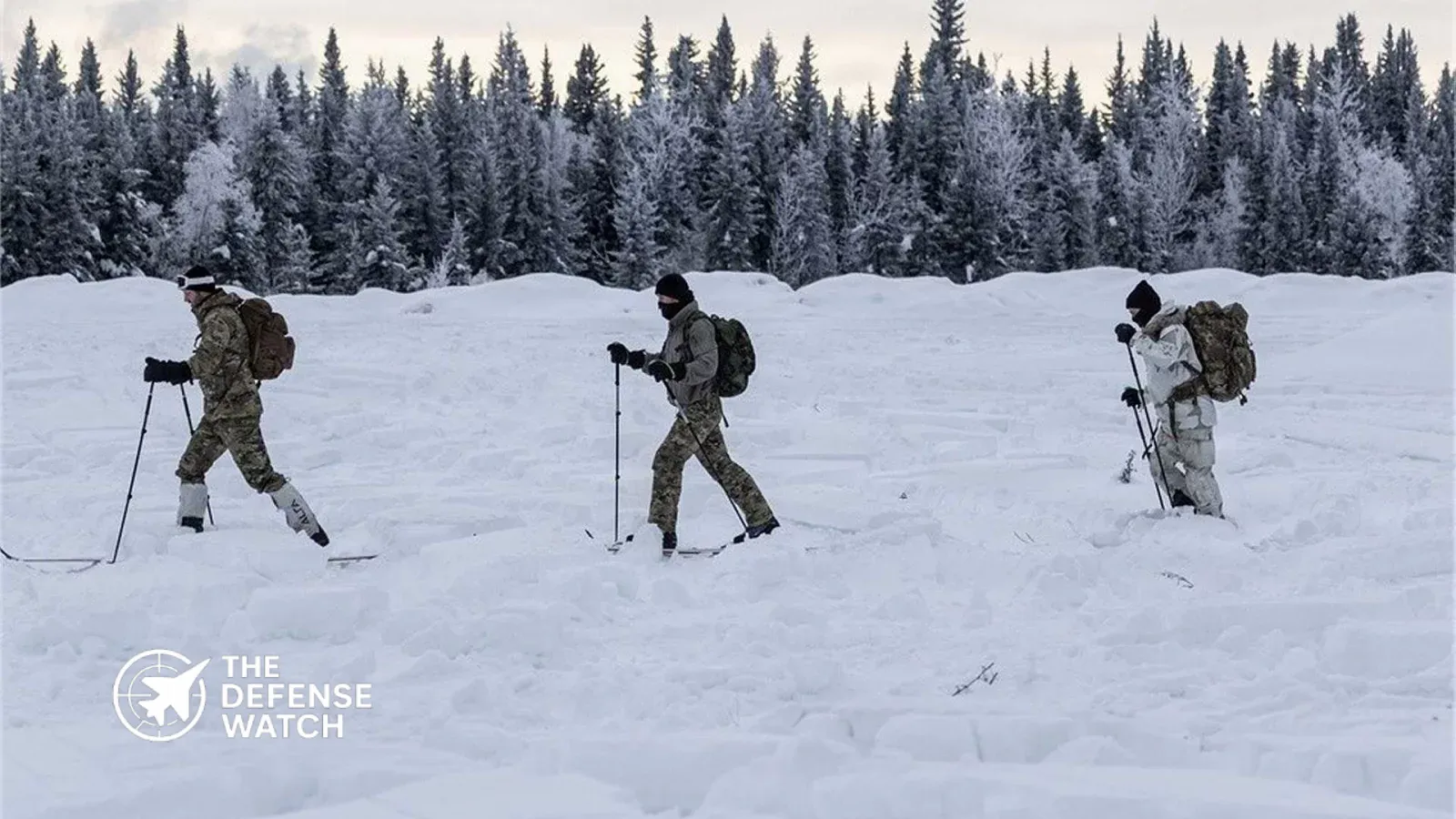
- ► U.S. Army Green Berets conducted Arctic reconnaissance and electronic warfare training in Alaska during the Joint Pacific Multinational Readiness Center rotation.
- ► Soldiers from 3rd Battalion, 10th Special Forces Group (Airborne) operated in extreme cold from February 11 to 20, 2026.
- ► Training included reconnaissance missions, signals intelligence collection, and electronic warfare support to conventional forces.
- ► Green Berets used FPV drones and snowmobiles to gather real-time battlefield intelligence in difficult Arctic terrain.
- ► The exercise supported large-scale combat operation scenarios and strengthened coordination with the 11th Airborne Division.
U.S. Army Green Berets Test Arctic Recon And Electronic Warfare Capabilities
U.S. Army Green Berets tested Arctic reconnaissance and electronic warfare capabilities during a cold-weather training exercise in Alaska, highlighting the military’s growing focus on operating in extreme northern environments.
The training involved soldiers from the 3rd Battalion, 10th Special Forces Group (Airborne) during the Joint Pacific Multinational Readiness Center (JPMRC) 26-02 rotation, which took place from February 11 to 20, 2026 across several training areas in central and southern Alaska.
The exercise placed Special Forces teams in harsh subarctic conditions to practice reconnaissance, signals intelligence, and electronic warfare tasks designed to support large-scale combat operations alongside conventional U.S. Army units.
According to the U.S. Army, the training aimed to ensure Special Operations Forces can deploy and fight effectively in one of the most challenging environments on Earth while supporting joint force commanders with timely battlefield intelligence.
Arctic Reconnaissance Missions In Extreme Conditions
A core element of the exercise focused on Arctic reconnaissance operations, where Green Beret teams conducted surveillance missions across snow-covered terrain and dense vegetation.
Operators used cross-country skis and snowmobiles to reach remote observation points. From these positions, small teams monitored simulated enemy targets such as air defense command and control nodes.
Reconnaissance units practiced establishing concealed surveillance sites and collecting intelligence on hostile electronic emissions and communications networks.
These activities are central to Special Forces doctrine, which often places small, highly trained teams deep behind enemy lines to gather critical intelligence and guide follow-on strikes by conventional forces.
In the Alaska exercise scenario, intelligence gathered by Special Forces could be passed to supporting units such as the 11th Airborne Division, enabling precision fires from artillery, rockets, or missiles during simulated combat operations.
Electronic Warfare And Signals Intelligence Integration
The training also emphasized the role of electronic warfare (EW) in modern military operations.
Signals intelligence specialists within the Green Beret teams analyzed radio frequency emissions and electronic signatures from simulated adversary systems.
By detecting and locating these signals, operators can identify command posts, communications links, or drone operators operating within the battlespace.
Electronic warfare capabilities are increasingly central to modern conflicts, where control of the electromagnetic spectrum is often as decisive as traditional firepower.
Recent conflicts, including the war in Ukraine, have demonstrated the growing importance of detecting and disrupting enemy communications, drones, and navigation systems.
The Alaska training allowed Special Forces units to refine these skills while operating in extreme cold conditions that can affect batteries, sensors, communications systems, and mobility equipment.
FPV Drones Expand Battlefield Awareness
One notable aspect of the exercise was the use of first-person-view (FPV) drones for tactical reconnaissance.
These small unmanned systems provide real-time video feeds that allow soldiers to confirm targets quickly and accurately.
According to U.S. Army personnel involved in the training, FPV drones allow teams to verify intelligence without exposing themselves to enemy observation or relying solely on reports from larger surveillance platforms.
The rapid deployment of drones helps commanders gain a clearer operational picture and enables faster decision-making during dynamic combat scenarios.
For Special Forces teams operating in dispersed formations, this capability can significantly improve situational awareness and targeting accuracy.
Alaska As A Testing Ground For Arctic Warfare
Alaska has become a central hub for the U.S. Army’s Arctic warfare training and experimentation.
The state’s extreme cold, rugged terrain, and vast training ranges make it an ideal environment for testing new tactics and technologies designed for cold-weather operations.
The Joint Pacific Multinational Readiness Center allows units to train in realistic operational conditions without leaving their regional area of responsibility.
Exercises conducted there combine live field training with advanced simulation and joint integration across multiple military branches.
The Arctic environment presents unique challenges for military operations, including limited infrastructure, extreme temperatures, and restricted mobility.
Cold weather can affect weapon systems, sensors, batteries, communications equipment, and logistics supply chains. Training in these conditions helps units identify technical limitations and refine operational procedures before deployment.
Strategic Importance Of Arctic Military Readiness
The United States has steadily increased its focus on Arctic military readiness in recent years.
The region is gaining strategic importance as melting ice opens new shipping routes and increases access to natural resources. At the same time, several major powers are expanding their presence in the High North.
Russia maintains a large network of Arctic bases and airfields, while China has expressed interest in developing polar shipping routes and infrastructure projects.
For the U.S. military, maintaining the ability to operate effectively in Arctic conditions is considered essential for homeland defense and for supporting allied operations in northern regions.
Training events such as the JPMRC rotation allow the U.S. Army to develop tactics and technologies that ensure forces remain capable of operating in contested environments across the Arctic.
By integrating reconnaissance, drones, electronic warfare, and cold-weather mobility, the Alaska exercise demonstrates how Special Operations Forces contribute to modern multi-domain operations.
Get real time update about this post category directly on your device, subscribe now.
