
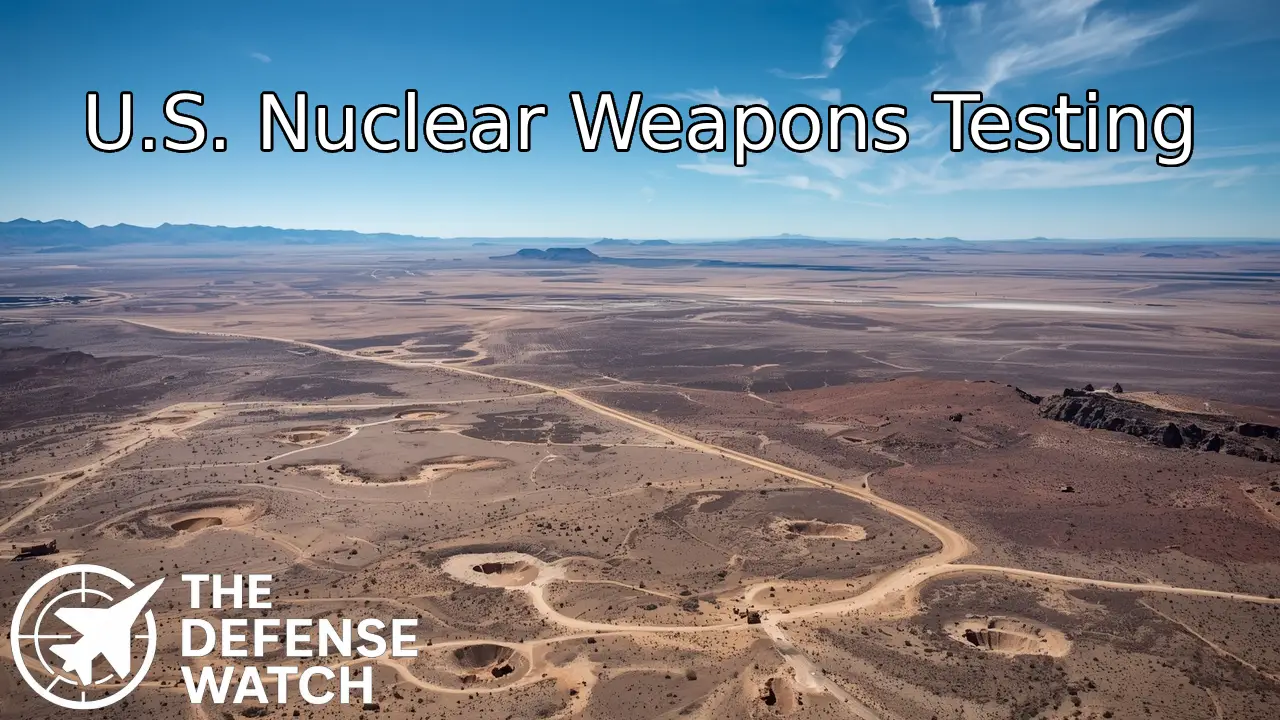
Trump Orders Resumption of U.S. Nuclear Weapons Testing After 33-Year Hiatus
President Donald Trump has directed the Pentagon to immediately resume nuclear explosive testing at the Nevada National Security Site (NNSS), marking the first such tests by the United States since 1992. The move comes amid mounting global tensions and renewed nuclear activities by Russia, China, and North Korea, which the administration says threaten to undermine American deterrence credibility.
Senior defense officials confirmed that the order authorizes limited underground testing of existing nuclear warhead designs to validate reliability, modernization, and readiness of the U.S. nuclear arsenal. The decision follows recent intelligence assessments indicating that Moscow and Beijing have conducted low-yield nuclear experiments in violation of international testing norms.
Strategic Rationale Behind the Decision
According to the White House and Department of Defense, the resumption aims to ensure the “credibility and survivability” of the U.S. deterrent. Officials argue that simulated and subcritical tests, while effective, no longer provide sufficient assurance about the long-term performance of aging warheads and next-generation nuclear delivery systems.
“Adversaries have not stopped testing, and America cannot afford to rely on outdated assumptions,” a senior administration official said. “This is about deterrence, readiness, and scientific verification — not arms racing.”
The Nevada National Security Site, located about 65 miles northwest of Las Vegas, hosted more than 1,000 nuclear tests between 1951 and 1992 before the United States imposed a voluntary moratorium under President George H. W. Bush. Since then, the country has relied on the Stockpile Stewardship Program — a non-explosive testing initiative using advanced simulations and subcritical experiments to maintain warhead reliability.
Treaty and International Implications
The move does not violate any existing treaty obligations, as the United States signed but never ratified the Comprehensive Nuclear-Test-Ban Treaty (CTBT). However, it is likely to provoke international criticism and potentially trigger a new round of nuclear tensions among major powers.
Russia and China have both called for a universal ban on nuclear testing, though U.S. officials have accused both nations of secretly conducting “supercritical” experiments. North Korea, which last conducted a nuclear test in 2017, recently declared it has resumed fissile material production.
Experts warn that renewed U.S. testing could encourage other nuclear states — such as Pakistan, India, and North Korea — to follow suit, eroding decades of progress in non-proliferation.
Arms control advocates, including the Union of Concerned Scientists, condemned the move, arguing it could “undo three decades of restraint and open the door to a global testing race.”
Defense and Technological Considerations
The Pentagon’s order will likely involve a combination of low-yield underground tests and advanced diagnostic instrumentation to gather data on modern warhead designs. These experiments are expected to support the upcoming modernization of the U.S. nuclear triad, including:
- Ground-Based Strategic Deterrent (GBSD) ICBMs replacing Minuteman III missiles.
- B-21 Raider stealth bombers, designed for nuclear and conventional missions.
- Columbia-class ballistic missile submarines entering service in the 2030s.
Defense analysts suggest that resuming nuclear testing could accelerate validation of new warhead components and boost confidence in next-generation delivery systems.
“Testing provides real-world data that simulations simply can’t replicate,” said Dr. Laura Hines, a former Los Alamos National Laboratory physicist. “It helps validate assumptions in modern warhead design and ensures deterrence remains credible under extreme conditions.”
Analysis: What This Means for U.S. Defense and Global Security
The decision underscores a strategic pivot toward deterrence realism in U.S. defense policy. By reintroducing nuclear testing, the administration signals a shift away from arms control diplomacy toward competitive readiness — mirroring trends in Russia’s and China’s nuclear postures.
However, this move may complicate Washington’s standing in future non-proliferation talks and challenge the credibility of its leadership in global arms control. Allies in NATO and the Indo-Pacific could face increased pressure to reassess their own nuclear policies, especially as adversaries test hypersonic and low-yield nuclear capabilities.
From a technological standpoint, the resumption could reinvigorate U.S. nuclear science and infrastructure, potentially driving innovation in radiation detection, materials science, and computational modeling. Yet it may also reignite public debate over nuclear safety and environmental impact.
Conclusion: A Defining Shift in Nuclear Strategy
President Trump’s decision to resume nuclear explosive testing marks a defining moment in modern U.S. defense strategy, signaling a renewed willingness to assert nuclear superiority amid a multipolar world. While proponents argue it reinforces deterrence, critics warn it risks undermining decades of non-proliferation progress.
Whether this leads to a new arms race or a recalibrated deterrent posture will depend on how Washington manages transparency, testing limits, and diplomatic messaging in the months ahead. For now, the Nevada desert — silent since 1992 — is once again at the heart of America’s nuclear strategy debate.
Get real time update about this post category directly on your device, subscribe now.

5 comments
[…] launch of the Minuteman III, the U.S. signals the credibility of the land-based leg of its deterrent without needing a nuclear […]
[…] but by whether those tests accelerate deployment of operational capabilities that enhance U.S. and allied deterrence and warfighting capacity in contested […]
[…] restore deterrence if China uses limited nuclear weapons […]
[…] ships and submarines in the 1980s and early 1990s. The current effort aims to fill a perceived deterrence gap with a low-yield nuclear […]
[…] techniques—methods designed to reduce seismic signatures and defeat monitoring systems—to hide nuclear testing activities from international detection networks. He specifically cited June 22, 2020, as the date […]