
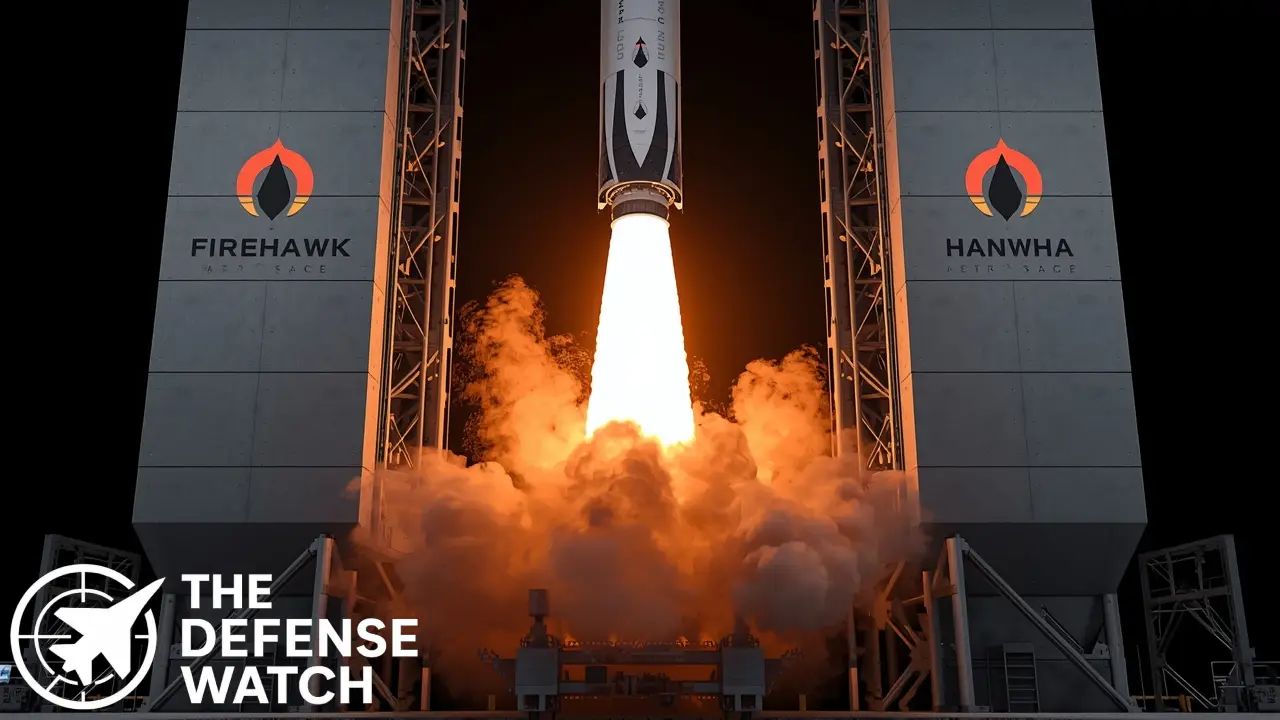
Firehawk Aerospace Gains Strategic Investment from Hanwha Aerospace
U.S.-based Firehawk Aerospace has secured a major investment from Hanwha Aerospace, the South Korean defense and propulsion company, marking a significant milestone in the evolution of gel-fueled rocket engine technology. The partnership is poised to enhance propulsion innovation for U.S. defense and space applications, underscoring the growing trend of cross-border collaboration in next-generation aerospace systems.
Hanwha’s Strategic Investment
Hanwha Aerospace, part of the Seoul-based Hanwha Group, has steadily expanded its global footprint in aerospace and defense manufacturing. Its investment in Firehawk reflects South Korea’s strategic aim to strengthen cooperation with U.S. defense startups specializing in propulsion and hypersonic technologies.
Although the funding amount was not disclosed, the partnership is expected to focus on scaling Firehawk’s hybrid rocket engine systems, which utilize gel propellants—a safer and more efficient alternative to traditional solid or liquid fuels. Gel fuels offer enhanced control, storability, and performance, making them highly attractive for reusable launch systems and tactical missile applications.
Advancing Gel-Fueled Rocket Technology
Founded in 2019, Firehawk Aerospace has emerged as a U.S. leader in additive manufacturing (3D printing) for hybrid rocket engines. The company’s technology enables rapid prototyping, reduced production costs, and improved mission flexibility for both defense and commercial launch programs.
By combining Firehawk’s proprietary hybrid propulsion with Hanwha’s manufacturing and systems integration expertise, the collaboration could accelerate the maturation of gel-based propulsion systems suitable for hypersonic platforms, tactical strike systems, and space launch vehicles.
Strengthening U.S. Defense and Space Capabilities
This partnership aligns closely with U.S. defense priorities to bolster resilient, cost-effective propulsion technologies amid escalating competition in the hypersonic and space domains. The Department of Defense (DoD) and U.S. Space Force have both identified propulsion modernization as a critical need to maintain strategic deterrence and operational flexibility.
Firehawk’s modular engines could support a variety of U.S. programs, from responsive space launch initiatives to autonomous hypersonic testbeds. Meanwhile, Hanwha’s participation offers an opportunity for allied nations to share technological insights and reduce supply-chain dependencies on traditional propulsion contractors.
Global Context and Industry Impact
The Firehawk–Hanwha deal reflects a wider global trend of alliances between defense startups and established international manufacturers. In recent years, Hanwha Aerospace has invested heavily in the United States, including in space propulsion, satellite systems, and advanced munitions.
For Firehawk, the collaboration provides access to capital, advanced materials, and international testing networks, potentially allowing faster certification cycles and operational readiness for defense customers. As the U.S. government increases funding for hypersonic research, the Firehawk-Hanwha partnership could position both companies as key players in the next generation of propulsion solutions.
Analysis: What This Means for U.S. Defense and Technology
The Firehawk-Hanwha collaboration highlights a growing emphasis on innovation through global partnerships within the defense industrial base. For the U.S., it strengthens technological sovereignty while benefiting from allied investments. Firehawk’s gel-fueled propulsion technology offers potential advantages for precision-guided weapons, reusable space systems, and tactical missiles, all areas of increasing importance in U.S. defense planning.
The integration of 3D-printed hybrid engines also underscores the Pentagon’s focus on rapid manufacturing and field adaptability, key attributes for future warfare and deterrence strategies. By leveraging allied cooperation, the U.S. can enhance both industrial resilience and technology agility against peer competitors like China and Russia, who are similarly investing in advanced propulsion and hypersonic capabilities.
Conclusion: Toward a New Era of Rocket Propulsion
As Firehawk Aerospace accelerates its gel-fueled engine development with Hanwha’s backing, the partnership could redefine the trajectory of propulsion innovation in both the defense and commercial sectors. If successful, this collaboration may pave the way for safer, more flexible, and cost-efficient rocket systems, strengthening the U.S. and its allies’ technological edge in space and hypersonic domains.
Get real time update about this post category directly on your device, subscribe now.

1 comment
[…] Addressing those will likely involve foreign collaboration (with Russia) and large-scale investment in India’s aerospace […]