
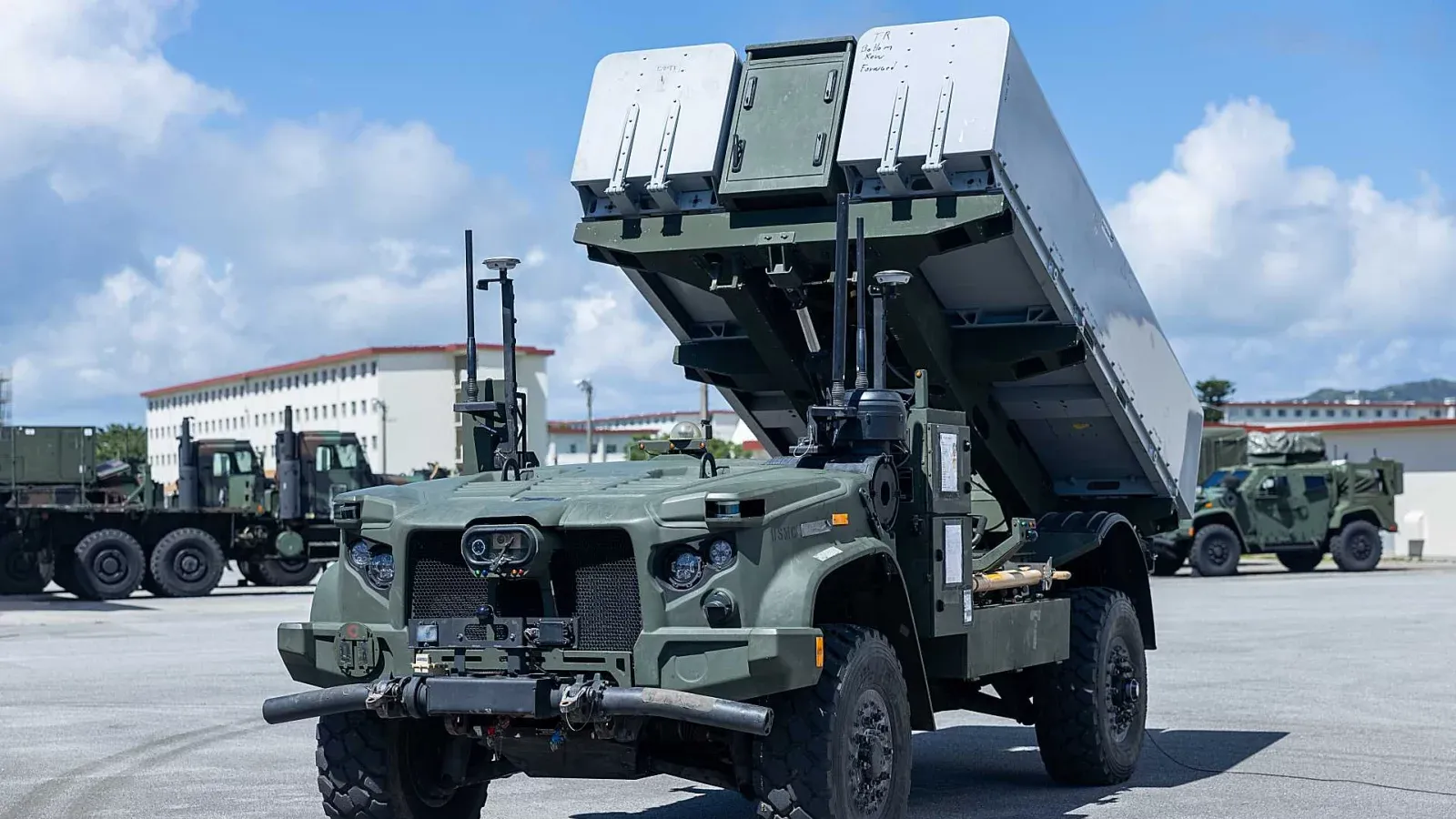
- ► Oshkosh Defense awarded 16.9 million contract to deliver additional NMESIS anti ship missile launchers.
- ► NMESIS integrates the Naval Strike Missile onto an unmanned Joint Light Tactical Vehicle platform.
- ► System supports the U.S. Marine Corps Force Design 2030 modernization plan.
- ► Provides shore based anti ship capability to deny adversary naval access in contested regions.
- ► Contract reflects continued investment in distributed maritime operations.
Oshkosh Expands NMESIS Anti Ship Missile Launchers For U.S. Marines
The NMESIS anti ship missile launchers are set to expand within the U.S. inventory after Oshkosh Defense secured a 16.9 million contract to deliver additional systems to the United States Marine Corps.
The award supports continued fielding of the Navy Marine Expeditionary Ship Interdiction System, or NMESIS, a ground based anti ship capability designed to give Marine units long range precision strike options from shore.
The system pairs the Naval Strike Missile with an unmanned variant of the Joint Light Tactical Vehicle, allowing Marines to launch anti ship missiles without placing operators directly at the firing point.
A Core Element Of Force Design 2030
NMESIS anti ship missile launchers are central to the Marine Corps Force Design 2030 restructuring effort. Under that plan, the Corps has divested tanks and certain legacy systems to focus on lighter, more mobile formations optimized for operations inside contested maritime spaces.
By deploying small units armed with precision anti ship missiles, the Marine Corps aims to complicate adversary naval maneuver. The concept aligns with broader U.S. Navy distributed maritime operations, which emphasize dispersal, survivability, and cross domain integration.
The Naval Strike Missile, developed by Kongsberg Defence & Aerospace and fielded by the U.S. Navy and Marine Corps, offers a range exceeding 100 nautical miles and uses advanced guidance to engage heavily defended surface targets. Its integration onto a mobile, unmanned platform expands its tactical flexibility.
Unmanned And Mobile By Design
The NMESIS launcher is built on the Remotely Operated Ground Unit for Expeditionary Fires, derived from the Joint Light Tactical Vehicle produced by Oshkosh. The vehicle operates without a crew onboard during launch operations, reducing risk to personnel.
Mobility is central to the concept. Marine units can rapidly reposition the launcher across island chains or coastal terrain, fire, and relocate. That shoot and scoot profile is intended to enhance survivability against counter fire or surveillance.
From an operational standpoint, this supports expeditionary advanced base operations, where small Marine elements establish temporary forward positions to control key maritime chokepoints.
Strategic Context In The Indo Pacific
The expansion of NMESIS anti ship missile launchers comes as the United States prioritizes deterrence in the Indo Pacific. While the contract itself is limited in dollar value, it reflects steady progress in equipping Marine littoral regiments with organic sea denial capability.
Analysts have noted that land based anti ship systems offer a cost effective way to hold high value naval assets at risk. Compared to large surface combatants, dispersed missile units can be harder to detect and target.
This approach also signals closer Navy Marine Corps integration. By combining naval sensors, joint targeting networks, and shore based missile batteries, the services are building layered maritime defense.
Industrial And Program Outlook
For Oshkosh Defense, the contract reinforces its role as a key supplier of tactical wheeled vehicles adapted for new mission sets. The company has already delivered Joint Light Tactical Vehicles to multiple U.S. and allied customers. Adapting that platform for unmanned missile launch operations reflects a broader shift toward modular, mission configurable ground systems.
The Marine Corps began receiving NMESIS systems in recent years, with initial operational capability declared for select units. Continued procurement suggests the service is moving from experimentation toward sustained deployment.
While the 16.9 million award represents a relatively modest increment, it demonstrates that NMESIS anti ship missile launchers remain a funded priority within the Marine Corps modernization portfolio.
As maritime competition intensifies, shore based anti ship missiles are likely to remain a key component of U.S. deterrence strategy. The latest contract signals that the Marine Corps is continuing to invest in that capability, aligning procurement with evolving operational concepts and regional security demands.
Get real time update about this post category directly on your device, subscribe now.
