Saab Flies Its Own AI Fighter Agents on Gripen E in BVR Combat Trials
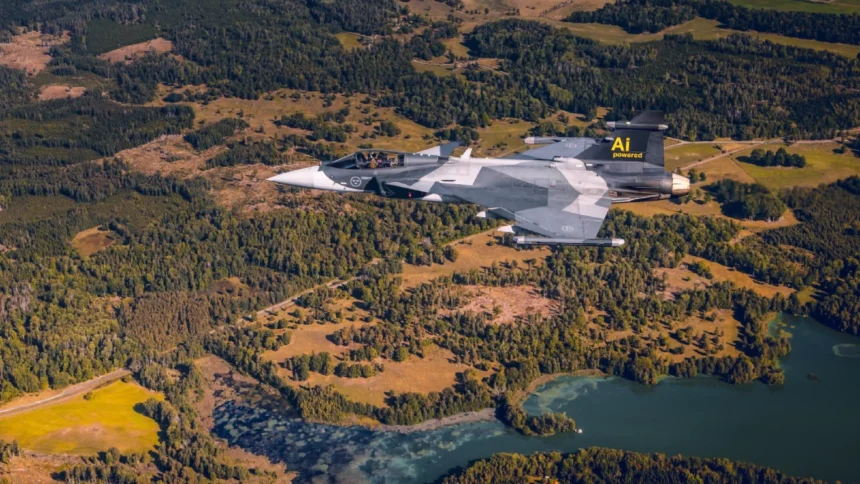
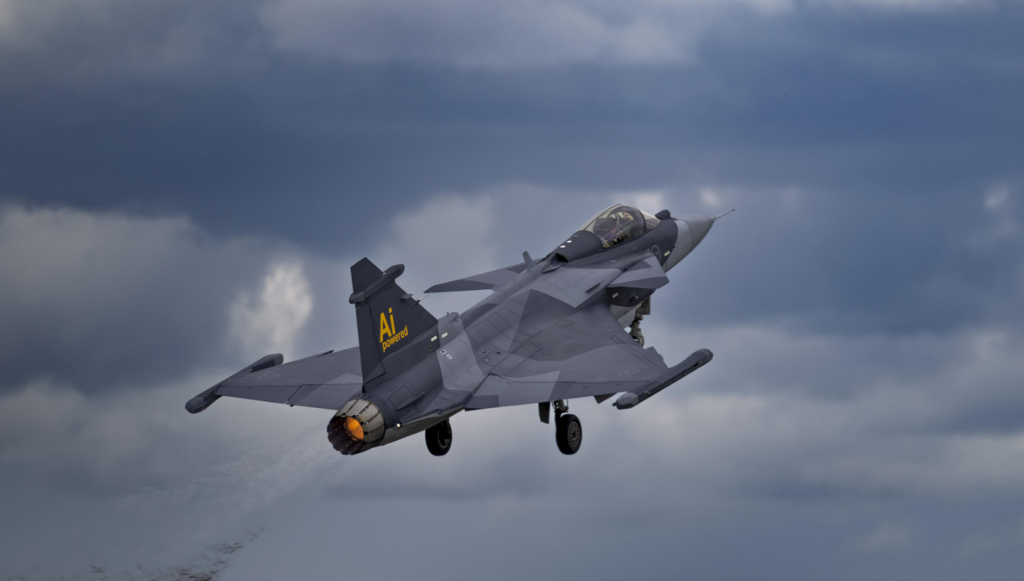
Swedish defense company Saab has flown its own artificial intelligence agents aboard the Gripen, demonstrating that software developed by the company can autonomously control a fighter aircraft during beyond-visual-range (BVR) air combat scenarios.
- Saab Flies Its Own AI Fighter Agents on Gripen E in BVR Combat Trials
- From AI Development to Actual Fighter Flight
- AI Fighter Pilot Academy Builds an In-House Development Chain
- Why Gripen E Matters to Saab’s AI Program
- Sferical AI Supports Sovereign Fighter Development
- How the New Program Differs From the 2025 Gripen AI Trials
- Connection to Future Uncrewed Combat Aircraft
- The Remaining Challenge Is Trust and Operational Verification
The announcement, released on November 3, 2026, introduces a new phase in Saab’s effort to develop artificial intelligence for future combat aircraft. The company has established an in-house development and training initiative called the AI Fighter Pilot Academy, intended to build, evaluate and improve AI agents for both crewed and uncrewed aircraft.
Unlike an AI system that only provides recommendations to a pilot, Saab says its agents have progressed to controlling an aircraft during actual flight trials. The company has not, however, disclosed detailed test results, engagement outcomes, or the specific performance measures used to evaluate the agents.
The work gives Saab greater control over the development process, including AI software, simulation environments, training infrastructure and flight testing.
From AI Development to Actual Fighter Flight
Saab’s latest trials focus on developing AI agents capable of making tactical decisions in complex air combat environments.
According to the company, the agents use different artificial intelligence techniques to learn, adapt and collaborate with pilots and other operators across multiple mission tasks. Their intended applications include assisting pilots inside the cockpit and operating independently aboard future uncrewed aircraft.
During the reported flight trials, an AI agent autonomously controlled the Gripen E in BVR combat scenarios. This is an important distinction because it moves the technology beyond laboratory research and simulated engagements into an airborne fighter environment.
However, the announcement does not establish that the AI has achieved operational combat readiness. Saab has not disclosed whether the trials included simulated weapon releases, live weapons, multiple opposing aircraft, or engagements against operational adversary systems.
The results should therefore be understood as a flight-test milestone rather than evidence of a fully autonomous combat capability.
AI Fighter Pilot Academy Builds an In-House Development Chain
The AI Fighter Pilot Academy is central to Saab’s effort to develop its own air combat AI.
The initiative is designed to combine agent development with the infrastructure needed to train and evaluate AI behavior across different operational scenarios. Saab says the agents accumulate millions of simulated flight hours, allowing them to examine tactical situations and decision paths that would be difficult to reproduce through conventional pilot training alone.
The training process involves repeatedly evaluating agent decisions against defined objectives. This allows the software to learn from simulated engagements and adjust its tactical behavior.
An important feature is the ability to reuse the underlying development infrastructure. Saab says new capabilities, scenarios and aircraft platforms can be introduced without rebuilding the entire training framework.
That approach could reduce the time and cost associated with developing additional AI functions, although Saab has not published comparative development timelines or cost figures.
Peter Nilsson, head of Advanced Programs at Saab Aeronautics, said the company had developed its own AI agents and demonstrated them in flight.
He described future air combat as an environment in which crewed and uncrewed aircraft operate as coordinated forces rather than relying exclusively on individual platforms.
Why Gripen E Matters to Saab’s AI Program
Gripen E’s software-defined architecture is an important part of the testing strategy.
The aircraft was designed with an architecture that supports the integration of new software and the introduction of additional capabilities during its service life. Saab says this allows AI software to be integrated and tested aboard an operational fighter without requiring a dedicated experimental aircraft.
This flexibility is relevant because artificial intelligence systems require repeated testing, evaluation and software updates before they can be considered suitable for demanding military applications.
Saab also says Gripen E can support rapid integration and testing of new technologies, including in civilian airspace under appropriate flight-test conditions.
The aircraft therefore serves as more than a platform for demonstrating AI. It provides Saab with an environment for testing how software-based capabilities interact with an operational fighter’s existing systems.
The approach could help shorten development cycles, but actual deployment will depend on further testing, verification and military approval.
Sferical AI Supports Sovereign Fighter Development
Saab’s AI development effort also depends on access to substantial computing resources.
The company is a founding partner in , a Swedish initiative intended to provide secure, large-scale computing capacity for advanced AI development.
This infrastructure supports the training and evaluation of increasingly complex AI agents. Saab’s participation also reflects an industrial and strategic consideration: maintaining greater national control over the computing resources and data used to develop sensitive military technologies.
According to Saab, the agents, training environments and supporting development tools have been developed in-house. The company argues that this provides greater control over how the AI behaves, how it is verified and how its capabilities evolve.
That control could become increasingly important as AI systems move from supporting individual pilots toward coordinating several crewed and uncrewed aircraft.
How the New Program Differs From the 2025 Gripen AI Trials
Saab’s announcement builds on earlier work involving artificial intelligence in Gripen E, but the two efforts should not be confused.
In June 2025, Saab and German defense technology company Helsing announced three successful flights involving Helsing’s Centaur AI agent under Saab’s Project Beyond.
During those trials, Centaur autonomously executed maneuvers in a BVR combat environment and provided firing cues to the pilot. One flight involved a Gripen D acting as an opposing aircraft, allowing the teams to evaluate the AI against a real airborne target using sensor data.
The November 2026 announcement concerns Saab’s own in-house AI agents and its broader development infrastructure.
This distinction matters because it shows Saab is working to build an independent capability rather than relying exclusively on external AI developers.
The two efforts also demonstrate different stages of the company’s approach: integrating external AI technology into a fighter and developing its own agents, training environments and evaluation tools.
Connection to Future Uncrewed Combat Aircraft
Saab’s AI work has implications beyond the Gripen E program.
The company is exploring future combat aircraft architectures in which crewed fighters operate alongside uncrewed platforms. AI agents could support this arrangement by helping aircraft process information, make tactical decisions and coordinate mission activities.
One relevant development is Saab’s A3-001 uncrewed combat aircraft concept, unveiled in August 2026.
Saab presented the full-scale concept as a potential future component of an integrated combat air system. The proposed aircraft is intended to explore missions such as electronic warfare, suppression of enemy air defenses and precision strike operations.
The company said it intends to fly uncrewed demonstrators with fighter-like characteristics before 2030, although this remains a development objective rather than a confirmed operational deployment date.
AI development could provide part of the technical foundation for these future aircraft. An autonomous platform would need to process mission information, respond to changing conditions and coordinate with other aircraft while operating within defined safety and control requirements.
For Saab, developing AI agents alongside its own aircraft concepts could help align software development with future platform requirements.
However, the company has not announced that its current Gripen E AI agents are ready to operate an A3-001 aircraft.
The Remaining Challenge Is Trust and Operational Verification
Flight testing an AI agent is an important milestone, but it does not resolve the wider challenges associated with autonomous air combat.
Military AI systems must perform reliably when faced with incomplete information, changing tactical conditions, electronic interference and unexpected events. Their decisions also need to remain predictable enough for military operators to understand and supervise.
Saab says safety and control are integrated into its development process from the beginning. It has not publicly detailed the complete verification framework, independent evaluation procedures or the operational limits imposed on its agents.
Several questions therefore remain unanswered:
- How consistently can the agents perform across different BVR scenarios?
- How will pilots supervise and override autonomous decisions?
- How will the software respond to degraded communications and electronic warfare?
- What level of autonomy will be approved for operational missions?
- When could the technology enter formal military evaluation?
These issues will determine whether the current flight-test capability can develop into a dependable military system.
For now, Saab has demonstrated that its own AI agents can autonomously control Gripen E during BVR flight scenarios. The next challenge is proving that the technology can operate safely and consistently across a wider range of missions and aircraft.
The company’s investment in the AI Fighter Pilot Academy and Sferical AI suggests that it intends to build a long-term development capability rather than treat the Gripen demonstrations as an isolated experiment.