

Beyond the Sonic Boom
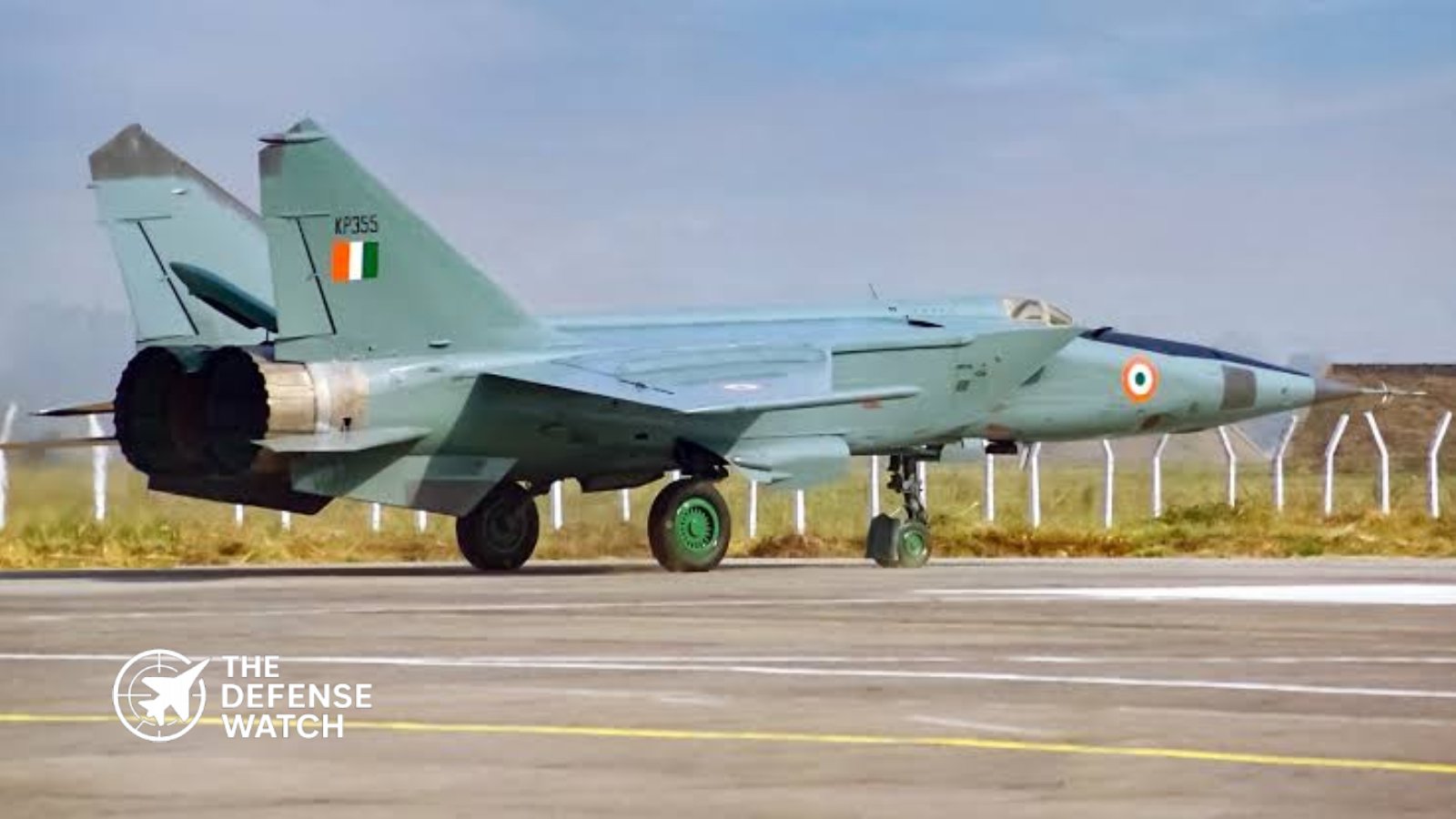
Former Indian Air Force pilots have provided new first-hand details about a MiG-25 reconnaissance mission that crossed into Pakistani airspace in May 1997, an incident that became one of the best-known episodes involving India’s former high-altitude reconnaissance aircraft.
Air Marshal Sumit Mukerji and retired Wing Commander Pradeep Jaswant Thakur discussed the mission during an October 2026 NDTV interview about their experience operating the MiG-25. Thakur said the aircraft crossed into Pakistani airspace on May 27, 1997, operating at about 20 kilometers altitude and Mach 2.4.
The account also challenges a long-standing version of the story that the aircraft deliberately flew over Islamabad to create a sonic boom and shatter windows.
Thakur said the aircraft was already flying at approximately 20 kilometers and Mach 2.4 before reaching the border. In his account, the sonic boom was a consequence of the aircraft’s supersonic flight rather than a separate attempt to damage buildings or intimidate people on the ground.
The historical record remains important to qualify. Pakistan attributed the incident to an Indian military aircraft, while India’s Defence Ministry publicly denied in 1997 that an Indian military aircraft had crossed the international border. The latest pilot testimony therefore provides significant new first-hand evidence, but it should not be described as a declassified official confirmation of the mission.
What the Former Pilots Say Happened
According to Thakur, the aircraft crossed into Pakistan during a reconnaissance mission. He said the MiG-25 was operating at approximately 20 kilometers and Mach 2.4, conditions that placed it firmly in the aircraft’s high-altitude supersonic operating regime.
The sonic booms heard on the ground were therefore not, in his account, the result of the pilot intentionally performing a low-level or symbolic supersonic pass over Islamabad.
That distinction is important because later retellings of the incident have often focused on the dramatic image of an Indian aircraft deliberately breaking the sound barrier over the Pakistani capital.
The available first-hand account does not support that interpretation.
It instead describes a reconnaissance flight in which altitude and speed were part of the aircraft’s established operating profile.
What Is Confirmed and What Remains Uncertain
The strongest evidence available today comes from the former pilots themselves.
Confirmed by first-hand testimony: Thakur says an Indian MiG-25 crossed into Pakistani airspace on May 27, 1997, and operated at approximately 20 kilometers and Mach 2.4. Mukerji also confirmed that such a mission occurred.
Historically documented: Pakistan reported the presence of an Indian aircraft, while India publicly denied that an Indian military aircraft had crossed the border at the time.
Not independently established in the available evidence: The precise intelligence targets photographed during the mission, the complete flight route, and the exact Pakistani interception sequence.
Disputed: The claim that the aircraft intentionally created a sonic boom to break or deliberately shake windows in Islamabad. Thakur specifically rejected that explanation.
This distinction keeps the historical account separate from the later mythology surrounding the incident.
Why India Used the MiG-25 for Strategic Reconnaissance
India inducted the MiG-25 in 1981 to provide a strategic reconnaissance capability. Historical records identify No. 102 Squadron, known as Trisonics, as the Indian unit associated with the aircraft. The squadron operated from Bareilly and was initially placed under direct functional control of Air Headquarters.
The MiG-25 was fundamentally different from a conventional fighter.
Its reconnaissance configuration was designed to collect imagery from high altitude. According to the former pilots interviewed by NDTV, Indian MiG-25 aircraft used a nose-mounted camera system for reconnaissance, including cameras covering different viewing angles and a vertical camera that provided geographic reference information.
The purpose was intelligence collection rather than air combat.
The aircraft’s speed and altitude were important because they reduced the amount of time available for an opposing force to respond to the reconnaissance flight. That does not mean the aircraft was immune to interception, nor does it establish that a particular Pakistani fighter could or could not have intercepted it under different circumstances.
The 1997 Mission Was Not a Conventional Attack
The available evidence describes the May 1997 flight as a reconnaissance operation.
Thakur said the MiG-25 was conducting a photographic mission involving areas of interest in Pakistan. He did not publicly identify the specific targets photographed during the flight. NDTV reported that the aircraft was used to photograph sensitive military or infrastructure locations, but the precise intelligence objective of the May 27 sortie has not been publicly established in the material reviewed for this article.
That distinction matters.
There is no basis in the available evidence to describe the mission as an attack, a bombing operation, or an attempt to damage Pakistani infrastructure.
The aircraft was carrying out intelligence collection.
How the Mission Was Tasked
The former pilots also described the level of compartmentalization surrounding MiG-25 reconnaissance operations.
Mukerji said mission requirements were passed through Air Headquarters to the squadron commander, who then assigned the task to an individual pilot. The selected pilot would plan the mission without necessarily sharing its details with other squadron personnel.
This account is consistent with the historical role of the MiG-25 as a specialized strategic reconnaissance platform.
Bharat Rakshak’s historical record notes that No. 102 Squadron operated under the functional control of Air Headquarters during much of the aircraft’s career.
The exact procedures for individual missions cannot be independently reconstructed from the publicly available material, so the pilots’ descriptions should be treated as their recollection of how the tasking system operated.
The Sonic Boom and the Islamabad Story
A sonic boom is an expected consequence of supersonic flight when the shock waves generated by the aircraft reach the ground.
The important point in the 1997 case is that Thakur did not describe the sonic boom as a separate objective of the mission.
He said the aircraft was already at approximately 20 kilometers and Mach 2.4 before crossing the border. In his account, operating at that altitude and speed was integral to the reconnaissance mission.
The earlier version of the story is therefore better understood as a later interpretation of the event rather than an established description of the pilot’s intent.
Contemporary reporting also connected the sonic boom with the Pakistani response. A 2006 Telegraph India report recalled that the aircraft’s sonic boom alerted Pakistani authorities and that interceptors were reportedly scrambled. However, details of the interception sequence remain dependent on historical reporting rather than a complete publicly available official Pakistani operational record.
The MiG-25’s Role in Kargil Was Different
The MiG-25 was also used for reconnaissance during the 1999 Kargil conflict, but the mission requirements were substantially different.
Thakur told NDTV that the aircraft’s normal operating altitude of approximately 20 kilometers was unsuitable for identifying small battlefield targets such as positions and bunkers in mountainous terrain. He therefore flew at a much lower altitude and at approximately Mach 0.95 during reconnaissance sorties over the area.
This illustrates an important limitation of the aircraft.
The MiG-25’s extreme altitude and speed were valuable for strategic reconnaissance, but they were not automatically optimal for every intelligence mission. Terrain, target size and required image resolution affected the appropriate flight profile.
According to Thakur, the lower-altitude Kargil missions also involved fighter support, including Mirage 2000 and MiG-29 aircraft. Those details come from his personal recollection and should be understood as such.
Why India Eventually Retired the MiG-25
India continued operating the MiG-25 for approximately 25 years after its introduction.
The aircraft was phased out in 2006. India’s Ministry of Defence recorded the phase-out ceremony at Bareilly in May 2006, while historical aircraft records place May 1, 2006, as the final operational date for the remaining aircraft.
The retirement reflected changes in reconnaissance technology as well as the age of the aircraft.
At the time of retirement, Indian officials pointed to the increasing importance of satellite-based surveillance and the declining cost effectiveness of maintaining the MiG-25. The Indian Air Force had also developed other methods of obtaining intelligence, including space-based systems.
Contemporary reporting described the MiG-25 as a specialized strategic reconnaissance platform that had photographed military activity, infrastructure and other areas of interest during its Indian service.
A More Careful Reading of the 1997 Incident
The 1997 Islamabad episode is significant because it provides a rare example of how the MiG-25 was used for strategic reconnaissance in the India-Pakistan security environment.
But the available evidence does not justify turning the incident into a story about one country demonstrating unquestioned superiority over another.
The former pilots’ accounts establish that they regarded high altitude and speed as central to the MiG-25’s mission profile. They also explain why the sonic boom should not automatically be interpreted as an intentional act of provocation.
At the same time, the historical record contains an important contradiction: India denied the aircraft had crossed the border in 1997, while the former pilots now say that it did.
That contradiction should remain part of the story.
The most defensible conclusion is therefore narrower. A former Indian MiG-25 pilot has now publicly described a May 27, 1997, reconnaissance mission that he says crossed into Pakistani airspace at approximately 20 kilometers and Mach 2.4. His account also rejects the idea that the resulting sonic boom was deliberately intended to shatter windows.
The precise targets, route and full operational details remain unavailable in the public record reviewed for this report.
Key Takeaways
What the former MiG-25 pilots revealed about the 1997 Islamabad mission
The 1997 overflight did occur
Retired Wing Commander Pradeep Jaswant Thakur confirmed that an Indian MiG-25 crossed into Pakistani airspace on May 27, 1997.
The aircraft was already supersonic
Thakur said the MiG-25 was operating at about 20 kilometers and Mach 2.4, making the resulting sonic boom a consequence of its normal mission profile.
The window-shattering story is disputed
The pilots rejected the popular claim that the aircraft deliberately flew over Islamabad to create a sonic boom and shatter windows.
The MiG-25 was built around speed and altitude
India used the aircraft as a specialized strategic reconnaissance platform, relying on its extreme altitude and speed to reduce the opportunity for interception.
