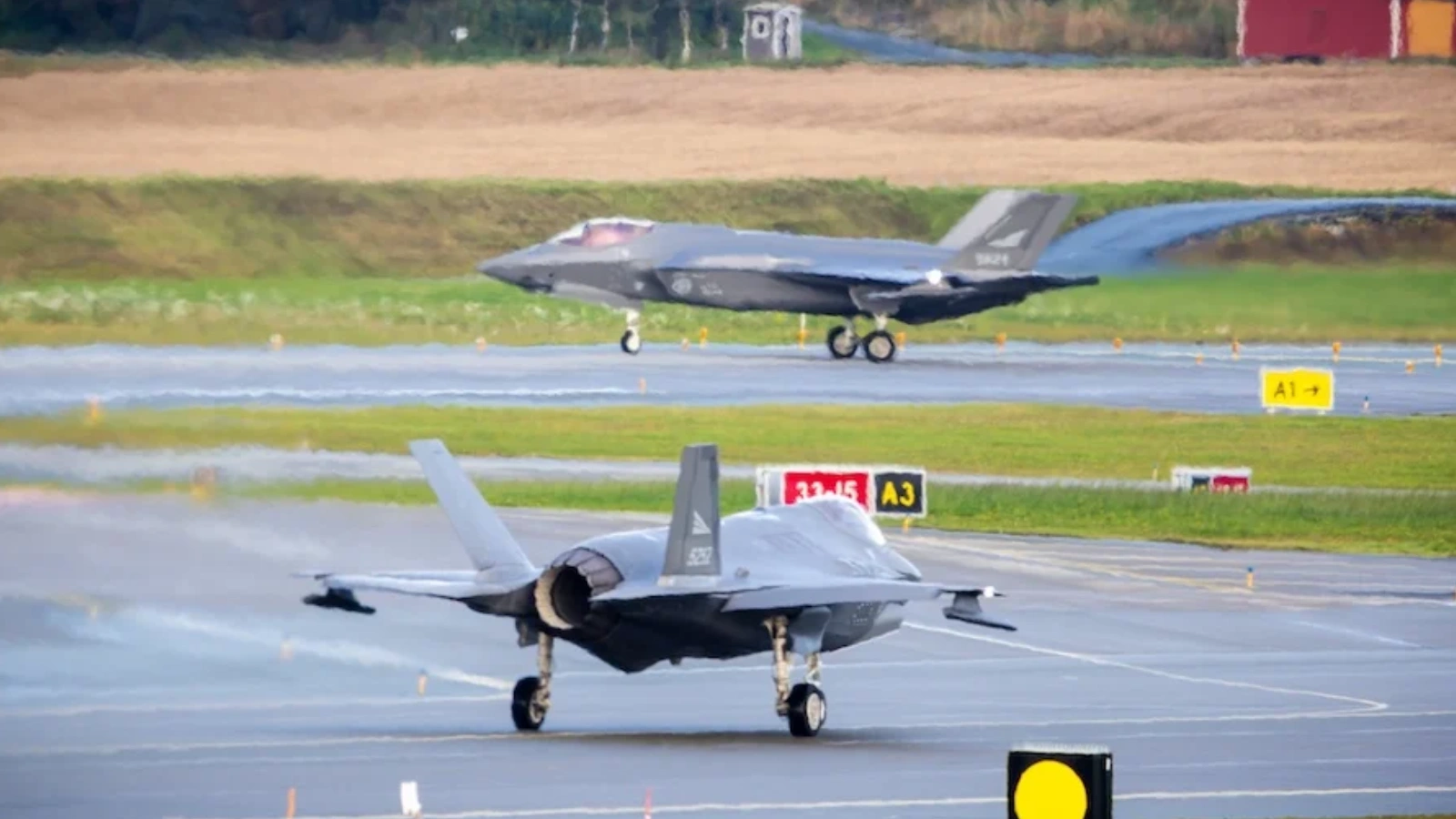
Finland F-35 Pilot Flies in Europe as NATO Cooperation Expands
Finland has taken another step toward integrating its future F-35A fleet into the wider European F-35 operating network, with a Finnish pilot completing the country’s first F-35 flight in Europe during a multinational training event in Norway on September 17.
The flight took place at Ørland Air Base during the airborne phase of Weapons Instructor Course 26, involving F-35 pilots from Finland, Norway, Denmark, the Netherlands, Belgium and the United States. Norwegian and Dutch F-35s were used for the multinational activity.
Executive Summary
- Finland conducted its first Finnish F-35 flight in Europe on September 17, 2026, when a Finnish pilot flew an F-35 during multinational training at Ørland Air Base in Norway.
- The activity brought together F-35 personnel from Finland, Norway, Denmark, the Netherlands, Belgium and the United States and operated under the Capacity on Call cooperation framework.
- The larger significance is logistical as much as operational. The arrangement is designed to allow participating NATO countries to share aircraft, personnel, maintenance support and compatible munitions, reducing the importance of national borders during dispersed F-35 operations.
The event matters because Finland is not simply introducing a new fighter. It is entering an established multinational operating ecosystem in which aircraft, pilots, maintainers and compatible weapons can potentially be used across participating countries.
That model could become particularly important as Finland replaces its F/A-18C/D Hornet fleet with 64 F-35A Block 4 aircraft and builds the domestic infrastructure needed to operate the new fleet through the coming decades. Finland’s government approved the F-35 acquisition in 2021, with deliveries planned through 2030.
Finland’s first F-35 flight in Europe
The September 17 mission was conducted as part of Interfly cooperation during Weapons Instructor Course 26. The Finnish Defence Forces said the activity represented Finland’s first participation in this type of European F-35 cooperation and the first time a Finnish pilot flew an F-35 in Europe.
Six countries were represented in the flight activity: Finland, Norway, Denmark, the Netherlands, Belgium and the United States. The participating forces operated Norwegian and Dutch F-35 aircraft.
This distinction is important. Finland already had F-35 aircraft and personnel involved in the program through U.S.-based training. The September activity demonstrated the next stage, namely using Finnish F-35 personnel inside a European F-35 operating network.
The Finnish Defence Forces said the cooperation will gradually become part of normal Finnish operations as additional F-35 aircraft enter service.
What is the Capacity on Call arrangement?
Finland, Norway, Denmark, the Netherlands and Belgium signed the Capacity on Call memorandum of understanding in 2025. The United States participates through a separate arrangement involving U.S. Air Forces in Europe.
The framework covers three practical areas:
| Area | Purpose |
|---|---|
| Interfly | Allows pilots to operate participating nations’ F-35 aircraft |
| Cross-servicing | Allows maintenance personnel to perform activities such as refueling and between-mission inspections on allied F-35s |
| Armament sharing | Provides for sharing compatible missiles and bombs between participating forces |
The distinction between these functions is operationally significant. Interfly creates flexibility for pilots and aircraft. Cross-servicing addresses the maintenance burden associated with dispersed operations. Armament sharing addresses another potential bottleneck, because an aircraft’s combat availability depends not only on the airframe and crew but also on access to compatible weapons.
The Weapons Instructor Course provided a practical demonstration of several elements. Finnish Defence Forces reporting said Danish pilots flew Norwegian F-35s, Danish bombs were released from Dutch aircraft, and Norwegian F-35s fired Dutch AIM-9X Sidewinder missiles.
Why weapons sharing matters for dispersed F-35 operations
The F-35’s value to NATO is increasingly tied to its ability to operate as part of a distributed force rather than as an isolated national fleet.
A fighter deployed away from its home base requires more than fuel and a runway. It needs trained personnel, maintenance equipment, spare parts, mission support, secure information systems and weapons.
Cross-national arrangements can reduce some of the friction created by separate national support structures.
For Finland, this has a direct geographical dimension. Its F-35 fleet will operate on NATO’s northern flank, where Norway and Denmark already operate the aircraft and where other European F-35 users are expanding their capabilities.
The result is a potential network in which an F-35 detachment can operate with greater access to allied support than would be possible if every aircraft, maintainer and weapon had to remain tied to its national infrastructure.
That does not eliminate national requirements. Each country retains responsibility for its own forces, logistics and weapons inventories, and the Capacity on Call framework covers participating systems and compatible resources rather than creating a single European F-35 fleet.
Finland’s F-35 program is moving from training to force generation
Finland ordered 64 F-35A aircraft to replace its F/A-18 Hornet fleet. The Finnish government selected the F-35 in December 2021, and the procurement package includes aircraft, weapons, training, maintenance equipment, spare parts and other sustainment elements.
The first Finnish F-35A, designated JF-501, arrived at Ebbing Air National Guard Base in Arkansas in January 2026 for the Finnish training program. The first eight Finnish aircraft are being used for U.S.-based training, while aircraft beginning with JF-509 are scheduled for delivery directly to Finland beginning in late 2026, according to Lockheed Martin’s account of the Finnish Air Force program.
The training pipeline is substantial. Finland has planned U.S. training for pilots, maintenance personnel and other specialists, with approximately 150 Finnish personnel scheduled to receive initial F-35 training in the United States.
The September flight therefore sits between two phases of the program.
The first phase established Finnish F-35 expertise through U.S. training. The second phase is the creation of a national operating capability in Finland. European interoperability provides a third layer, allowing Finnish personnel to develop common procedures with other F-35 operators before the Finnish fleet reaches full maturity.
The industrial side of Finland’s F-35 transition
Finland’s F-35 program also includes a significant domestic industrial component.
The original procurement agreement included industrial participation involving Lockheed Martin and Pratt & Whitney. Finnish government documents identified production of F-35 forward fuselages, structural components and equipment testing and maintenance as important elements of the industrial package.
Lockheed Martin says Patria is manufacturing F-35 forward fuselages in Finland and is involved in F135 engine assembly and sustainment activities. The company also identifies cooperation with more than 30 Finnish companies and academic institutions.
This matters to operational availability because Finland is developing more than an aircraft fleet. It is building domestic expertise around maintenance, components and sustainment while simultaneously integrating into the international F-35 logistics system.
The two approaches are complementary.
Domestic capacity can support national resilience, while multinational support arrangements can provide access to a larger pool of expertise, infrastructure and compatible resources.
European F-35 interoperability is becoming a force multiplier
The Finnish development comes as F-35 operators across northern Europe increasingly train as a connected force.
During Ramstein Flag 2026, F-35 aircraft from Denmark, Italy, Norway and the United States operated across northern Europe. U.S. F-35B aircraft also operated from Rovaniemi, Finland, while U.S. Air Force F-35As operated from Pirkkala. Allied Air Command said the exercise demonstrated the ability to disperse fifth-generation airpower and integrate F-35s with other allied capabilities.
Finland’s participation in Capacity on Call adds another layer to that network.
The emerging model is not based simply on buying identical aircraft. It depends on common procedures, shared training, compatible weapons, maintenance interoperability and the ability to move personnel and aircraft between locations.
That is particularly relevant for fifth-generation aircraft because their effectiveness depends heavily on information systems and networked operations, not just individual aircraft performance.
What changes for NATO’s northern flank?
Finland’s entry into the European F-35 community expands the geographic depth of the network.
Norway already operates the F-35 from its northern European bases, while Denmark and the Netherlands are also established European operators. Belgium is entering the same ecosystem, and the United States provides another major source of aircraft, personnel and infrastructure.
Finland adds a country with a long northern border with Russia and a defense structure designed around national territorial defense.
The immediate benefit is interoperability rather than a new weapon capability.
A Finnish pilot flying an allied F-35, a Finnish maintainer supporting an allied aircraft or compatible weapons being used across national boundaries may appear to be relatively small procedural developments. Collectively, however, they can reduce the number of national seams that an adversary could otherwise exploit during a prolonged air campaign.
F-35 cooperation versus the legacy Hornet model
Finland’s Hornet force was developed primarily as a national fleet, although Finnish aircraft have routinely participated in NATO and multinational exercises.
The F-35 introduces a deeper multinational ecosystem because Finland is joining a global user community operating the same basic aircraft architecture.
| Area | Finnish F/A-18 era | Finnish F-35 era |
|---|---|---|
| Primary fighter | F/A-18C/D Hornet | F-35A Lightning II |
| Fleet transition | Hornets scheduled for replacement | 64 F-35As ordered |
| European F-35 network | Not applicable | Finland joins established F-35 community |
| Interfly | Not based on an F-35 common fleet | Covered by Capacity on Call |
| Cross-servicing | Conventional allied support | F-35-specific multinational framework |
| Armament sharing | Existing bilateral/allied arrangements | Formal F-35 compatible-weapon sharing framework |
| Training model | Primarily national plus multinational exercises | U.S. F-35 training plus European interoperability |
The comparison should not be interpreted as meaning that Finnish Hornet operations lacked NATO interoperability. The difference is that the F-35 program creates a much larger common technical and logistical ecosystem around the fighter itself.
The main constraint is still sustainment
The Capacity on Call arrangement improves flexibility, but it does not remove the fundamental sustainment requirements of the F-35.
Aircraft availability depends on maintenance capacity, spare parts, technical personnel, software and data systems, weapons availability and the broader global F-35 support network.
Finland is therefore pursuing two tracks simultaneously.
One is national capability. The other is multinational integration.
That balance is especially important for Finland because the country has emphasized security of supply as a central consideration in its fighter procurement. The original F-35 procurement included maintenance equipment, spare parts, training systems and sustainment services alongside the aircraft.
The September flight demonstrates that interoperability is moving from policy documents into practical flying activity. The more difficult test will be whether the same cooperation can support sustained operations during periods of high demand.
What comes next for Finland’s F-35 fleet?
The next major phase is the transition from U.S.-based training to Finnish operations.
Lockheed Martin says the first eight Finnish aircraft will remain associated with the U.S. training pipeline before eventually being transferred to Finland. Aircraft from JF-509 onward are scheduled for direct delivery to Finland beginning in late 2026.
Finland’s government originally planned for the F-35 fleet to replace the Hornet capability during the 2028 to 2030 period.
The European interoperability framework should therefore become increasingly relevant as Finnish aircraft begin operating from Finnish bases.
The immediate milestone is not the number of aircraft in the Finnish inventory. It is whether Finnish pilots, maintainers, weapons personnel and command structures can function as part of the broader F-35 community without creating additional national-level delays.
That is the strategic significance of the September flight.
Finland has moved from being an F-35 customer undergoing training to becoming an active participant in a European F-35 operating network. The long-term value of the Capacity on Call arrangement will depend on how consistently aircraft, people, maintenance capacity and weapons can be combined during exercises and, if required, sustained operations.
For NATO’s northern flank, that creates a more integrated fifth-generation fighter structure across Finland, Norway, Denmark, the Netherlands, Belgium and the United States.
The aircraft are important. The shared operating system around them may prove just as important.