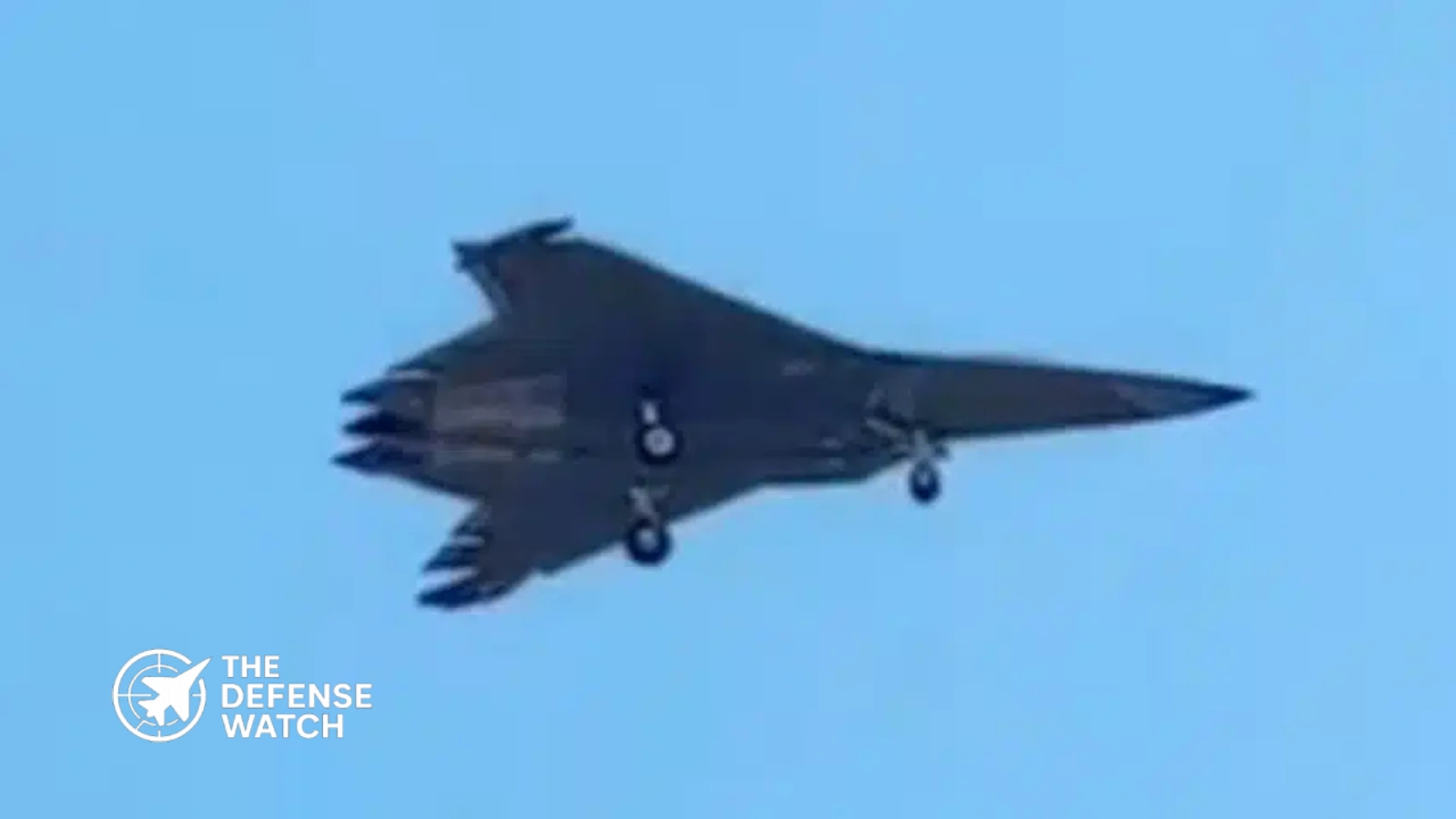
New imagery of China’s Shenyang J-XDS prototype suggests the aircraft may have entered a new phase of flight testing, with a differently colored nose radome raising questions about whether a radar has been installed.
The aircraft was seen in unofficial footage circulating on September 17, showing it flying at low altitude with its landing gear extended. The imagery appears to have been recorded near the Shenyang Aircraft Corporation facility. The J-XDS is frequently referred to by outside observers as the J-50, but China has not publicly confirmed either designation.
Executive Summary
- New unofficial imagery shows a J-XDS aircraft with a differently colored nose radome, prompting analysts to assess whether a radar or related sensor suite has been installed for flight testing. The aircraft is commonly referred to as the J-50, although neither designation has been officially confirmed by China.
- The imagery also appears to show larger engine exhaust nozzles and no clearly visible flight-test probe. Analysts have associated the changed configuration with a more advanced phase of prototype testing, but the radar itself has not been publicly identified or confirmed.
- If the aircraft is now carrying an operationally representative radar, the change would be significant because it could mark a transition from basic aerodynamic and flight-control testing toward integration of the sensors, computing, electronic warfare and weapons systems required for a next-generation air-combat platform.
The most notable change is the nose. Earlier imagery showed a darker or less distinctive nose area, while the latest aircraft appears to have a light-colored radome. Analysts have interpreted that change as potentially indicating the installation of a radar, although the visual evidence alone cannot establish what equipment is inside the radome.
A Changed Radome Could Signal a New Test Phase
A fighter radome provides the aerodynamic enclosure for an aircraft’s forward radar and related equipment. Changes in its color, material or appearance can therefore provide clues about prototype configuration, but they are not definitive proof that a particular radar has been fitted.
The Aviationist reported that a Chinese military aviation observer identified the new radome as a possible indication of radar integration. However, the publication also noted that radome coloration practices vary and that the visual change should not be treated as direct confirmation of a radar.
That distinction is important.
The J-XDS program remains heavily dependent on unofficial imagery because Beijing has not publicly released a detailed program description. Consequently, the identity, frequency characteristics, antenna architecture, electronic warfare functions and processing capability of any radar associated with the aircraft remain unverified.
What the latest imagery shows
Feature Latest observation Confidence Nose radome Differently colored nose section Observed in imagery Radar installation Possible Unconfirmed Flight-test probe Not clearly visible Observed absence in available imagery Engine nozzles Appear larger than earlier examples Observed, interpretation uncertain Engine type Analysts have associated configuration with WS-15 Unconfirmed Aircraft designation J-XDS or J-50 used by outside observers Unofficial Operational status Prototype flight testing Consistent with available evidence The aircraft also appears to have larger exhaust nozzles than previously seen configurations. Defense aviation researcher Andreas Rupprecht has associated the change with possible WS-15 engine installation, although that identification is not confirmed by an official Chinese source.
Why Radar Integration Matters More Than the Radome Color
The important development is not the color of the radome itself. It is what radar integration would allow the test program to evaluate.
A next-generation fighter cannot be assessed solely through aerodynamic flight testing. Once a representative radar is installed, engineers can begin evaluating the interaction between the sensor, aircraft structure, power generation, cooling, mission computers, electronic warfare equipment and flight-control systems.
For a stealth aircraft, the radar also becomes part of the broader signature-management problem.
The antenna aperture, radome, cooling equipment and associated electronics have to operate without undermining the aircraft’s low-observable design. This makes sensor integration particularly important for a tailless aircraft such as the J-XDS.
The latest imagery therefore potentially represents a transition from testing the aircraft as an airframe toward testing it as an integrated combat system.
That remains an assessment rather than a confirmed program milestone.
J-XDS Configuration Is Becoming More Significant
The J-XDS has attracted attention because of its unusual tailless configuration and movable wingtip control surfaces.
Earlier imagery indicated a large, streamlined forward fuselage, an electro-optical or infrared sensor beneath the nose and internal weapon accommodation. A technical review published by Asia Pacific Defence Reporter also identified the aircraft as a twin-engine, tailless design with two-dimensional thrust-vectoring exhausts and unusual articulating wingtips.
The latest configuration adds another potentially important element: a more clearly defined radome.
If a radar is now being tested, the aircraft could be entering the stage at which designers evaluate how the sensor works with the aircraft’s other systems rather than testing each subsystem independently.
That distinction matters because modern air combat increasingly depends on sensor fusion rather than the performance of a single radar.
The Sensor Is Only One Part of the Architecture
China’s next-generation fighter effort is being discussed in the context of a broader shift toward highly networked combat aircraft.
A recent paper from researchers at the Shenyang Aircraft Design & Research Institute described concepts including autonomous flight assistance, operation in satellite-denied environments and cooperation between crewed aircraft and reconfigurable unmanned wingmen. The paper did not identify the J-XDS by name or confirm that the aircraft incorporates those specific technologies.
That caveat is important.
Nevertheless, the concepts described in the research provide useful context for understanding why radar integration alone would not define the aircraft’s combat capability. A future air-superiority platform would need to combine sensing, electronic warfare, communications, onboard processing, weapons and unmanned systems into a single mission architecture.
A radar test would therefore be one step in a much larger integration process.
Comparison With the U.S. F-47 Program
The emerging Chinese test activity can be compared with the publicly disclosed U.S. Next Generation Air Dominance program, but the two programs are at different publicly observable stages.
The U.S. Air Force awarded Boeing the Engineering and Manufacturing Development contract for the F-47 in March 2025. The contract includes maturation, integration and testing of the aircraft and options for low-rate initial production. The Air Force has also said that earlier experimental aircraft had accumulated flight-test experience before the F-47 development contract was awarded.
Public information on the F-47’s radar, electronic warfare suite, weapons and detailed performance remains classified.
That makes direct capability comparisons with the J-XDS unreliable.
Area J-XDS / J-50 U.S. F-47 Program status Prototype flight testing reported Engineering and manufacturing development Publicly observed aircraft Yes, unofficial imagery No operational aircraft imagery released Radar Possible integration indicated by imagery, unconfirmed Details classified Configuration Tailless, twin-engine prototype Detailed configuration classified Unmanned teaming Discussed in Chinese research, not confirmed for J-XDS Part of broader NGAD family concept Official designation Not publicly confirmed F-47 officially designated Production status No public production decision identified EMD contract includes LRIP options The comparison illustrates a key problem with claims that one side is simply ahead of the other.
Visible prototype activity is not the same thing as operational capability.
China’s J-XDS can be photographed in flight while critical information about its radar, electronic warfare systems, weapons and mission computers remains unavailable. The F-47, meanwhile, has a formal U.S. development program but similarly limited public technical information.
The meaningful benchmark will eventually be integration, testing, production capacity, availability and operational deployment rather than the date on which an aircraft is first photographed with a new radome.
Radar Integration Could Change the Intelligence Picture
For outside observers, a functioning radar would provide an important indication that the J-XDS program is moving beyond basic airframe development.
It could also enable more detailed assessment of the aircraft’s nose architecture and sensor integration.
However, imagery alone cannot establish whether the radar is a developmental unit, an engineering test article, a production-intent system or simply a non-operational installation used to evaluate fit and environmental effects.
This is where the current evidence has to be separated into three categories:
Observed: The aircraft has appeared with a differently colored nose radome, larger-looking exhaust nozzles and no clearly visible flight-test probe in the available imagery.
Reported by analysts: The radome could indicate radar installation, while the engine changes may relate to WS-15 integration.
Not established: The radar’s type, power, frequency bands, antenna configuration, detection range, electronic warfare capability and combat readiness.
That last category is particularly important because no reliable primary-source performance figures are publicly available.
China Is Testing More Than a New Fighter Shape
The wider significance of the J-XDS is its potential role within China’s transition from fifth-generation fighters toward a more distributed air-combat architecture.
The People’s Liberation Army has already invested heavily in airborne sensing, long-range weapons, electronic warfare, unmanned systems and space-based surveillance. The Pentagon’s 2025 China Military Power Report describes China’s expanding C4ISR architecture and a large space-based intelligence, surveillance and reconnaissance presence supporting military operations.
A next-generation fighter operating within that architecture would not necessarily need to perform every sensing function itself.
Instead, its value could come from combining onboard sensors with offboard information from other aircraft, unmanned platforms, satellites and ground or maritime systems.
That makes the development of the aircraft’s mission architecture at least as important as the shape of its airframe.
What to Watch Next
Several developments would provide stronger evidence that the J-XDS has moved into advanced systems integration.
A clearly identifiable radar
Additional imagery showing the radar aperture or consistent evidence of a functional sensor installation would strengthen the assessment that radar flight testing has begun.
Repeated flight activity
Multiple aircraft appearing with the same configuration would provide stronger evidence that the change is part of a deliberate test configuration rather than a temporary engineering modification.
New sensor and antenna features
Changes around the nose, fuselage or wing roots could reveal additional electronic warfare, communications or passive sensing equipment.
Weapons testing
Visible internal weapons-bay testing or controlled weapons trials would represent a more significant step toward combat-system integration.
Official Chinese disclosure
The most authoritative confirmation would come from China’s defense establishment or aircraft industry. To date, public information remains dominated by unofficial imagery and outside analysis.
Strategic Implications
The J-XDS program matters because it demonstrates the increasing difficulty of assessing China’s next-generation airpower through conventional milestones.
The important question is no longer simply when China can fly a new stealth fighter.
It is whether China can integrate that aircraft into a wider combat network, equip it with sufficiently capable sensors and electronic warfare systems, produce it at scale, maintain it at useful availability and connect it with unmanned and offboard systems.
The latest imagery potentially marks progress on one part of that problem.
It does not yet establish the aircraft’s combat capability.
For the United States and its allies, the development reinforces the importance of treating China’s next-generation fighter effort as a systems-development challenge rather than simply a race between individual aircraft. The U.S. response through the F-47 and the wider NGAD family is similarly structured around an aircraft, sensors, networking, autonomy and supporting systems rather than a standalone fighter.
The J-XDS radar question will therefore be worth following, but the more consequential milestones will be the aircraft’s progression toward integrated mission-system testing and, eventually, a production-standard configuration.