
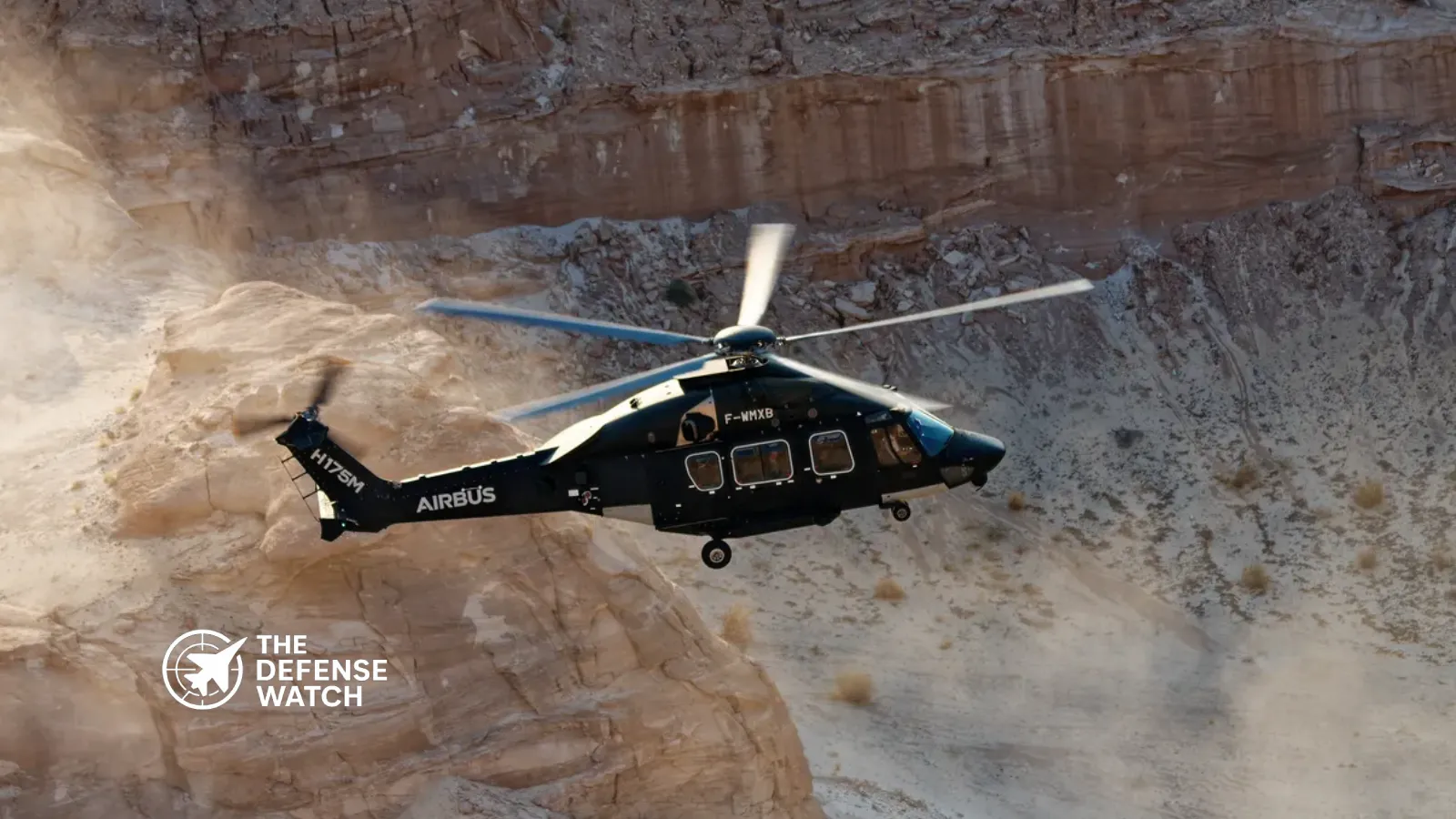
Airbus H175M Proves Exceptional Range Capabilities In Middle East Operations
The Airbus H175M military helicopter has successfully demonstrated its superior operational range and performance capabilities during rigorous evaluation flights conducted in Saudi Arabia’s challenging desert environment, according to official company reports released in November 2023.
During demonstration flights that included a critical 486 nautical mile journey from Riyadh to Abha—a mountainous region at elevation—the H175M showcased range capabilities that Airbus officials say exceed competing platforms by nearly 100 percent when operating on standard fuel tanks.
Military Helicopter Demonstrates 600 NM Range Advantage
Alain Fugit, Utility Market Segment Manager at Airbus Helicopters, emphasized the H175M’s efficiency as its defining characteristic in the military rotorcraft market. The aircraft’s 600-pound weight reduction compared to direct competitors, combined with equivalent passenger capacity, translates to a maximum range of approximately 600 nautical miles on standard fuel tanks—nearly double that of rival platforms.
“If our helicopter weighs 600kg less than its competitors, accommodates the same number of people on board and flies much further… That’s real efficiency,” Fugit stated in the company’s official account of the demonstration tour. “When both are operating on standard tanks the H175M can fly nearly twice as far as its rival, 600 NM.”
The extended range capability addresses evolving battlefield requirements where long-range precision fires are expanding threat zones. Ukrainian combat operations have demonstrated that military helicopters must operate from staging areas beyond the 80-kilometer range of modern artillery systems, making the H175M’s endurance particularly relevant for contemporary military operations.
Extreme Altitude Operations Validate Advanced Flight Systems
Test pilot Christophe Prunel reported the demonstration aircraft completed the Riyadh-to-Abha flight segment departing with two tonnes of fuel and landing with 470 kilograms remaining—representing substantial operational reserves beyond minimum requirements.
Flight operations at Jabal Sawda, Saudi Arabia’s highest peak at 9,700 feet elevation, provided critical validation of the H175M’s performance at high density altitudes. Operating at density altitudes approaching 12,000 feet, the helicopter demonstrated automated hover capabilities for simulated firefighting and personnel recovery missions.
“We hovered there automatically to perform the winch demonstration,” Prunel reported. “That also impressed them.”
The H175M features a helicopter-specific autopilot system that operates based on altitude rather than airspeed, providing precise low-speed control during critical mission phases including targeting, observation, and landing approaches. This design philosophy distinguishes the system from fixed-wing aircraft autopilots adapted for rotary-wing applications.
Vibration-Free Platform Enhances Combat Effectiveness
The H175M’s absence of low-speed vibration provides measurable advantages for military operations. Unlike competing platforms that experience significant vibration at tactical speeds, the H175M offers a stable observation and weapons platform critical for accuracy during engagement operations.
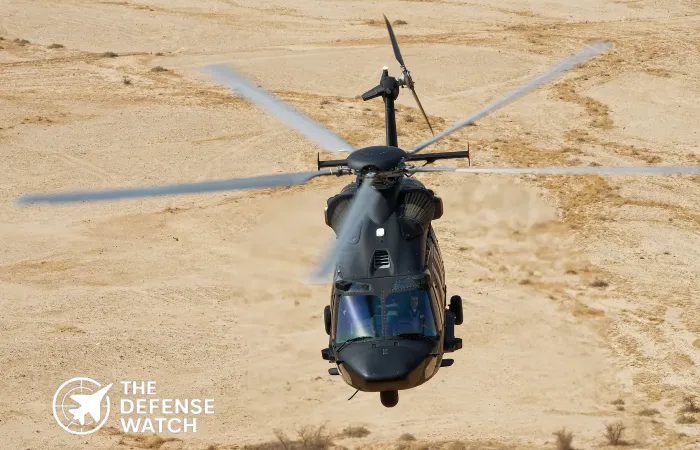
“Some competing platforms experience a great deal of vibration at low speeds,” Fugit explained. “In the military market, low-speed vibration is not just about comfort. A military helicopter is an observation platform. If it doesn’t vibrate, you can observe much better.”
The stable platform characteristics support precision weapon employment and enhance sensor performance during intelligence, surveillance, and reconnaissance missions where sustained observation is required.
Environmental Performance In Extreme Desert Conditions
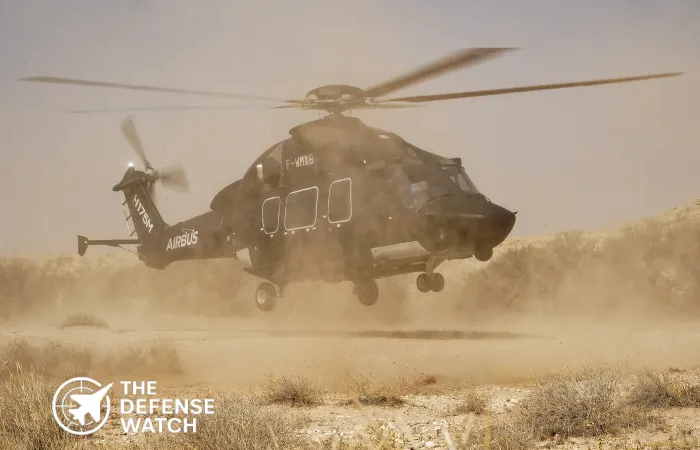
Saudi Arabian desert operations validated the H175M’s environmental protection systems under harsh operating conditions. Anti-sand filtration systems successfully protected the aircraft’s Pratt & Whitney Canada PT6C-67E turboshaft engines during operations from unprepared landing zones in desert terrain.
The demonstration included operations during sandstorms, high-temperature conditions, and severe turbulence. The aircraft’s environmental control system maintained cabin temperatures suitable for mission personnel even during extended flights in ambient temperatures exceeding 40 degrees Celsius.
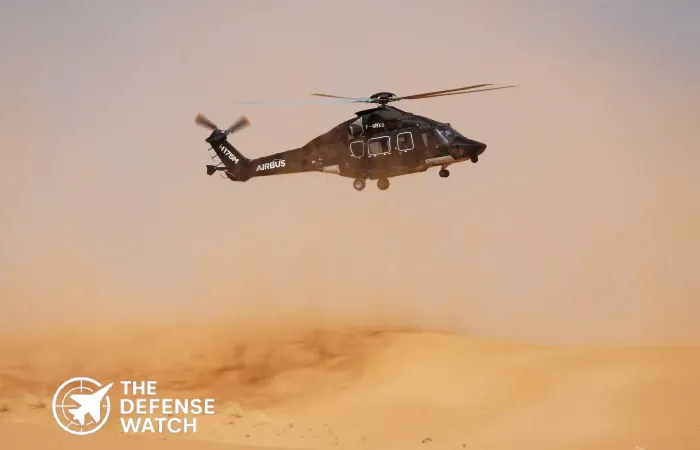
“Sand is an enemy, so the helicopter was equipped with anti-sand filters that served us well on the flights we did, proving that we could land in the dunes and that the filters did their job of protecting the engines,” Prunel reported.
Troop Carrying Capacity Supports Special Operations
The H175M accommodates up to 15 combat-equipped personnel in its super-medium class cabin, providing flexibility for special operations and conventional troop transport missions. The spacious cabin configuration supports casualty evacuation operations with multiple stretcher positions while maintaining medical attendant working space.
Reduced noise levels, minimal vibration, and effective climate control systems minimize crew fatigue during extended missions—a critical factor for special operations forces who must maintain combat effectiveness immediately following insertion flights.
“A military mission could involve flying these commandos for three hours and then landing for their operation,” Prunel noted. “If, after three hours, the soldiers arrive and are uncomfortable, they may not be at their best to do their job on the ground.”
Civil-Military Duality Leverages 200,000 Flight Hours
The H175M benefits from Airbus Helicopters’ dual-range strategy, incorporating systems and components proven in civil offshore energy sector operations. The civil H175 variant has accumulated more than 200,000 flight hours, primarily with energy industry operators known for demanding maintenance and reliability standards.
This operational heritage provides the military variant with mature systems, established maintenance procedures, and continuously upgraded avionics packages that benefit from ongoing civil market development.
“The duality of the Airbus range means that we have civil helicopters that are tried and tested,” Fugit stated. “The H175M will therefore benefit from the safety and maintenance standards of the civil market—and avionics which are continuously upgraded.”
Combat-Proven Design Heritage Informs Development
Airbus Helicopters’ military portfolio includes combat-proven platforms including the Tiger attack helicopter, NH90 tactical transport, H145M light utility helicopter, and H225M heavy-lift rotorcraft—all deployed in active combat zones including Afghanistan, Mali, and ongoing Middle East operations.
This operational experience directly informs H175M development priorities including mission system integration, survivability features, and operational flexibility requirements.
The modular mission system architecture accommodates undefined future requirements—a critical capability for military customers who must maintain operational flexibility across unpredictable mission sets and deployment locations.
Strategic Implications For Military Aviation Procurement
The H175M addresses emerging military requirements for extended-range rotorcraft capable of operating in contested environments where long-range fires have expanded threat areas beyond traditional helicopter operating zones.
Its combination of range, payload capacity, and advanced automation systems positions the platform for consideration in military aviation modernization programs across Europe, the Middle East, and Asia-Pacific regions where nations are recapitalizing aging helicopter fleets.
Defense analysts note that super-medium military helicopters represent a growing market segment as armed forces seek platforms offering greater capability than light utility helicopters while maintaining lower operating costs than heavy-lift types.
The Saudi Arabian demonstration flights represent Airbus Helicopters’ strategy of providing potential customers with hands-on evaluation opportunities in operationally representative environments, allowing military decision-makers to validate manufacturer performance claims under realistic conditions.
Get real time update about this post category directly on your device, subscribe now.
