• Home
  • About
  • Defense Systems
  • Manufacturer
  • Comparisons
  • Compare 
  • Tools
TheDefenseWatch.com
  • Aerospace & Aviation
  • Military & Ordnance
  • Naval & Maritime
  • Cyber & Space Defense
  • Policy & Strategy
  • Global News
  • Tools Library
    • Smart Calculator
    • Drone Flight Time Calculator
    • Drone Range Calculator
    • Counter-Drone Jammer Effective Range Calculator
    • Counter-Battery Radar Detection Calculator
    • Artillery Fire Correction Calculator
    • Thermal Camera Detection Range Calculator
    • Missile Range & Time-of-Flight Calculator
    • Radar Detection Range Calculator
    • FPV Strike Drone Payload vs Range Calculator
    • Loitering Munition Endurance Calculator
    • Sniper Ballistic Drop & Windage Calculator
    • Bullet Drop Calculator
    • U.S. Army Combat Fitness Test (ACFT) Calculator
    • Military Pension Calculator
    • Military Retirement Calculator
    • Military Pension Calculator
    • Large Number Calculator
Font ResizerAa

TheDefenseWatch.com

The Defense Watch | U.S. & Global Defense News, Analysis & Military Updates

Search
  • Home
  • About
  • Defense Systems
  • Manufacturer
  • Comparisons
  • Compare 
  • Tools

Stay Updated

Get the latest update

Subscribe

Explore

  • Drone
  • Fighter Jets & Military Aircraft
  • Hypersonic Weapons
  • Aircraft Carriers
  • Strategic History & Missions
  • Tools Library
Home » US and South Korea to Build Navy Underwater Drone Swarms to Counter China
Global News

US and South Korea to Build Navy Underwater Drone Swarms to Counter China

TeamDefenseWatch
Last updated: December 11, 2025 10:13 am
TeamDefenseWatch
Share
2 Min Read
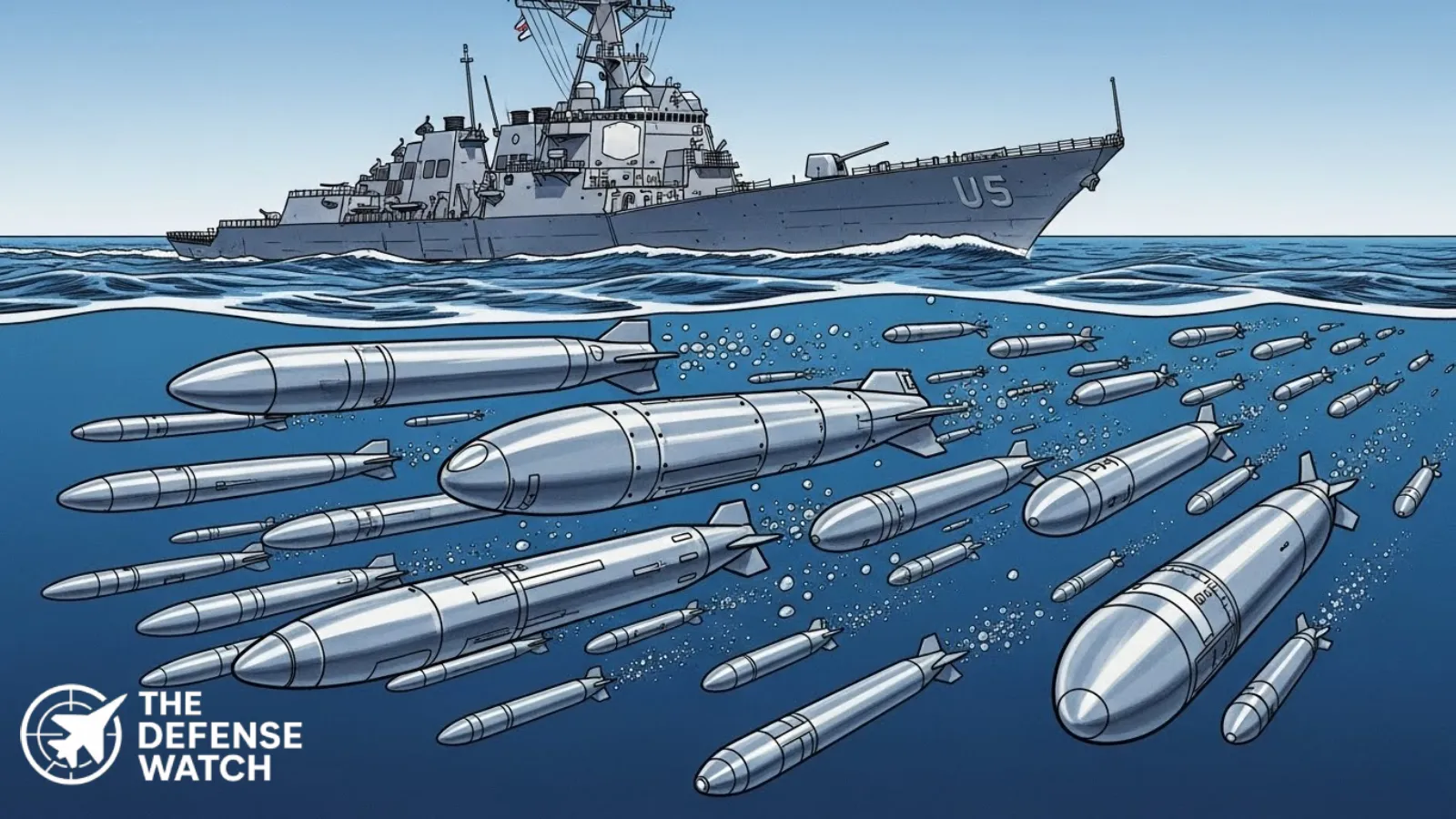
US South Korea underwater drone swarms
Conceptual illustration
SHARE

US and South Korea Agree to Build Underwater Drone Swarms for Indo-Pacific Security

In a move aimed at strengthening undersea capabilities against China’s growing maritime presence, the United States and South Korea have agreed to co-develop low-cost autonomous underwater drone swarms for the US Navy. The deal, announced in December 2025, pairs South Korea’s Hanwha Group with US defense startup Vatn Systems to accelerate production of scalable underwater systems that can perform surveillance and strike missions across contested littoral waters.

Contents
US and South Korea Agree to Build Underwater Drone Swarms for Indo-Pacific SecurityBackground on Underwater Autonomy and Strategic NeedPartnership Details and TechnologyStrategic Context and US Naval GoalsExpert and Policy PerspectivesLooking Ahead

Background on Underwater Autonomy and Strategic Need

Pressure on undersea dominance in the Indo-Pacific has risen with China’s rapid naval modernization and expanding fleet of submarines and unmanned systems. The region’s contested sea lines of communication and geographic chokepoints have highlighted the need for novel approaches to maritime security and deterrence. Autonomous underwater systems offer a way to extend presence and sensing without exposing crewed vessels to risk.
US South Korea underwater drone swarms

The Republic of Korea Navy (ROKN) has also been expanding its unmanned maritime portfolio, including surface and underwater vehicles, as part of a broader shift toward autonomy and distributed operations. South Korean industry has been active in the global market for unmanned maritime systems and has developed platforms ranging from surveillance AUVs to concepts for larger anti-submarine unmanned underwater vehicles and unmanned surface vessels.

Partnership Details and Technology

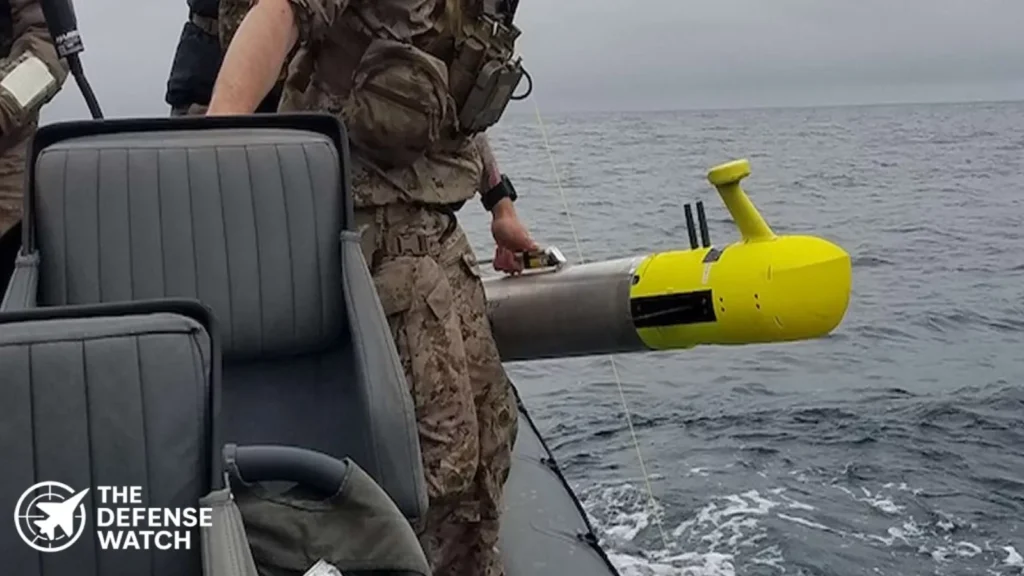
Under the agreement, Hanwha and Vatn Systems will jointly produce autonomous underwater drones based on Vatn’s Skelmir S6 design, often described as a compact modular underwater effector. These torpedo-shaped vehicles weigh about 50 to 60 pounds, measure roughly 6 inches in diameter, and can carry payloads between 10 and 20 pounds. They can reach speeds up to 20 knots and operate out to about 20 nautical miles at depths around 100 meters.

- Advertisement -

The drones are designed for expendability and mass deployment. Vatn’s mission software enables a single operator to plan and monitor hundreds of vehicles at once using mobile tactical systems. Launch options include shore sites, small boats, submarines, surface combatants, or aircraft, giving commanders flexible deployment options in response to evolving threats.

The S6 platform is built to accept a range of mission payloads including kinetic warheads, electronic warfare modules, or cyber and sensor packages without extensive integration into host platforms. At an estimated unit cost of about 75,000 US dollars, these systems are far cheaper than traditional large UUVs or crewed platforms, enabling saturation tactics across strategic maritime zones.

Hanwha, already a major supplier of submarines, mine countermeasure systems, and unmanned maritime vehicles for the ROKN, brings industrial scale and integration expertise. Its shipyard capacity in South Korea and the United States will support scaling Vatn’s small batch innovations into production-level quantities.

Strategic Context and US Naval Goals

For the US Navy, the partnership fits into broader efforts to field large numbers of affordable autonomous systems under initiatives like the Pentagon’s Replicator program. Replicator calls for thousands of attritable unmanned systems across domains to offset adversary numerical advantages, particularly in contested Indo-Pacific waters where GPS denial and electronic disruption can degrade traditional platforms.

Analysts see the mass use of cheap autonomous effectors as a way to create undersea “saturation zones” that can act like mines, screen high-value units, or detect and pursue enemy submarines. The approach reflects a shift toward distributed maritime operations and layered defense strategies that rely on both crewed and uncrewed assets.

For Seoul, the agreement deepens defense industrial cooperation with Washington and accelerates technology transfer in autonomy software, networking, and certification standards consistent with US Navy requirements. It also offers South Korea a pathway to adapt the effector family for its own needs, including mine hunting, port defense in the Yellow Sea, and layered anti-infiltration barriers around key naval installations.

Expert and Policy Perspectives

Experts note that affordable autonomous systems are rapidly reshaping naval planning. Massed underwater drones could complicate adversary maneuvers by forcing them to account for extensive sensor networks and potential strike vectors. Low unit cost gives commanders the option to deploy swarms at scale, changing how sea control and denial might be executed in high-intensity conflict scenarios.

The partnership also signals a shift in alliance industrial ties. Hanwha’s recent investments in Vatn, including a reported 60 million dollar funding round, bind South Korean defense industrial capacity more closely to US military needs. This comes amid broader US efforts to diversify defense supply chains with allied participation and enhance interoperability across platforms and systems.

- Advertisement -

Policy observers argue that such cooperation helps address capability gaps in a region where China has invested heavily in undersea platforms and counter-access strategies. Autonomous systems may not replace traditional submarines and crewed vessels, but they offer a complementary set of tools that could deter or blunt adversary action by complicating their operational calculus.

Looking Ahead

The Hanwha-Vatn agreement sets the stage for rapid experimentation, testing, and scaling of autonomous underwater drones within the next few years. Key milestones to watch include field trials with the US Navy, integration with existing fleet and littoral combat systems, and export or allied adoption across the Indo-Pacific. Future exercises may reveal how these systems operate alongside crewed assets and complement broader distributed maritime operations.


TAGGED:HanwhaIndo Pacific securitynaval autonomyunderwater drones
Share This Article
Facebook Copy Link Print
ByTeamDefenseWatch
TeamDefenseWatch is the official editorial byline of TheDefenseWatch.com. Working under one umbrella, TheDefenseWatch.com, the team delivers verified, factual reporting on global defense, military technology, aerospace systems, and security developments. Articles are sourced from official statements, defense industry releases, and trusted media, with editorial review to ensure accuracy and clarity.Contact: info@TheDefenseWtach.com

Search Defense Systems

Latest Defense Systems

  • B61 Nuclear Bomb B61 Nuclear Bomb
  • Japan E-767 Airborne Japan E-767 Airborne
  • Remington 870 Shotgun Remington 870 Shotgun
  • RUTA B1 Cruise Missile RUTA B1 Cruise Missile
  • XQ-67A Drone XQ-67A Drone
  • B-25 Mitchell Bomber B-25 Mitchell Bomber
  • F-100 Super Sabre F-100 Super Sabre
  • North American F-86 Sabre North American F-86 Sabre
  • North American XB-70 Valkyrie North American XB-70 Valkyrie

Recent Compares

  • J-10C vs JF-17 Thunder: Which Fighter Is More Capable? J-10C vs JF-17 Thunder: Which Fighter Is More Capable? View Comparison →
  • Tejas vs Gripen: Key Differences and Capabilities Tejas vs Gripen: Key Differences and Capabilities View Comparison →
  • Tejas vs MiG-21 Bison: How India Replaced Its Iconic Supersonic Fighter Tejas vs MiG-21 Bison: How India Replaced Its Iconic Supersonic Fighter View Comparison →
  • F-35 vs F-16: Stealth, Sensors and Combat Roles F-35 vs F-16: Stealth, Sensors and Combat Roles View Comparison →
  • Tejas Fighter Jet vs F-16 Fighting Falcon: Capability Compared Tejas Fighter Jet vs F-16 Fighting Falcon: Capability Compared View Comparison →
  • Rafale Fighter Jet vs F-16 Fighting Falcon : Which Fighter Has the Edge? Rafale Fighter Jet vs F-16 Fighting Falcon : Which Fighter Has the Edge? View Comparison →
  • Su-57 Fighter Jet vs J-20 Fighter Jet: Stealth and Air Combat Compared Su-57 Fighter Jet vs J-20 Fighter Jet: Stealth and Air Combat Compared View Comparison →
  • Mirage 2000 vs Tejas Mk1A: Legacy Combat Power vs Indigenous Modernization Mirage 2000 vs Tejas Mk1A: Legacy Combat Power vs Indigenous Modernization View Comparison →
  • Rafale Fighter Jet vs F-22 Raptor: Which Air Dominance Fighter Has the Edge? Rafale Fighter Jet vs F-22 Raptor: Which Air Dominance Fighter Has the Edge? View Comparison →
  • Tejas Fighter Jet vs. Rafale Fighter Jet: India’s Indigenous Fighter Meets France’s Proven Multirole Combat Aircraft Tejas Fighter Jet vs. Rafale Fighter Jet: India’s Indigenous Fighter Meets France’s Proven Multirole Combat Aircraft View Comparison →

Recent Posts

  • General Atomics to Supply Components for U.S. Army and Navy Hypersonic Weapons
  • Lockheed Martin Tests Mk21A Reentry Vehicle for Sentinel ICBM
  • Lockheed Martin Wins $122.4 Million Trident II Navigation Contract
  • Pentagon Prepares Review of Military Legal System and JAG Corps
  • U.S. and Colombia Launch Southern Vanguard 2027 Exercise

You Might Also Like

U.S. Army proof gun system conducting artillery ammunition testing at Yuma Test Center in Arizona
Global News

U.S. Army Deploys New Proof Gun System To Strengthen Artillery Testing Capability

May 8, 2026
Babcock French military pilot training
Global News

Babcock Wins French Military Pilot Training Contract To Expand Air Force And Navy Flight Instruction

February 12, 2026
Tor-E2 Air Defense System
Global News

Russia Showcases Tor-E2 Short-Range Air Defense With 360° Engagement at Dubai Airshow 2025

November 23, 2025
Spain frigate F-102 deployment
Global News

Spain Deploys Frigate Almirante Juan de Borbón (F-102) to Lead NATO Maritime Group 1

January 10, 2026

Logo

Copyright © 2026 TheDefenseWatch.com

Helpful Links

  • Home
  • About Us
  • Privacy Policy
  • Terms of Use / Disclaimer
  • U.S. Privacy Notice – CCPA Compliance

Defense Systems

  • Defense Systems
  • Comparisons 
  • Manufacturer
  • Tactical Calculators

Popuplar

Which 5 Air Forces Possess the Costliest Fighter Jet Fleets in the World
Evolving Strategic Value: Carrier Strike Groups in the Indo-Pacific’s Future Security Architecture
Autonomous Weapon Systems Spark U.S. Ethics Debate Amid Rapid Military AI Integration

We report on developments involving military forces, governments, defense companies, research organizations, and security institutions around the world. 

Welcome Back!

Sign in to your account

Username or Email Address
Password

Lost your password?