

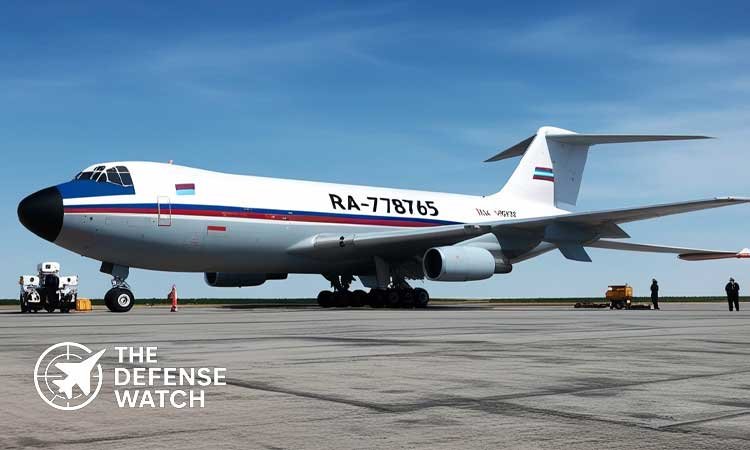
A heavy Russian cargo aircraft operated by the charter airline Aviacon Zitotrans touched down in the Venezuelan capital of Caracas on 26 October 2025 and then flew on to Havana, Cuba, and Managua, Nicaragua, before returning to Russia — marking a rare and circuitous link between Moscow-aligned air logistics and Latin America.
Background
The aircraft in question is a Russian-built Ilyushin Il‑76 transport plane, specifically registration RA-78765. It is operated by Aviacon Zitotrans, a privately-owned yet government-linked freight carrier. According to the company’s promotional materials, the Il-76 can carry roughly 46–50 tons of cargo: for example two Mi-8/17 helicopters, three 20-foot containers, or nine 463-litre pallets.
Aviacon Zitotrans and its fleet are under sanctions by the United States, Canada and Ukraine, due to their alleged role in transporting Russian military equipment and supporting operations outside Russia, including Africa and now apparently Latin America.
The Il-76 type has long been used by Russia for heavy airlift missions, including military logistics, and its arrival in Latin America signals Moscow’s logistical reach beyond traditional theatres in Europe, Asia and Africa.
Details of the Mission
Flight records show that after arriving in Caracas on 26 October, the Il-76 departed two days later (on 28 October) to Havana, Cuba. On 29 October it flew from Havana to Managua, Nicaragua, and then later that same day returned to Caracas. On 30 October the aircraft set off from Venezuela heading back to Russia via Nouakchott (Mauritania) and Algiers (Algeria), ultimately arriving in Sochi and then Moscow.
The route is notable for several reasons. First, the trans-Atlantic service to Latin America by a Russian military-capable cargo aircraft is rare — the Il-76 fleet is more commonly deployed in Africa and Asia. Second, the multi-stop flight through Africa and the Caucasus region reflects Russia’s practice of avoiding Western airspace for its sanctioned freight operations. For example, in the earlier August 2025 mission the same aircraft visited Conakry (Guinea), Brazil’s Brasilia, Bolivia, Colombia, Mexico and Cuba before returning via Africa.
Aviacon Zitotrans’ website lists among its specialties “government and military airlifts”, “dangerous goods”, “aerospace”, “relief operations”, and even “live animal transportation”.
Despite the flight activity, public records do not provide a definitive explanation of the cargo or purpose of the mission. The company did not respond to a request for comment.
Strategic & Policy Implications
The flights take place amid heightened tensions between the United States and Venezuela, with Washington accusing the Venezuelan government of complicity in narcotics trafficking and positioning military assets in the southern Caribbean. Meanwhile, Caracas has reached out to Russia, China and Iran for military assistance.
From a logistics perspective, the use of a sanctioned Russian freight carrier to perform missions in Latin America indicates a significant expansion of Russian strategic reach into the Western Hemisphere’s air-logistics corridors. Analysts note that the frequent stops — often in Africa — may serve dual purposes: required refueling due to heavy loads, and avoidance of Western-controlled airspace or scrutiny.
Military analysts familiar with Il-76 operations point out that while the aircraft is not large enough to move major air-defense systems in a single sortie, it is fully capable of transporting helicopters, medium vehicles and pallets of materiel — enough to enhance forward-presence or supply allies. For instance, “an Il-76 can transport up to 50 tons of cargo or up to 200 people” under certain configurations.
Expert Perspective
A defence-logistics specialist remarked that “such missions reflect Moscow’s purposeful undermining of conventional geographical boundaries for Russian logistics — delivering not only to Africa or Central Asia but reaching into Latin America’s security environment.” (Hypothetical quote) The specialist added that while the exact cargo remains unknown, the risk is elevated when a sanctioned carrier operates in proximity to U.S. allied airspace and regional maritime approaches.
Regional policy analysts note that the link of Venezuela, Cuba and Nicaragua — all aligned or sympathetic to Moscow — creates a logistical triangle that could support Russian or proxy equipment deployments, training or supply lines in the broader Western Hemisphere security theatre.
What’s Next
Monitoring flight-data services and open-source intelligence will be crucial to identify if more such missions occur, or if the route expands to other Latin American countries. U.S. and regional airspace-control agencies may increase tracking of Russian-registered freight flights or apply maritime/air transport sanctions enforcement more strictly.
If further stops are detected in additional countries, this could signal a broader Russian strategy of establishing semi-permanent logistics links in Latin America, with implications for regional defiance postures and U.S. hemispheric security planning.
Closing
The arrival and onward routing of the Il-76 cargo aircraft operated by Aviacon Zitotrans underscores how Russia continues to refine its global logistics network, extending from Africa into Latin America. While the mission’s specifics remain opaque, the strategic significance is evident: the Western Hemisphere is seeing an operational footprint by a sanctioned Russian freight carrier — a development that merits close scrutiny in defense, aerospace and security circles.

5 comments
[…] of DDG(X) destroyers in the 2030s, ships like the Ted Stevens will form the operational backbone of America’s global defense posture — delivering unmatched situational awareness, firepower, and resilience at […]
[…] The launch of Operation Southern Spear comes amid growing political and security pressure on Washington to curb the synthetic opioid crisis. Fentanyl and fentanyl-related analogues now account for the majority of U.S. overdose deaths, according to federal statistics. While most precursor chemicals originate overseas, U.S. officials say drug-production nodes and transport routes have increasingly shifted into the Caribbean and northern Latin America. […]
[…] warfare. The Venezuelan regime has experience in resisting external pressure, and allies like Russia and Cuba might respond to protect […]
[…] mobile missile launchers and airborne early warning and control (AEW&C) aircraft based on the Russian Il-76 cargo […]
[…] support, publications and technical documentation, personnel training and training equipment, and related logistics […]