General Atomics Electromagnetic Systems (GA-EMS) will manufacture critical components for two U.S. military hypersonic weapon programs under a multiyear subcontract with Leidos, extending the company’s involvement in the Common Hypersonic Glide Body (CHGB) program through 2031.
Announced on November 4, the agreement covers precision-machined components and cable assemblies for the shared glide body used by the U.S. Army’s Long-Range Hypersonic Weapon (LRHW), known as Dark Eagle, and the U.S. Navy’s Conventional Prompt Strike (CPS) program.
The subcontract moves GA-EMS beyond its earlier prototype manufacturing and flight-test support work into a longer-term production role. Its financial value, however, has not been publicly disclosed.
The work falls under Leidos’ broader Army hypersonic weapons development and production contract, awarded in March 2026. General Atomics is a subcontractor on that effort, not the recipient of the main $2.7 billion award.
Production Work Extends Beyond Prototype Manufacturing
According to General Atomics, its new responsibilities include precision-machined metal parts, structural subassemblies and electrical cable assemblies associated with the Common Hypersonic Glide Body.
The company will also supply cable assemblies for the Elevon Control Module, an important part of the glide vehicle’s flight-control architecture.
These components support different aspects of the vehicle’s mechanical and electrical systems. Their manufacturing requires close control of material properties, dimensional accuracy and assembly quality.
GA-EMS previously manufactured prototype glide-body subassemblies and supplied hardware and cables for the successful 2020 CHGB flight test. That earlier involvement gives the company experience with the design and manufacturing requirements of the shared Army-Navy weapon.
General Atomics President Scott Forney said the new agreement carries the company’s prototype and flight-test experience into component production through 2031.
The company plans to use its existing manufacturing workforce, specialized equipment and high-volume machining capabilities. Inspection and testing procedures will be used to verify that the components meet the required engineering specifications.
The subcontract also illustrates how the Pentagon’s hypersonic weapons programs depend on a network of suppliers rather than a single prime contractor.
One Glide Body, Two Military Launch Requirements

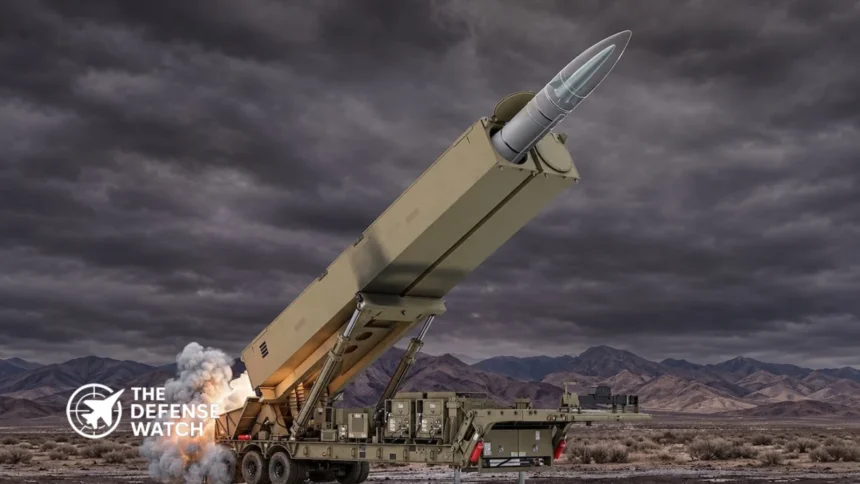
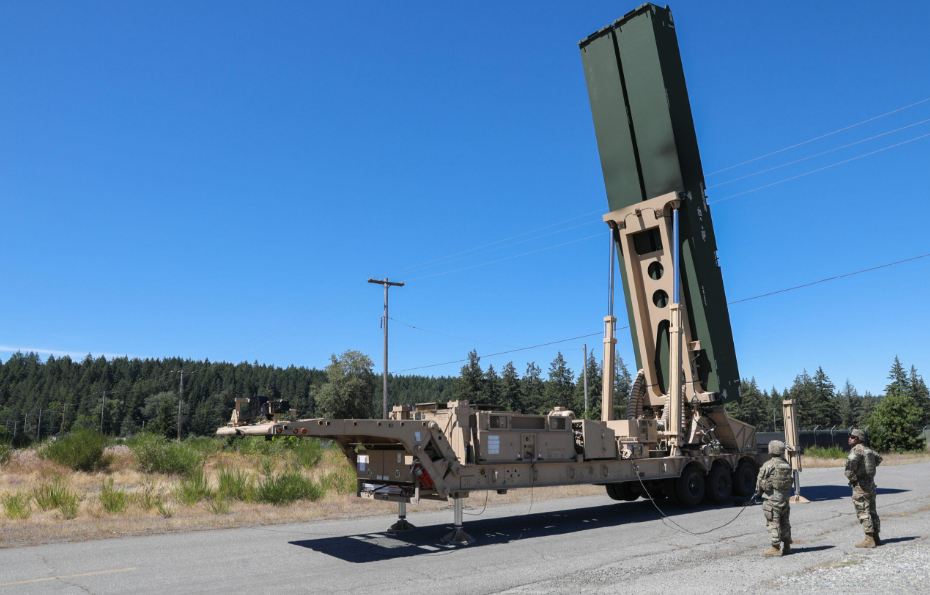
The Common Hypersonic Glide Body is a central component of the Army’s Dark Eagle and Navy’s Conventional Prompt Strike weapons.
Both programs use a boost-glide configuration. A rocket booster accelerates the weapon before the glide vehicle separates and continues toward its target using aerodynamic lift and maneuvering flight.
The two services share the underlying missile and glide-body architecture, but their launch systems are adapted to different operating environments.
The Army’s Dark Eagle is designed for deployment from mobile, land-based launchers. The Navy’s CPS is intended for use aboard naval platforms, including surface ships and submarines.
According to the Government Accountability Office (GAO), the Army version uses a hot-launch arrangement, in which the missile ignites from its launcher. The Navy employs a cold-gas launch system that ejects the missile from its launch canister before the rocket motor ignites.
This common architecture allows the services to share development and production infrastructure while adapting the complete weapon system to their respective operational requirements.
The arrangement also makes component suppliers such as General Atomics important to both programs. Production problems affecting the shared glide body can have consequences for Army and Navy procurement schedules simultaneously.
Leidos’ $2.7 Billion Contract Provides the Larger Framework
General Atomics’ subcontract is part of a wider acquisition effort led by Leidos.
On March 31, 2026, the U.S. Army awarded Leidos a $2.7 billion contract supporting the transition of the Common Hypersonic Glide Body and Thermal Protection System programs from prototyping toward production.
Leidos subsequently announced the award on May 12, describing the arrangement as an effort to combine development and production activities under a unified contract.
The Army’s acquisition approach is intended to improve coordination between the two closely related programs and establish a more consistent production pathway.
The distinction between the prime contract and General Atomics’ subcontract is important. The $2.7 billion figure belongs to the broader Leidos award and should not be interpreted as the value of General Atomics’ manufacturing agreement.
The Army has also described the March award as the first production contract for the Common Hypersonic Glide Body program, transitioning the effort from an Other Transaction Authority agreement to a Federal Acquisition Regulation Part 15 contract.
That transition provides a formal production framework after years of prototype development and testing.
Production Capacity Remains a Major Program Challenge
The additional manufacturing capacity is relevant because the Army and Navy still face challenges moving their shared hypersonic weapon toward operational deployment.
A July 17, 2026, GAO report, Navy Ship Modernization: DOD Needs Comprehensive Strategy to Field Hypersonic Missile Capability, identified production, testing and integration problems affecting the Conventional Prompt Strike program.
According to the report:
- CPS flight testing aboard the Zumwalt-class destroyer was postponed from an earlier 2025 target to 2027.
- Production quality and manufacturing problems had kept the missile output rate well below the program’s target of 12 rounds annually.
- Modernization of the three Zumwalt-class destroyers was running approximately 24 months behind schedule.
- The Pentagon lacked a comprehensive strategy for coordinating investment decisions across the Army and Navy hypersonic programs.
The GAO also reported that the Department of Defense planned to invest at least $50 billion in developing, testing, producing and fielding CPS capabilities across several related programs.
These findings provide important context for General Atomics’ new production assignment.
Additional suppliers can help expand manufacturing capacity and reduce dependence on a limited number of production facilities. However, supplying more components does not automatically resolve problems involving system integration, testing, quality control or overall missile assembly.
The effectiveness of the new subcontract will therefore depend on whether GA-EMS and other suppliers can deliver consistent hardware at the pace required by the larger program.
Implications for Dark Eagle and Conventional Prompt Strike
The Army and Navy are pursuing hypersonic weapons to provide conventional long-range strike options against high-value targets, including targets protected by advanced air and missile defense networks.
Dark Eagle is intended to give Army units a mobile ground-launched capability. Conventional Prompt Strike is designed to extend the Navy’s long-range strike options from surface ships and submarines.
The shared glide body reduces the need for the services to develop entirely separate missile technologies. It also creates opportunities for common manufacturing, testing and procurement arrangements.
However, the GAO findings show that shared development does not eliminate the challenges of coordinating separate service requirements, production schedules and launch-platform integration.
For General Atomics, the agreement provides a multiyear manufacturing role in a strategically important weapons program. For the Pentagon, the subcontract adds another industrial supplier to a production effort that must overcome existing manufacturing and integration challenges.
The agreement runs through 2031, but General Atomics and Leidos have not publicly disclosed specific delivery quantities, production targets or the subcontract’s financial value.
The ability to translate this additional industrial capacity into reliable deliveries will be an important factor in determining how quickly the Army and Navy can expand their hypersonic strike capabilities.