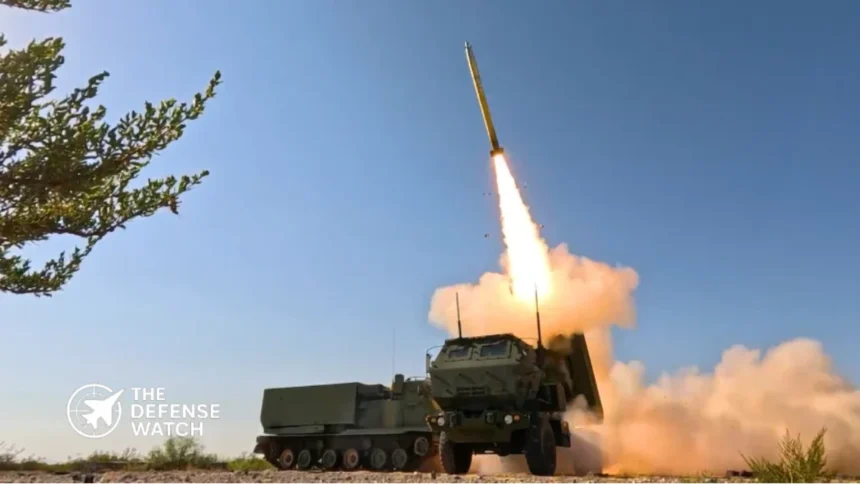
Lockheed Martin and the U.S. Army have demonstrated the ability to redirect a Guided Multiple Launch Rocket System (GMLRS) rocket after launch, allowing it to engage a moving target during a test at White Sands Missile Range, New Mexico.
The test, announced by Lockheed Martin on October 28, 2026, used a High Mobility Artillery Rocket System (HIMARS) launcher, the company’s Strigo datalink and its Remote Interceptor Guidance-360 (RIG-360) system. According to the company, the team updated the rocket’s target information during flight, and the rocket subsequently destroyed the moving target.
The demonstration addresses a practical challenge for precision rocket artillery: how to engage a target whose position changes after a firing solution has been established. Rather than relying entirely on the coordinates provided before launch, the approach allows updated targeting information to reach a rocket already in flight.
Lockheed Martin described the event as a first for the GMLRS program. However, the company has not publicly disclosed the target’s type, the engagement distance, the timing of the update or the detailed test conditions.
How the GMLRS retargeting system works
The demonstration combined three elements: the GMLRS rocket, a communications link and a system for transmitting updated guidance information.
The rocket was fired from a HIMARS launcher. During flight, the test team used Strigo and RIG-360 to communicate the revised target information to the rocket, according to Lockheed Martin. The company said the integration work was funded internally.
Each component serves a different purpose in the demonstrated arrangement:
- GMLRS: The precision rocket used to engage the target.
- Strigo datalink: Provides the communications capability needed to transfer information.
- RIG-360: Supports the transmission of updated guidance information to the weapon.
The important result is the integration of these elements into a working engagement sequence. The test showed that a GMLRS rocket could receive a target update after launch and still complete the engagement against a moving target.
Lockheed Martin said the approach can expand the capabilities of the existing rocket without fundamentally changing its design. That could offer an alternative to developing an entirely new munition for every emerging targeting requirement, although the extent of any required hardware, software or production changes has not been disclosed.
The company has also not published enough technical information to establish how much of the rocket’s trajectory can be changed, what communications range the system supports or how frequently target updates can be transmitted.
Why moving targets present a different problem
Conventional precision strikes depend on accurate target coordinates and a reliable firing solution. When a target moves between the time it is identified and the time a weapon arrives, the original coordinates may no longer describe its position.
This problem is particularly relevant to mobile military assets, including vehicles, mobile command posts and other targets that can relocate before impact. A weapon that accepts updated targeting information during flight potentially gives commanders another way to respond when the original target picture changes.
The capability does not, by itself, establish that the rocket can independently detect, identify and track moving targets. The announced test describes an externally supplied target update, not an autonomous onboard seeker identifying a target without outside assistance.
That distinction matters. The system’s operational value will depend on the availability of accurate target tracks, the speed at which information reaches the weapon and the ability to maintain communications during an engagement.
A successful test under controlled conditions is an important technical demonstration, but it does not establish how reliably the arrangement would work against a mobile target in a contested environment.
HIMARS could gain more flexibility without a new launcher
The test builds on the existing relationship between GMLRS and the HIMARS launcher. The U.S. Army also operates the rocket through the tracked M270 Multiple Launch Rocket System family, giving the munition a role across two established artillery platforms.
GMLRS is designed to deliver precision fires against targets at tactical and operational depths. Its established launcher compatibility means that improvements to the rocket and its supporting systems could potentially expand mission options without requiring the Army to replace its launch vehicles.
The Army has also been developing the Extended-Range GMLRS (ER GMLRS), which is designed to extend the weapon’s reach. In February 2026, the service reported a successful ER GMLRS test against area targets beyond 100 kilometers, while identifying a planned range of up to 150 kilometers. The rocket is intended to operate from existing launcher platforms.
Longer range and in-flight retargeting address different operational requirements. Extended range allows artillery units to engage targets farther from their firing positions, while updated targeting information could help them respond to targets that change location after a rocket has been launched.
Combining these capabilities could be useful against mobile targets, but the October demonstration does not establish that the retargeting package has been qualified for operational use with ER GMLRS.
Lockheed Martin identifies two potential applications
Lockheed Martin said the datalink package could also be applied to ER GMLRS and the Precision Strike Missile (PrSM). These are potential extensions of the demonstrated technology, not evidence that the same capability is already operational across those weapons.
PrSM is the Army’s next-generation precision-strike missile, developed for use with HIMARS and M270 launchers. Its planned mission set includes deep strikes against targets beyond the reach of conventional GMLRS.
The moving-target requirement is also relevant to PrSM’s development. In March 2026, Lockheed Martin reported that PrSM Increment 2 had completed its first flight test, demonstrating a new multimode seeker and an ability to engage moving maritime targets. That capability is distinct from the externally supplied in-flight targeting update demonstrated with GMLRS.
The difference is important. A seeker-equipped weapon can use onboard sensing to help locate or track a target during an engagement. A weapon that relies on external target updates instead depends on information supplied by other sensors and transmitted through a communications network.
The two approaches can serve complementary roles. External updates can help keep a weapon’s targeting information current, while an onboard seeker can provide an additional means of acquiring a target. The exact balance depends on the weapon’s design and the operational requirements.
Communications and targeting remain critical constraints
The demonstration also raises questions about how the capability would perform in an environment where adversaries actively disrupt military communications.
An in-flight update depends on a functioning communications path between the targeting network and the weapon. Jamming, interference, disrupted data links or an inaccurate target track could reduce the usefulness of the system.
These are general operational considerations, not reported failures during the October test. Lockheed Martin has not released test results describing the system’s performance under electronic attack or other degraded communications conditions.
The Army would also need to evaluate how target updates fit into its existing command-and-control processes. Operators must have timely, reliable information and clear procedures for authorizing changes to an engagement after launch.
Other unanswered questions include the equipment required to support the link, the cost of integrating it into existing rockets, and whether the Army intends to fund further development or procure the capability.
Those details will help determine whether the demonstration leads to a fielded upgrade or remains a technology experiment.
What the test establishes, and what it does not
The October 28 announcement provides evidence of a successful live-fire demonstration in which a HIMARS-launched GMLRS rocket received updated targeting information during flight and struck a moving target.
It also shows that Lockheed Martin is exploring ways to extend the capabilities of existing precision munitions through communications and guidance integration rather than a fundamental redesign of the rocket.
The announcement does not establish an operational fielding date, a production decision, a new Army procurement requirement or the performance of the system under combat conditions.
For the Army, the next important question is whether the demonstrated approach can be developed into a dependable operational capability. That will require more information about test results, integration requirements, communications resilience and the cost of deploying the system across existing and future precision-fires weapons.
Until those details are available, the test is best understood as a technical milestone in the development of networked artillery, rather than evidence that the Army has already fielded a new moving-target engagement capability.