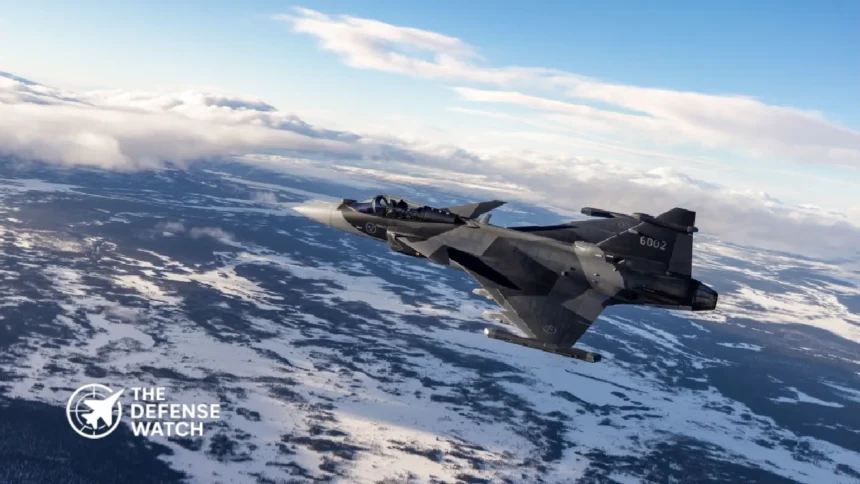
Saab has identified IMP Aerospace & Defence, CAE and Magellan Aerospace as its principal Canadian industrial partners for a proposed Gripen E fighter program, outlining how the Swedish company would organize local aircraft production, training and sustainment if Canada selects the aircraft.
Announced on October 27, 2026, the plan includes a proposed final assembly line, domestic manufacturing of aircraft structures, fighter pilot and technician training, and long-term maintenance capabilities. The arrangements remain conditional on a Canadian government decision to acquire the Gripen E. Saab has not announced a Canadian fighter order as part of this announcement.
The partnership announcement gives Saab a more detailed industrial proposal for the Canadian market. Rather than focusing solely on aircraft performance, the company is presenting a potential domestic supply chain intended to support the fighter throughout its service life.
Three Companies, Three Industrial Roles
Saab has assigned different responsibilities to the three companies, covering aircraft assembly, component manufacturing and the training and technical support needed to operate a future Gripen fleet.
IMP Aerospace & Defence: Final assembly and sustainment
Under a new teaming agreement, IMP would establish a final assembly line for the Gripen in Canada if the government proceeds with the purchase.
The Halifax-based company would also handle electrical assembly production and in-service support for Canadian Gripen aircraft. IMP President David Gossen said the proposed capability could potentially extend beyond Canada’s own fleet, allowing the company to support international Gripen customers.
That possibility could give Canadian industry a role in Saab’s wider fighter program. However, the announcement does not establish that IMP would receive export production orders or specify how many aircraft the facility might assemble.
Magellan Aerospace: Aircraft structures
Saab has signed a memorandum of understanding with Magellan Aerospace covering the proposed Canadian manufacture of advanced aerostructures, composite structures and structural assemblies.
The arrangement would add domestic manufacturing work to the proposed program, creating opportunities for Canadian suppliers involved in aerospace materials and structural components.
Magellan’s role would complement IMP’s assembly responsibilities. The companies’ proposed work would cover different parts of the aircraft production chain, although Saab has not disclosed production volumes, contract values or a detailed manufacturing schedule.
CAE: Pilot and technician training
CAE’s proposed responsibilities would cover fighter pilot and technician training, mission systems engineering, and support and sustainment capabilities.
Saab and CAE signed their memorandum of understanding in July 2026. The earlier agreement established a framework for developing Canadian-based training capabilities if the Gripen E becomes part of the Royal Canadian Air Force’s future fighter fleet.
Local training would form an important part of the proposed arrangement because a new fighter requires more than aircraft deliveries. Pilots, maintenance personnel and technical specialists must be trained, while simulators and other training systems need continuing support.
The announcement does not specify the number of training systems, simulators or personnel that would be provided.
Why Saab Is Emphasizing Canadian Production
The industrial proposal addresses a major consideration in fighter procurement: the ability to maintain operational capability without depending entirely on overseas facilities.
Domestic assembly, component manufacturing and technical support could give Canada a larger role in maintaining its aircraft and managing selected upgrades. The extent of that independence would depend on the final agreements, the technologies made available to Canadian industry and any restrictions on foreign-origin components.
Saab says the proposed partnerships would help establish Canadian capabilities in advanced manufacturing, composite materials and model-based systems engineering. The company also says it is engaging with additional Canadian businesses, academic institutions and research organizations.
These are stated program objectives rather than confirmed employment or investment outcomes. Saab has not provided a detailed estimate of the number of jobs that would be created, the total investment required or the proportion of the aircraft’s value that would be produced in Canada.
The distinction matters when comparing fighter proposals. A commitment to local assembly does not automatically mean that every major component, software element or maintenance capability will be controlled domestically.
Canada would need to assess the proposed industrial arrangements against its operational requirements, acquisition costs, long-term support expenses and access to the technology needed to maintain the fleet.
The Gripen Proposal Remains Conditional
Saab’s announcement concerns the industrial arrangements it would activate if Canada selects the Gripen E. It does not establish that the fighter has been selected, that production facilities are under construction or that the companies have begun manufacturing aircraft for the Royal Canadian Air Force.
The announcement also does not disclose a proposed Canadian fleet size, delivery schedule, aircraft price or total program cost.
These details will be important in determining the scale of the proposed industrial ecosystem. The economics of a Canadian assembly line would depend partly on the number of aircraft ordered, the timing of production and whether additional international orders could support the facility over time.
IMP’s stated interest in serving international Gripen customers suggests a possible wider role, but that opportunity remains prospective rather than a confirmed source of future production work.
Saab has experience establishing industrial partnerships outside Sweden. In Brazil, for example, the Gripen program includes cooperation with Embraer, which has undertaken aircraft production activities in the country. The first Gripen E produced in Brazil made its maiden flight in October 2026, according to Saab.
That experience provides a relevant example of how Saab has organized international industrial participation. It does not, by itself, establish that a Canadian program would follow the same production model or achieve the same industrial outcomes.
What Canada Would Need to Evaluate
The proposed partnership gives Ottawa a clearer picture of how Saab intends to distribute work among Canadian companies. Several questions remain unanswered.
First, the government would need to establish the overall cost of acquiring and operating the aircraft, including training, infrastructure, maintenance, spare parts and future upgrades.
Second, the proposed division of work would need to be assessed against Canada’s requirements for sovereign support. Local assembly and maintenance could improve domestic capacity, but the level of independence would depend on access to components, technical data, software and foreign-controlled technologies.
Third, Canada would need to determine the practical value of the proposed industrial participation. That assessment would include confirmed work packages, investment commitments, delivery schedules, employment estimates and the conditions attached to potential export production.
These questions are not unique to Saab. They are central to evaluating any fighter acquisition that includes substantial industrial participation.
For Saab, naming IMP, Magellan Aerospace and CAE demonstrates how the company intends to organize a Canadian Gripen program. For Ottawa, the next step would be to determine whether that proposed industrial structure, together with the aircraft’s military capabilities and lifecycle costs, meets Canada’s requirements.
Until the government makes an acquisition decision and the parties establish more detailed contractual commitments, the proposed Canadian production and support network remains a plan rather than an operational industrial capability.