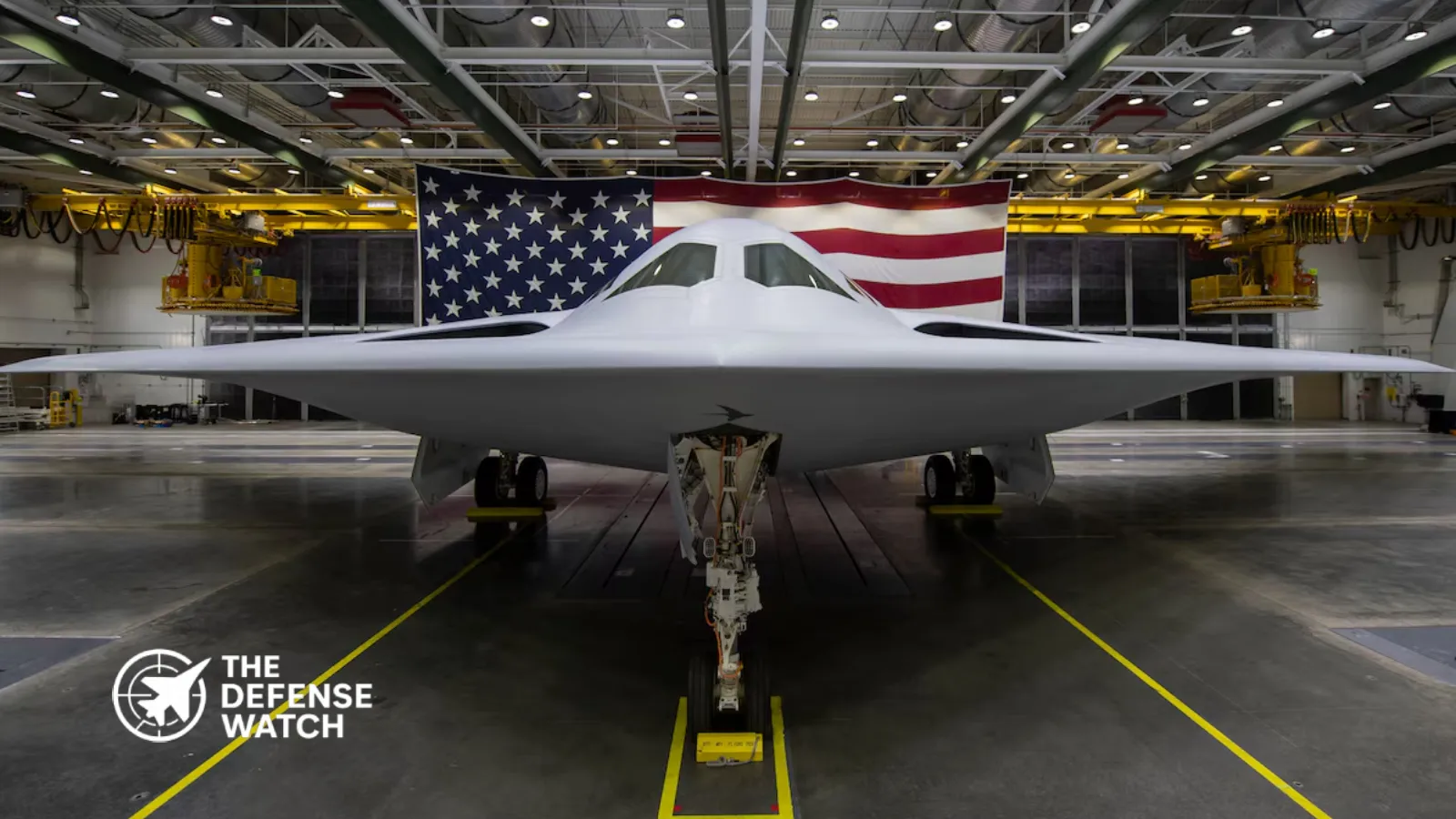
Northrop Grumman expects investments in new manufacturing capacity to translate into higher B-21 Raider production later this decade, with much of the facility expansion work extending through 2028. The company is preparing to increase output of the U.S. Air Force’s next-generation stealth bomber while continuing flight testing and development.
- Production Capacity Is Being Built Before Output Increases
- A 25 Percent Capacity Increase Is the Official Target
- New Manufacturing Facilities Support the Ramp-Up
- Testing Progress and Production Costs Remain Important
- Why Faster B-21 Production Matters to the Air Force
- What the Expansion Does Not Yet Establish
Chief Executive Kathy Warden outlined the expected timeline during Northrop Grumman’s third-quarter earnings call on Oct. 20, 2026. She said the company would spend the next couple of years building the capacity needed to support the higher production rate, with the increase in aircraft output expected to follow later in the decade.
The expansion is part of a wider agreement with the U.S. Air Force to accelerate B-21 production. However, additional factory capacity does not mean aircraft deliveries will increase immediately. The pace of the production ramp will also depend on manufacturing performance, supplier readiness, testing progress and the Air Force’s acquisition schedule.
Production Capacity Is Being Built Before Output Increases
Northrop Grumman’s plans reflect a basic challenge in advanced military aircraft manufacturing: expanding production requires investment well before a factory can deliver aircraft at a higher rate.
During the earnings call, Warden said the main phase of preparing the additional capacity would continue through 2028. The company expects that investment to support higher production volumes later in the decade.
Northrop Grumman has previously disclosed plans to invest approximately $2.5 billion over multiple years to expand B-21 production capacity. In its third-quarter 2026 regulatory filing, the company said the investment was tied to an agreement with the Air Force to increase the aircraft production rate. The arrangement also gives Northrop Grumman an opportunity to improve returns on the program’s low-rate initial production and subsequent negotiated production lots.
The distinction between capacity and actual output matters. New buildings, production equipment and manufacturing infrastructure create the conditions for higher production, but they do not independently establish how many bombers will be completed each year.
Northrop Grumman has not publicly specified an annual B-21 production figure in the cited earnings-call remarks. The company’s comments therefore establish the direction and broad timing of the expansion, not a confirmed yearly delivery target.
A 25 Percent Capacity Increase Is the Official Target
In February 2026, the Department of the Air Force announced an agreement with Northrop Grumman to expand B-21 production capacity by 25 percent. The department said the arrangement used $4.5 billion in funding already authorized and appropriated under fiscal year 2025 reconciliation legislation. The stated objective was to accelerate delivery of the Air Force’s future bomber fleet.
That figure needs to be interpreted carefully. The 25 percent increase refers to annual production capacity, not a publicly confirmed 25 percent increase in aircraft deliveries in a particular year. The timing of actual deliveries will depend on how quickly the expanded industrial base can support the program.
The Air Force’s agreement and Northrop Grumman’s investment plan are related parts of the same production acceleration effort. The government has committed funding to support faster fielding, while the contractor is preparing the facilities and manufacturing processes needed to produce the aircraft at a higher rate.
The new capacity also has to support a complex aircraft program whose development and manufacturing activities are progressing simultaneously. That makes the quality of production processes and the stability of the supply chain as important as the size of the factory footprint.
New Manufacturing Facilities Support the Ramp-Up
The expansion is already taking physical form. Northrop Grumman opened its East Gate 3 manufacturing facility at its Layton, Utah, campus on Sept. 9, 2026, adding space intended to support next-generation aircraft manufacturing, including the B-21 program. The company says the wider East Gate campus is planned to encompass approximately 845,000 square feet of facilities and accommodate up to 1,500 employees by 2032.
These investments are part of a broader effort to prepare the industrial base for larger production volumes. Manufacturing a low-observable bomber requires more than assembling aircraft structures. Production must also accommodate precision fabrication, systems integration, inspection, testing and coordination with specialized suppliers.
The available public information does not establish how much additional B-21 output will come from the Utah facility specifically. Nor does the facility’s opening mean that all planned production capacity is already available. The company’s broader expansion program is expected to continue over several years.
That distinction is important because the B-21 production line must mature while the aircraft remains in flight testing. Changes identified during testing can affect manufacturing processes, engineering work and the integration of aircraft systems.
Testing Progress and Production Costs Remain Important
Northrop Grumman’s production plans are closely connected to the program’s development performance.
During the Oct. 20 earnings call, Warden said the aircraft was meeting key performance parameters during testing. She also said that continued testing and manufacturing experience were helping reduce program risks, while acknowledging that some risk remained as the company completed outstanding low-rate initial production aircraft.
The distinction matters because the B-21 is being manufactured under contracts that have exposed Northrop Grumman to substantial financial risk.
In its regulatory disclosures, the company has reported approximately $2 billion in cumulative losses on the low-rate initial production phase. Its third-quarter 2026 filing said it had made no significant change to its previously recognized loss estimate for that phase. The filing also described pricing arrangements for additional production lots that were not yet fully negotiated.
Expanding capacity could improve production efficiency as workers gain experience and manufacturing processes become more established. However, the investment also creates financial exposure if production takes longer than expected or costs remain higher than anticipated.
Northrop Grumman’s leadership expects the B-21 program to contribute to growth in its Aeronautics Systems business. The company’s earnings-call remarks also identified sustainment and modernization as additional sources of future program activity, beyond the production of new aircraft.
For the Air Force, the priority is different. Higher production capacity is valuable if it enables the service to receive aircraft sooner and build the planned force without sacrificing program requirements or quality.
Why Faster B-21 Production Matters to the Air Force
The B-21 Raider is being developed as a long-range penetrating bomber capable of conventional and nuclear missions. It is intended to strengthen the United States’ ability to conduct long-range strikes against defended targets, complementing existing bomber capabilities.
The Air Force has identified a minimum planned fleet of 100 B-21 aircraft. A higher sustainable production rate could help the service field its future bomber force more quickly, although the precise relationship between the new capacity and the final fleet delivery schedule has not been publicly established.
Production timing matters because the B-21 is intended to become a central component of the future U.S. bomber fleet. The aircraft is expected to complement the existing B-52H and eventually replace the B-1B and B-2 as those aircraft leave service.
A faster production ramp could also give the Air Force greater flexibility when planning training, maintenance infrastructure, personnel requirements and the distribution of aircraft across its bomber bases.
But factory capacity alone cannot determine when the fleet becomes operationally useful. Aircraft must be delivered, tested and accepted, while crews, maintainers, support equipment and base infrastructure must be prepared to sustain operations.
The Air Force previously stated that B-21 aircraft were expected to be present at Ellsworth Air Force Base, South Dakota, in 2027. That milestone is distinct from achieving the higher production volumes Northrop Grumman expects later in the decade.
What the Expansion Does Not Yet Establish
Northrop Grumman’s announcement provides a clearer picture of its manufacturing timeline, but several questions remain unanswered.
The company has not disclosed a confirmed annual production rate in the cited earnings-call remarks. Public statements also do not establish how many additional aircraft will be delivered in each year following the expansion, or when the entire planned capacity increase will translate into completed aircraft.
The $2.5 billion figure describes Northrop Grumman’s planned multiyear investment in production capacity, while the $4.5 billion figure announced by the Air Force refers to government funding already authorized and appropriated for the acceleration agreement. They describe different parts of the effort and should not be treated as interchangeable measures of the cost of the B-21 program.
The next meaningful indicators will be progress on the manufacturing expansion, the results of flight testing, the performance of suppliers and any official updates to production or delivery schedules.
For now, Northrop Grumman’s position is that the groundwork for faster B-21 production is being laid over the next several years. Whether that translates into a sustained increase in deliveries will become clearer as the expanded facilities enter use and the program advances through testing and production.