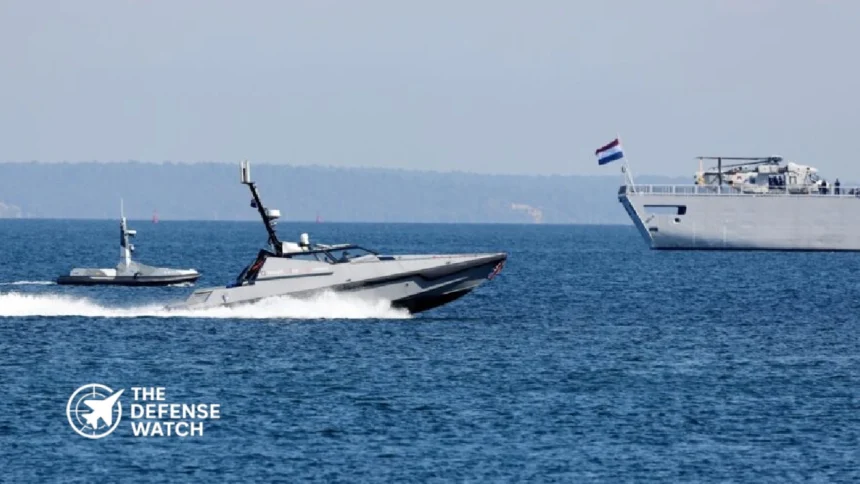
Ukraine DELTA System Demonstrates NATO Compatibility at Sea
Ukraine’s DELTA military command system has demonstrated its ability to integrate NATO-standard unmanned aircraft, surface vessels, underwater systems and radar data during the REPMUS 2026 maritime exercise in Portugal, according to Ukraine’s Ministry of Defence.
- Ukraine DELTA System Demonstrates NATO Compatibility at Sea
- Maritime drone coordination puts DELTA to the test
- What DELTA does in military operations
- NATO interoperability has been a continuing objective
- Why STANAG 4817 matters
- Lessons for NATO’s maritime drone operations
- What the exercise establishes, and what remains open
The exercise, reported by the ministry on October 14, tested DELTA in multinational maritime scenarios involving reconnaissance, maritime surveillance, maneuvering, escort operations and simulated engagements. Ukraine said participating systems transmitting telemetry in accordance with NATO STANAG 4817 were successfully integrated into the platform.
The results extend a series of interoperability trials that have helped Ukraine develop DELTA from a national battlefield management system into a platform capable of supporting multinational military operations.
Maritime drone coordination puts DELTA to the test
REPMUS, short for Robotic Experimentation and Prototyping with Maritime Unmanned Systems, is an annual exercise led by the Portuguese Navy. It focuses on integrating uncrewed technologies into maritime operations and testing how they work alongside conventional military forces.
Ukraine participated for the third consecutive year in 2026. Ukrainian personnel from multiple military branches used DELTA to coordinate their activities with allied participants, according to the Ukrainian Ministry of Defence.
The system integrated aerial, surface and underwater uncrewed platforms, together with radars, provided they transmitted data in accordance with the relevant NATO standard.
That distinction matters. Integrating a platform into a command system is not the same as demonstrating that every feature of the platform, its communications, and its weapons can operate across all allied networks. The Ukrainian announcement establishes successful integration of the reported systems during the exercise, but it does not detail every interface tested or establish unrestricted compatibility with every NATO command network.
The Ukrainian team also reported that DELTA continued operating under unstable connectivity conditions. Personnel highlighted the streaming functions of Vezha, a DELTA module used to handle video feeds, describing its performance favorably compared with other platforms.
The ministry did not publish detailed technical measurements of network availability, latency, data throughput or performance under electronic attack.
What DELTA does in military operations
DELTA is a Ukrainian-developed military situational awareness and command-and-control system designed to bring operational information together in a shared digital environment.
NATO Allied Command Transformation described the platform in a July 2024 account as a cloud-based integration system that combines information from digital maps, sensors, trackers, radars and satellite providers. It can help military personnel track friendly forces, identify reported enemy positions and coordinate reconnaissance and targeting activities.
Its functions include situational awareness, unmanned aircraft video streaming, secure messaging and planning tools for coordinating reconnaissance and target acquisition assets.
The system has evolved during Russia’s full-scale war against Ukraine, with battlefield experience informing its development. Rather than relying exclusively on separate applications and sensor displays, commanders can use a common operational picture to understand reported activity across different areas of the battlespace.
For maritime forces, the same principle applies to information collected by uncrewed surface vessels, underwater vehicles, aircraft and shore-based sensors.
Combining those feeds can help operators identify activity, monitor areas of interest and coordinate reconnaissance. However, the quality of the resulting picture still depends on the reliability, accuracy and timeliness of the underlying data.
DELTA does not eliminate those limitations. Nor does integration alone demonstrate that the system can independently identify targets or authorize weapons engagement. Those functions depend on the connected equipment, software configuration, operating procedures and command authority.
NATO interoperability has been a continuing objective
The REPMUS 2026 results build on earlier tests of DELTA with allied systems.
In July 2024, NATO Allied Command Transformation reported that Ukrainian representatives tested DELTA during the Coalition Warrior Interoperability eXploration, eXperimentation, eXamination eXercise, known as CWIX. The trials examined the exchange of operational information between Ukrainian and NATO-developed systems across several military domains.
The following year, DELTA served as the primary command-and-control platform for a multinational team during REPMUS 2025. Ukraine’s Ministry of Defence said the system coordinated more than 100 uncrewed platforms across air, maritime, underwater and land domains. Video feeds from the team’s uncrewed systems were routed through the Vezha module.
In 2026, the Ukrainian ministry again reported successful integration of assets transmitting telemetry under NATO STANAG 4817.
These events demonstrate continuity in Ukraine’s interoperability efforts. They do not, by themselves, establish that DELTA has been formally adopted as a standard NATO-wide command system or approved for every operational environment.
Why STANAG 4817 matters
Military interoperability depends on more than connecting devices to the same network. Systems must exchange information in formats that other platforms can interpret and use.
NATO standardization agreements, commonly known as STANAGs, establish technical or procedural requirements intended to support cooperation among allied forces. STANAG 4817 is the standard identified by Ukraine’s Ministry of Defence in its account of DELTA’s maritime integration at REPMUS 2026.
For operations involving uncrewed systems, standardized data exchange can reduce the need for bespoke interfaces between individual platforms and command applications.
That is particularly relevant in maritime operations, where several countries may contribute aircraft, surface vessels, underwater vehicles, sensors and command facilities to a single mission.
If those assets can share useful information through compatible systems, commanders may have a more complete operational picture without requiring every participating country to use identical hardware.
Nevertheless, technical interoperability is only one part of multinational operations. Different national security policies, communications restrictions, data-sharing rules and command arrangements can still limit what information is available to other participants.
The public account of REPMUS 2026 does not specify whether all those wider operational requirements were tested.
Lessons for NATO’s maritime drone operations
The exercise offers a practical example of how combat experience from Ukraine may inform allied approaches to uncrewed warfare.
Ukraine has relied heavily on unmanned systems to gather intelligence, monitor contested areas and conduct operations against Russian forces. At sea, the conflict has also demonstrated the operational relevance of uncrewed surface platforms in an environment where conventional naval forces face significant threats.
For NATO navies, the challenge is not simply acquiring additional drones. It is ensuring that these platforms can share information with existing ships, aircraft, surveillance systems and command structures.
A command-and-control system that can integrate multiple types of uncrewed assets could help address that challenge, provided its performance, security and reliability are validated under operational conditions.
DELTA’s reported performance under unstable connectivity is relevant because maritime operations can involve dispersed assets and communications links that are not continuously available. Still, the Ukrainian ministry has not released enough technical data to determine how the platform performs under sustained jamming, cyberattack or complete communications loss.
Those remain important questions for any military system intended to support operations in a contested environment.
What the exercise establishes, and what remains open
The available evidence supports three conclusions.
First, Ukraine used DELTA to coordinate maritime activity during REPMUS 2026. Second, the Ukrainian Ministry of Defence reported successful integration of participating aerial, surface and underwater uncrewed systems and radars transmitting data under NATO STANAG 4817. Third, the trials continued a process of interoperability testing documented by NATO and Ukraine since at least 2024.
The evidence does not establish a NATO-wide procurement decision, formal adoption of DELTA as an alliance standard, or approval for unrestricted use across allied networks.
No new procurement agreement, delivery schedule or formal NATO-wide deployment decision was announced in the cited reporting.
For now, DELTA’s significance lies in demonstrating that a Ukrainian-developed command system can support practical maritime coordination with NATO-standard uncrewed assets during a multinational exercise. Whether that capability translates into broader allied adoption will depend on further technical validation, security requirements and national decisions.