Executive Summary
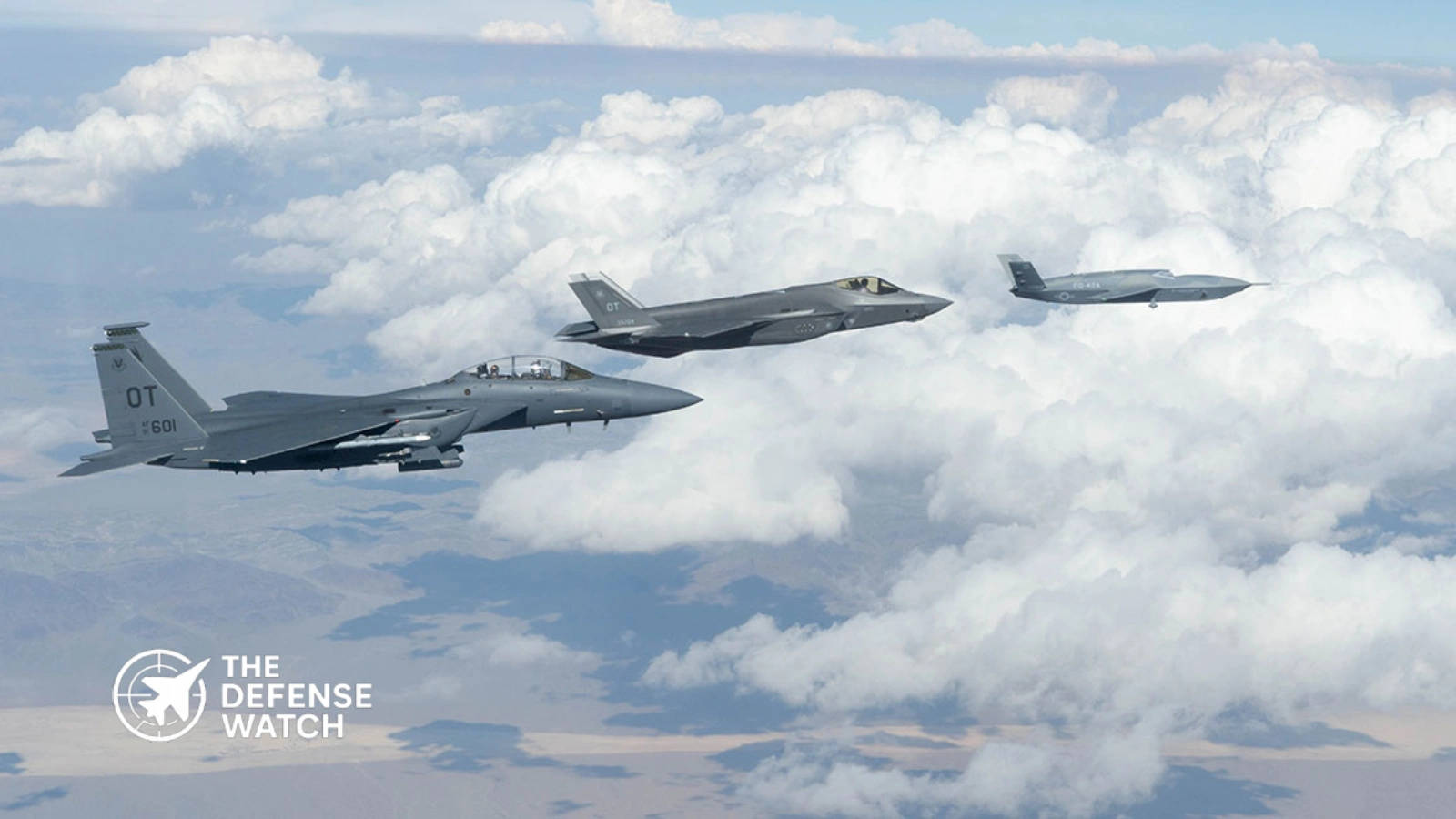
- General Atomics has released an image showing an FQ-42 Vengeance Collaborative Combat Aircraft flying alongside an F-35A Lightning II and F-15E Strike Eagle. The company did not disclose when the formation flight occurred.
- The aircraft is now operating in the U.S. Air Force’s CCA test and evaluation effort at Creech Air Force Base, Nevada. The Air Force has placed the FQ-42 and Anduril FQ-44 into Increment 1 production and plans to have 500 combat-ready, semi-autonomous CCAs by 2032, within a broader planned fleet of about 1,000 aircraft.
- The formation flight should not be interpreted as proof that the F-35 or F-15E already controlled the FQ-42 during the sortie. The more important milestone is the transition from independent CCA flight testing toward the software, communications and command-and-control architecture required for crewed-uncrewed teaming.
General Atomics Aeronautical Systems has released an image of its FQ-42 Vengeance flying alongside a U.S. Air Force F-35A Lightning II and F-15E Strike Eagle, providing a visible demonstration of how the service’s new Collaborative Combat Aircraft are being integrated into an environment with existing crewed fighters.
The photograph was released on Sept. 21, one day after General Atomics announced that another FQ-42 had arrived at Creech Air Force Base, Nevada, on Sept. 18 for continued test and evaluation. GA-ASI did not identify the date or circumstances of the formation flight shown in the photograph.
The distinction matters. Flying in formation with an F-35 or F-15E demonstrates that the aircraft can operate in the same airspace during testing, but it does not by itself demonstrate that a crewed fighter was controlling or tasking the FQ-42. The Air Force’s larger objective is to establish a system in which semi-autonomous aircraft can receive and execute tasks as part of a wider combat formation.
That transition could become one of the most important parts of the CCA program.
FQ-42 Moves Into a New Phase of Testing
The FQ-42, now officially named Vengeance by the Air Force, is one of two aircraft selected for the first increment of the service’s Collaborative Combat Aircraft program. The other is Anduril’s FQ-44 Fury. The Air Force officially announced both names on Sept. 14.
The service says the CCA program is intended to provide additional combat mass while extending the reach, awareness and survivability of crewed aircraft in contested environments. Secretary of the Air Force Troy Meink said the service plans to have 500 combat-ready, semi-autonomous aircraft by 2032 and an overall fleet of about 1,000.
The June 2026 production decision marked another major step. The Department of the Air Force moved the FQ-42 and FQ-44 into Increment 1 production while also establishing a competitive marketplace for mission-autonomy software.
This is significant because the CCA concept is not simply about building another unmanned aircraft.
It is about connecting aircraft, autonomy software, human operators, sensors and weapons into a larger combat system.
What the FQ-42 Formation Flight Actually Shows
The photograph provides useful evidence, but it should be interpreted carefully.
GA-ASI has confirmed that the FQ-42 at Creech will continue test and evaluation activities with the Air Force. The company says the work will include experimentation intended to advance CCA operations, including demonstrations derived from previous company testing using the MQ-20 Avenger as a CCA surrogate.
The Aviationist reported that the FQ-42 and FQ-44 are operating with the Air Force’s Experimental Operations Unit and that the aircraft currently use their own mission autonomy systems while operating alongside crewed aircraft.
That creates three distinct levels of CCA integration:
| Development stage | What it means |
|---|---|
| Formation flight | CCA operates alongside crewed aircraft |
| Networked experimentation | Aircraft exchange information within a common operational environment |
| Collaborative control | Crew can assign tasks that the CCA executes through its autonomy system |
The first stage is increasingly visible. The third is the operational objective.
The difference is important because autonomy is not simply an autopilot function. A combat CCA must be capable of interpreting authorized tasks, navigating, maintaining appropriate formation or tactical geometry, responding to changing conditions and operating within human-defined constraints.
The Air Force’s command-and-control work is therefore as important as the aircraft itself.
The FQ-42 and FQ-44 Are Taking Different Paths to the Same CCA Objective
The first CCA increment has created a direct competition between two different aircraft designs.
General Atomics’ FQ-42 is based on the company’s work with the XQ-67A Off-Board Sensing Station and is designed around a low-observable, air-combat-oriented configuration. GA-ASI has described the aircraft as a fifth-generation uncrewed fighter with an internal weapons bay and features intended to improve survivability.
Anduril’s FQ-44 Fury represents the other Increment 1 design. The Air Force’s decision to move both aircraft forward is important because the CCA program is intended to create combat capability at scale rather than depend on a single traditional fighter development model.
The comparison is better understood through architecture than through claims about which aircraft is universally superior.
| Area | FQ-42 Vengeance | FQ-44 Fury |
|---|---|---|
| Manufacturer | General Atomics Aeronautical Systems | Anduril |
| CCA increment | Increment 1 | Increment 1 |
| Air Force designation | FQ-42 | FQ-44 |
| Official name | Vengeance | Fury |
| Intended role | Semi-autonomous collaborative combat aircraft | Semi-autonomous collaborative combat aircraft |
| Current status | Test and evaluation, Increment 1 production | Test and evaluation, Increment 1 production |
| Publicly confirmed formation activity | F-35A and F-15E | F-35A |
| Public performance figures | Limited | Limited |
Exact range, speed, payload, radar cross-section and unit-cost figures for the operational FQ-42 should not be treated as confirmed unless released by the Air Force or General Atomics.
That information gap is important. The program’s operational value cannot be established from photographs alone.
Why the F-35 Connection Matters
The F-35A is particularly relevant to the CCA concept because its role extends beyond conventional fighter missions.
The aircraft’s sensors, communications systems and ability to operate in highly contested environments make it a logical platform for experimentation with crewed-uncrewed cooperation. The CCA program is designed to complement existing fifth-generation fighters as well as future platforms.
The objective is not necessarily to make the F-35 remotely fly another aircraft.
A more useful model is distributed tasking.
A crewed fighter could retain responsibility for the overall mission while an autonomous aircraft performs a defined task within established rules. Depending on the final operational architecture, those tasks could involve sensing, escort, air combat, electronic warfare, communications support or weapons employment.
The exact operational task set for the FQ-42 remains under development.
That makes the current formation flight a test of integration rather than proof of a mature operational teaming capability.
Command and Control May Be the Harder Problem
The Air Force has already begun testing the infrastructure needed to control and support CCAs outside traditional fixed-base operations.
In August, the Department of the Air Force completed prototype evaluations of its Portable Command and Control Enclave, or C2E. The system is intended to provide a deployable command-and-control capability for semi-autonomous aircraft in austere operating environments.
The service also conducted field demonstrations at Springfield-Beckley Air National Guard Base in Ohio involving five industry vendors. The tests examined rapidly deployable C2E concepts in an expeditionary setting.
This points to a broader lesson from the CCA program.
A large fleet of autonomous aircraft cannot depend exclusively on conventional centralized infrastructure.
If CCAs are expected to operate from dispersed locations, their command networks must remain usable despite degraded communications, changing basing locations and contested electromagnetic conditions.
That makes resilient communications, autonomy behavior and human-machine interfaces central parts of the program.
From Prototype to Combat Mass
The speed of the FQ-42 program is another notable feature.
The first YFQ-42 prototype flew in August 2025, followed by another test aircraft in October 2025. By June 2026, the Air Force had moved the program into Increment 1 production.
The Air Force has also publicly emphasized the effort to shorten conventional acquisition timelines. In September, officials said the program had moved from first flight to live munitions firing in nine months, although that specific milestone involved the broader CCA program rather than establishing an operational capability for every FQ-42 aircraft.
The production target is now much larger than the initial objective announced earlier in 2026.
The service initially described a goal of procuring more than 150 combat-capable CCAs by the end of the decade. By September, the stated objective had expanded to 500 combat-ready, semi-autonomous aircraft by 2032, with about 1,000 planned overall.
That scale changes the acquisition problem.
The challenge is no longer simply proving that an autonomous aircraft can fly.
The Air Force must demonstrate that hundreds of aircraft can be manufactured, maintained, updated, transported, controlled and integrated into combat units without creating a new sustainment burden that offsets their intended affordability.
The FQ-42’s Real Test Is Integration at Scale
The FQ-42’s appearance alongside the F-35A and F-15E is therefore more than a formation photograph, but less than an operational demonstration.
The immediate question is whether the aircraft can progress from operating near crewed fighters to contributing meaningful effects within the same mission architecture.
That requires several pieces to mature together:
- Autonomy: The aircraft must execute authorized tasks without continuous manual control.
- Human-machine interfaces: Pilots and mission commanders need a practical way to supervise and task multiple uncrewed aircraft.
- Communications: The system must function across contested and degraded networks.
- Weapons integration: Any armed mission requires appropriate testing, certification and human oversight.
- Sustainment: The aircraft must be maintainable at the scale envisioned by the Air Force.
- Production: Increment 1 must demonstrate that the design can move from test articles to a repeatable production system.
The Air Force has already begun addressing several of these areas. The C2E work demonstrates attention to distributed control, while the mission-autonomy contracts and Increment 1 production decision address the software and hardware sides of the program.
What Comes Next for the FQ-42
The next meaningful milestone will not necessarily be another formation photograph.
It will be evidence that an FQ-42 can participate in a controlled crewed-uncrewed mission, receive an authorized task, execute it through its autonomy system and return useful information or effects to the human force.
That distinction also provides a better way to measure the FQ-42 against competing CCA approaches.
The key comparison is not simply aircraft shape, apparent stealth features or published specifications. It is how effectively each system combines airframe survivability, autonomy, communications, weapons, command and control, production capacity and sustainment.
For the FQ-42, the move to Creech and the appearance alongside the F-35A and F-15E indicate that testing is progressing toward that broader integration problem.
The program’s success will ultimately depend on whether those aircraft can become a repeatable part of Air Force combat operations rather than remain advanced autonomous test vehicles.