
The India China Border Tech Race Is Moving Beyond Troop Numbers
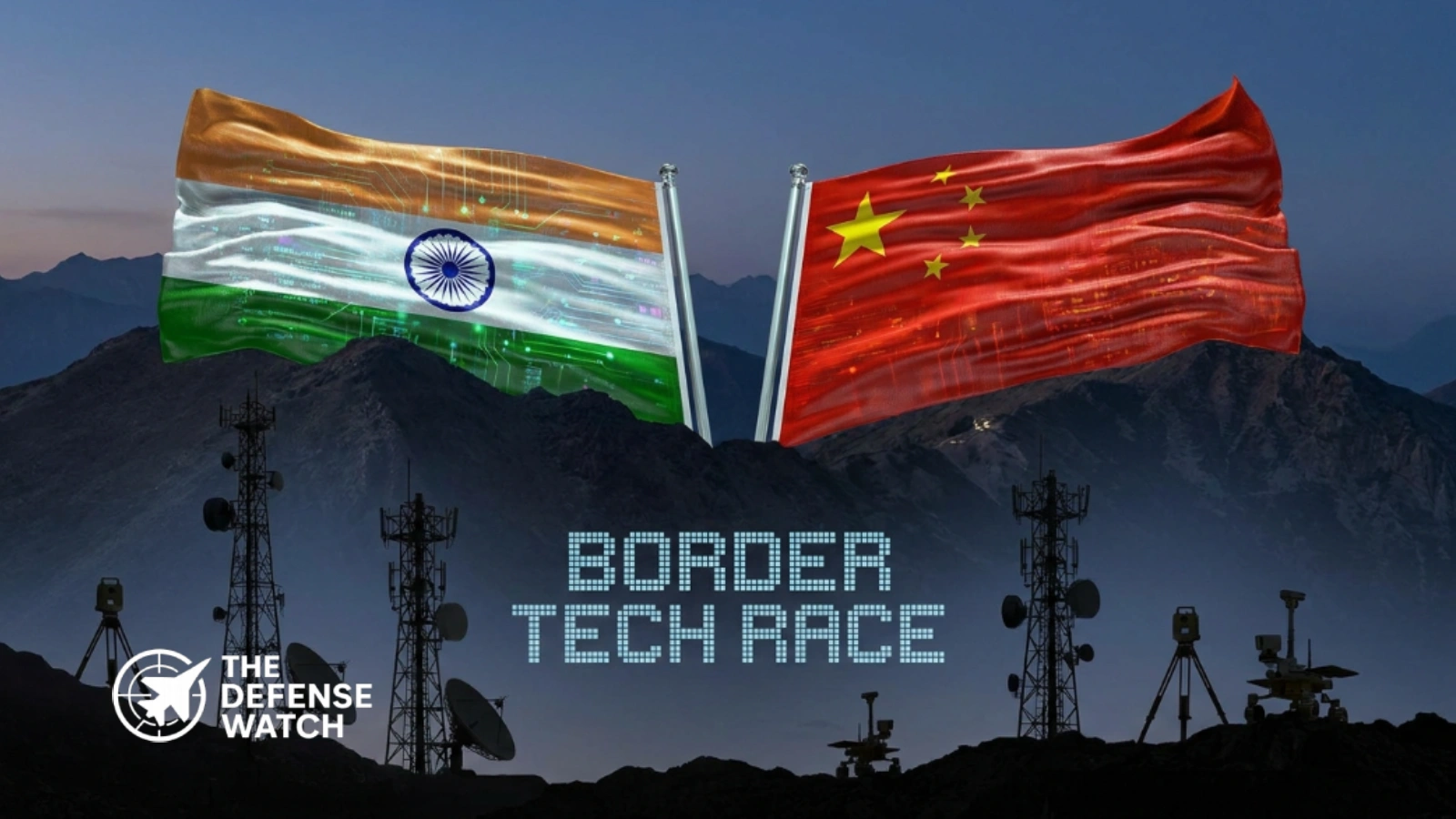
The India China border tech race in 2026 is increasingly being defined by sensors, drones, air defense, communications, mobility, precision fires and infrastructure rather than troop numbers alone. Along the Line of Actual Control, or LAC, both countries are adapting military forces to an environment where altitude, weather, road access and persistent surveillance can determine how quickly units can detect, reinforce and respond to a crisis.
- The India China Border Tech Race Is Moving Beyond Troop Numbers
- Takeaways
- India China Border Tech Race: What Is Changing Along the LAC?
- 2. ISR and Sensors Are Becoming More Important Than Traditional Observation Posts
- 3. Air Defense Is Moving Closer to the Front Line
- 4. High-Altitude Armor Is Getting More Specialized
- 5. Infrastructure Is a Weapon-System Enabler
- 6. Electronic Warfare Is Becoming a Core Layer
- India vs China: Where the Technology Balance Stands in 2026
- The Strategic Importance of the 2026 Diplomatic Pause
- The Next Phase: From Platforms to Kill Chains
- Key Challenges for Both Militaries
- What the LAC Battlefield Could Look Like by 2030
- Conclusion: The LAC Is Becoming a Technology Competition
Takeaways
India and China are reshaping the military balance along the Line of Actual Control through drones, surveillance, air defense, mobility, electronic warfare and high-altitude infrastructure.
The military situation remains sensitive even as diplomatic channels have expanded. In August 2026, Indian and Chinese officials reached an eight-point consensus that included additional military meeting points and two additional border military hotlines intended to reduce the risk of misunderstanding and miscalculation along the LAC.
That diplomatic activity does not mean the technology competition has stopped.
India continues to invest in indigenous drones, air defense, high-altitude armor, electronic warfare and surveillance systems. China, meanwhile, benefits from a mature military-industrial base and extensive infrastructure across the Tibetan plateau, supporting the People’s Liberation Army Western Theater Command.
The result is a competition increasingly centered on who can sense first, communicate faster, move forces more efficiently and sustain combat power longer in extreme terrain.
India China Border Tech Race: What Is Changing Along the LAC?
The post-2020 period accelerated a technological transformation on both sides.
The central problem is straightforward. The LAC extends across some of the most difficult military terrain in the world. Units may operate at altitudes where thin air affects personnel, engines, helicopters and unmanned aircraft. Roads can be restricted by snow, landslides and seasonal conditions. The terrain also limits line-of-sight communications and complicates reinforcement.
This makes conventional measures of military power incomplete.
A useful assessment therefore needs to examine at least six technology areas:
- Persistent intelligence, surveillance and reconnaissance
- Unmanned aerial systems and loitering munitions
- Air defense and counter-UAS systems
- High-altitude mobility and armored warfare
- Long-range fires and precision strike
- Military infrastructure, communications and logistics
1. Drones Are Becoming Central to LAC Operations
Unmanned aircraft have become one of the most important technologies for Himalayan warfare.
At high altitude, drones can provide commanders with surveillance without exposing soldiers to unnecessary observation posts or patrol missions. They can also support artillery targeting, route reconnaissance, logistics and battle-damage assessment.
India has been developing systems specifically for these conditions. Earlier Indian Army programs highlighted the difficulty of drone operations at altitudes of roughly 4,000 to 5,000 meters, where reduced air density affects lift and engine performance while cold temperatures and high winds further complicate operations.
The requirement has pushed India toward specialized systems rather than simply adapting conventional commercial UAVs.
In 2026, India’s military modernization effort has expanded further. The Defence Acquisition Council approved procurement proposals including anti-UAV electronic warfare systems, jet-based kamikaze drones and a fixed-wing high-altitude pseudo-satellite system for persistent ISR and communications support.
The significance of this combination is greater than any individual platform.
A high-altitude ISR aircraft can provide persistent surveillance. Smaller tactical drones can inspect terrain and positions. Loitering munitions can provide a precision strike option. Electronic warfare systems can interfere with hostile UAV operations.
Together, they create a layered unmanned warfare architecture.
China has also been pursuing unmanned and robotic systems for the Himalayan theater. Research published in 2026 by the Centre of Excellence for Himalayan Studies at Shiv Nadar University documented reported integration of quadrupedal robotic systems across PLA formations under the Western Theater Command.
The military value of such systems is still developing, but the trend is significant. Robotics can potentially support reconnaissance, logistics and operations in terrain where human movement is slow and dangerous.
2. ISR and Sensors Are Becoming More Important Than Traditional Observation Posts
The LAC is increasingly becoming a sensor-driven battlespace.
The advantage goes to the side capable of creating a more complete operational picture from multiple sources, including:
- UAV electro-optical and infrared sensors
- Ground surveillance radars
- Electronic intelligence systems
- Satellite imagery
- Signals intelligence
- Synthetic aperture radar
- Battlefield communications networks
- Airborne surveillance platforms
India’s July 2026 procurement approvals illustrate this shift. The government approved a fixed-wing HAPS capability for the Indian Air Force intended to provide persistent intelligence, surveillance and reconnaissance, telecommunications and remote sensing.
For the LAC, persistence matters.
A tactical drone may remain airborne for a limited period. A high-altitude pseudo-satellite can potentially provide longer-duration surveillance and communications support.
China’s geographical advantage also matters. The Tibetan plateau provides relatively broad areas for infrastructure development compared with the steep and fragmented Himalayan terrain on the Indian side. Analysts have noted that China’s road network can run parallel to much of the LAC, while India’s lateral movement across mountain ranges is considerably more difficult.
This creates a competition not simply between sensors, but between sensor networks and the infrastructure needed to exploit their information.
3. Air Defense Is Moving Closer to the Front Line
Air defense is another major component of the India China military technology competition.
The LAC is not only a ground confrontation. Both countries have modern combat aircraft, helicopters, UAVs, cruise missiles and precision weapons that could be employed in a wider conflict.
India has consequently emphasized layered air defense.
The country’s Akash Prime system successfully intercepted two high-speed unmanned aerial targets during high-altitude testing in Ladakh in July 2025. The system was specifically adapted for operations above approximately 4,500 meters and incorporated an indigenous radio-frequency seeker.
This matters because air-defense performance at high altitude cannot simply be extrapolated from sea-level testing.
Atmospheric conditions, terrain masking and reduced aircraft performance can affect detection and engagement timelines.
India’s March 2026 acquisition approvals also included an Air Defence Tracked System intended to provide real-time air-defense control and reporting capabilities.
In July, the Defence Acquisition Council additionally approved AKASH TARANG, an anti-UAV electronic warfare system intended to provide counter-drone protection to Army formations.
The combination suggests an increasingly layered model:
Detect → identify → track → electronically disrupt → intercept
That architecture is particularly important against low-cost drones because using a high-value missile against every inexpensive UAV creates an unfavorable cost exchange.
4. High-Altitude Armor Is Getting More Specialized
Armored warfare at extreme altitude presents a different engineering problem from conventional mechanized warfare.
Heavy tanks provide protection and firepower, but their weight can create major logistical challenges in mountainous terrain.
India’s answer has included the development of the Zorawar light tank, designed specifically for high-altitude operations.
The Indian Light Tank program was developed by DRDO’s Combat Vehicles Research and Development Establishment with Larsen & Toubro. The vehicle is a 25-ton-class platform intended for high-altitude applications. It demonstrated firing performance at altitudes above 4,200 meters, while its airlift capability was also demonstrated.
The underlying requirement reflects lessons from the 2020 India China military confrontation in eastern Ladakh.
A lighter armored vehicle can potentially be transported more easily, negotiate difficult terrain and operate where heavier main battle tanks face mobility limitations.
China has also deployed modern light tanks in the Tibetan theater. Indian defense reporting collected by DRDO in 2026 noted that PLA light tanks with high power-to-weight ratios had been fielded along the LAC, while India had deployed heavier T-72 and T-90 tanks in Ladakh.
This creates a clear technology competition around mobility versus protection and firepower.
5. Infrastructure Is a Weapon-System Enabler
Infrastructure receives less attention than fighter jets and missiles, but along the LAC it may be just as important.
A modern weapon system cannot generate its full combat effect if fuel, ammunition, spare parts, communications equipment and personnel cannot reach the battlefield.
China has invested heavily in roads, airfields, rail links, border settlements and logistics infrastructure across Tibet. A 2026 assessment by the Centre for Contemporary Affairs Studies described a layered Chinese infrastructure network involving highways, railways, airports, heliports, border villages and military sensors.
India has responded with its own infrastructure expansion.
The Border Roads Organisation’s Project Himank maintains approximately 2,216 kilometers of roads in Ladakh, including routes supporting access to strategic areas close to the LAC.
Infrastructure has two military effects.
First, it improves the speed at which forces can be reinforced.
Second, it increases the endurance of deployed units.
A road capable of moving fuel and ammunition regularly can be more strategically valuable than an isolated weapon system.
This is why the India China border tech race should be understood as a competition involving military infrastructure as well as military hardware.
6. Electronic Warfare Is Becoming a Core Layer
Electronic warfare is increasingly central to the LAC battlefield because modern forces depend heavily on wireless communications, satellite navigation, data links and unmanned systems.
A conflict in which both sides possess large numbers of drones would create intense competition for the electromagnetic spectrum.
India’s 2026 approval for the AKASH TARANG anti-UAV electronic warfare system is significant in this context. The system is intended to provide anti-UAV protection for Army formations.
India is also developing high-power microwave technology for counter-drone applications. In 2026, DRDO’s SHIELD program was reported as focusing on evaluating the effects of high-power microwave energy on electronic systems, including those used by drones.
The larger trend is toward combining kinetic and non-kinetic effects.
A future LAC air-defense network could use radar and electro-optical sensors to identify a UAV, electronic warfare to disrupt it, directed energy or guns for close defense, and surface-to-air missiles for more difficult targets.
India vs China: Where the Technology Balance Stands in 2026
There is no single winner across all categories.
China retains important advantages in industrial scale, infrastructure and the ability to integrate military and civilian technology ecosystems.
India has made significant progress in indigenous development and is increasingly tailoring systems for the specific demands of Himalayan warfare.
The comparison is therefore more useful when divided by capability.
| Capability | India | China | 2026 Assessment |
|---|---|---|---|
| High-altitude UAVs | Rapidly expanding indigenous capability | Broad PLA UAV ecosystem | China retains scale advantage, India is closing specialized gaps |
| ISR | UAVs, HAPS, satellites and airborne systems | Satellites, UAVs and extensive sensor networks | Competitive, with China holding infrastructure advantages |
| Counter-UAS | Electronic warfare, air defense and emerging directed-energy systems | Extensive electronic and kinetic counter-UAS capabilities | Both expanding rapidly |
| High-altitude armor | Zorawar light tank development | Modern light tanks already deployed | China currently has fielding advantage |
| Air defense | Akash, Akash Prime, MRSAM and other layers | Extensive SAM and radar network | Both possess layered systems |
| Infrastructure | Major investment in Ladakh roads and airfields | Extensive Tibet road, airfield and logistics network | China retains a major infrastructure advantage |
| Domestic defense industry | Rapid expansion under Atmanirbhar Bharat | Large and mature defense-industrial base | China has greater industrial scale |
| Electronic warfare | Expanding rapidly | Broad and mature PLA EW ecosystem | China retains an overall maturity advantage |
| Tactical mobility | Improved roads, helicopters and specialized vehicles | Strong plateau infrastructure and air mobility | China has geographic and infrastructure advantages |
| Strategic trajectory | Increasing indigenous production | Continued high-speed military modernization | Competition is likely to intensify |
The Strategic Importance of the 2026 Diplomatic Pause
The technology competition is occurring alongside an effort to stabilize the border.
In August 2026, the two countries agreed to strengthen mechanisms designed to prevent incidents from escalating. The agreement included additional meeting points and military hotlines in the eastern and middle sectors.
Corps commander-level communication also continued in September. India and China held military talks in the eastern sector amid reports of tensions around the Taksing area in Arunachal Pradesh.
This produces an unusual strategic situation.
Diplomatic engagement can reduce the probability of accidental escalation while both militaries continue improving their ability to operate in the same contested environment.
In other words, de-escalation does not necessarily mean demilitarization.
Both sides have strong incentives to maintain technological readiness even if the immediate political relationship improves.
The Next Phase: From Platforms to Kill Chains
The most important change in the India China border tech race may not be the introduction of a particular tank, drone or missile.
It will be the integration of these systems.
Future LAC operations are likely to depend increasingly on networked kill chains linking:
Satellite ISR → airborne sensors → tactical UAVs → command networks → electronic warfare → artillery or precision weapons → battle-damage assessment
This approach reduces the importance of individual platforms and increases the importance of information flow.
For India, the challenge is to integrate rapidly expanding indigenous systems into a common battlefield architecture while maintaining interoperability between Army, Air Force and other services.
For China, the challenge is different. The PLA has considerable industrial and technological depth, but operating across the Himalayan environment still presents geographical, climatic and logistical constraints.
Neither side can completely eliminate the effects of terrain.
Key Challenges for Both Militaries
Extreme Altitude
Low oxygen affects personnel and engines. UAV lift, helicopter performance and vehicle power-to-weight ratios become especially important.
Weather
Cloud, snow, wind and extreme cold can degrade sensors, aircraft operations and communications.
Logistics
A sophisticated weapons network still depends on fuel, batteries, ammunition, spare parts and trained personnel reaching remote positions.
Electromagnetic Contest
Heavy reliance on digital networks increases vulnerability to jamming, spoofing and electronic attack.
Counter-Drone Warfare
Cheap UAVs can force expensive defensive systems to operate at high tempo. Both countries therefore need scalable and cost-effective counter-UAS architectures.
Escalation Control
The more capable the surveillance and strike networks become, the faster commanders may be able to act during a crisis. That can improve deterrence but can also compress decision-making timelines.
What the LAC Battlefield Could Look Like by 2030
The direction of development suggests that the LAC will become increasingly automated and sensor-rich.
The battlefield could include:
- Persistent high-altitude ISR platforms
- Large numbers of tactical UAVs
- Loitering munitions
- Autonomous logistics drones
- Counter-UAS electronic warfare
- Mobile air-defense systems
- Advanced ground surveillance radar
- Networked artillery
- High-altitude light armor
- Satellite-enabled communications
- Robotic reconnaissance platforms
- Artificial intelligence-assisted intelligence analysis
This does not mean autonomous weapons will replace soldiers.
The more likely model is a human-directed network of increasingly autonomous systems.
The side that can combine these systems into a reliable architecture will have an advantage over a force that possesses individual advanced platforms but cannot connect them effectively.
Conclusion: The LAC Is Becoming a Technology Competition
The India China border tech race in 2026 is no longer primarily a contest over troop concentrations or individual weapons.
It is becoming a competition over persistent surveillance, battlefield connectivity, mobility, electronic warfare, counter-drone systems, precision fires and logistics.
China retains substantial advantages in industrial capacity and Tibetan infrastructure, while India’s modernization programs are increasingly focused on indigenous systems designed around the specific demands of high-altitude warfare.
India’s recent approvals for counter-UAS electronic warfare, jet-based kamikaze drones, HAPS, air defense and other capabilities show how quickly the technology mix is changing.
The development of the Zorawar light tank and high-altitude Akash Prime further demonstrates India’s effort to adapt hardware to the Himalayan environment rather than relying exclusively on systems originally designed for lower-altitude operations.
China’s infrastructure and Western Theater Command capabilities remain a major factor in the military balance.
The strategic picture is therefore best described as competitive modernization under diplomatic management.
The border may be calmer than during the most dangerous periods of the post-2020 standoff, but both militaries are using the current period to improve their ability to see, move, communicate and fight in one of the world’s most demanding operational environments.
For defense planners in Washington and other Indo-Pacific capitals, that development matters beyond the LAC itself. The technologies being tested in the Himalayas, especially autonomous systems, counter-UAS networks, persistent ISR, electronic warfare and high-altitude logistics, are increasingly relevant to the broader military balance across the Indo-Pacific.