FlyFocus Unveils TASACK At MSPO 2026
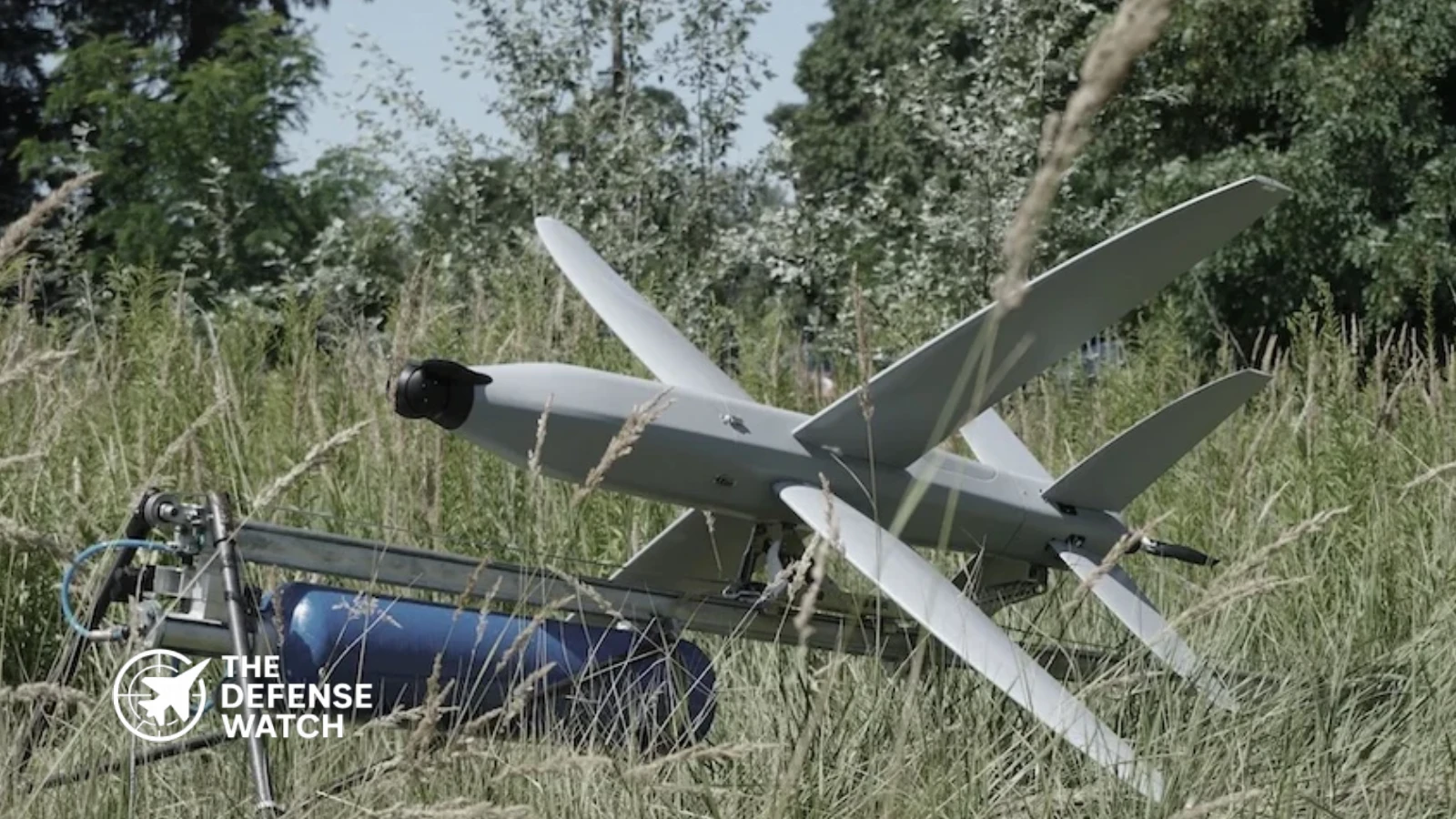
FlyFocus has unveiled the TASACK loitering munition, a new Polish precision strike system with a stated operational range of up to 110 kilometers, at the MSPO 2026 defense exhibition in Kielce. The company says the electrically powered aircraft is intended to engage both stationary and moving targets while offering a lower-cost and easier-to-operate alternative to conventional FPV strike drones.
- FlyFocus Unveils TASACK At MSPO 2026
- Takeaways
- TASACK Technical Specifications
- 110-Kilometer Range Expands The Tactical Strike Envelope
- EO/IR Gimbal Supports Precision Targeting
- Top-Attack Profile Adds A Different Anti-Armor Option
- Point-And-Click Interface Targets The FPV Training Burden
- Polish Production And Supply-Chain Considerations
- Manufacturing Cost Is Central To TASACK’s Concept
- Electronic Warfare Will Remain A Key Test
- Why TASACK Matters For European Defense
- Production Target Set For 2027
Takeaways
FlyFocus has introduced TASACK, a Polish precision loitering munition designed to combine long-range strike, operator simplicity and a modular payload architecture.
The public debut took place on September 8, with FlyFocus targeting production readiness during the first quarter of 2027. The system weighs 15 kilograms and can carry up to 5 kilograms of payload.
The unveiling comes as European militaries are placing greater emphasis on relatively inexpensive unmanned strike systems that can provide precision effects without requiring the cost and infrastructure associated with larger crewed aircraft or conventional missile systems.
TASACK Technical Specifications
| Specification | TASACK |
|---|---|
| System type | Precision loitering munition |
| Manufacturer | FlyFocus, Poland |
| Maximum takeoff weight | 15 kg |
| Payload | Up to 5 kg |
| Operational range | Up to 110 km |
| Datalink range | Up to 80 km |
| Endurance | Up to 90 minutes |
| Maximum speed | Up to 300 km/h |
| Flight speed range | 70 to 300 km/h |
| Maximum altitude | 4,000 m AMSL |
| Propulsion | Electric |
| Navigation | GNSS-enhanced navigation and INS |
| Optional navigation | Radio navigation |
| Targeting | Stabilized daylight or infrared gimbal |
| Visual targeting accuracy | 1 m CEP50, according to FlyFocus |
| Coordinate guidance accuracy | 5 m CEP50, according to MSPO data |
| Launch | Pneumatic launcher or RATO |
| Preparation time | Approximately 5 to 7 minutes |
| Attack profiles | Flat approach to near-vertical top attack |
| Production readiness target | Q1 2027 |
The technical data above is based primarily on FlyFocus information presented through MSPO and current reporting on the system. MSPO lists a maximum takeoff weight of 15 kilograms, a 5-kilogram payload, a maximum speed of 300 km/h, an 80-kilometer radio range and an operational range of up to 110 kilometers.
110-Kilometer Range Expands The Tactical Strike Envelope
The most significant characteristic of TASACK is the relationship between its relatively small size and its stated range.
A 110-kilometer operational radius places the system beyond the short-range employment profile associated with many FPV strike drones. It gives commanders a potential option for attacking targets considerably deeper behind the immediate forward line without committing a manned aircraft.
The distinction between operational range and datalink range is important. FlyFocus lists an operational range of up to 110 kilometers but a radio datalink range of up to 80 kilometers. The difference means the maximum stated flight distance should not automatically be interpreted as an 110-kilometer direct-control radius.
TASACK uses enhanced satellite navigation together with an inertial navigation system during cruise flight, while FlyFocus lists radio navigation as an optional capability. That combination provides a navigation architecture intended to support longer-range operations rather than relying solely on continuous manual control.
EO/IR Gimbal Supports Precision Targeting
TASACK also differs from many basic expendable strike drones through its stabilized electro-optical and infrared targeting system.
The gimbal is designed to allow operators to identify and track targets before the final engagement. FlyFocus states that the visual guidance system can achieve an accuracy of approximately 1 meter CEP50, while MSPO lists 5 meters CEP50 for coordinate-based guidance.
The distinction matters operationally. Coordinate navigation can place the munition near a planned location, but an onboard sensor can provide a final targeting function against a target whose exact position may change after mission planning.
The EO/IR sensor also supports different attack geometries. TASACK can reportedly approach a target on a relatively flat trajectory or transition into a near-vertical top attack.
Top-Attack Profile Adds A Different Anti-Armor Option
The ability to conduct a top attack is particularly relevant for armored targets.
Armored vehicles are generally designed with different levels of protection across their frontal, side, rear and roof surfaces. A munition capable of approaching from above can therefore attack a different part of the target than a conventional direct-flight strike.
TASACK is not presented as an anti-tank weapon exclusively. Its modular airframe is designed to accept different warhead configurations, allowing the same basic aircraft architecture to be adapted to different target sets.
That modularity is potentially more important for military procurement than any individual headline performance figure. A common airframe that can support multiple payload configurations can reduce the need to maintain separate unmanned systems for every mission type.
Point-And-Click Interface Targets The FPV Training Burden
FlyFocus is also emphasizing operator simplicity.
Rather than requiring the operator to manually fly an FPV aircraft throughout the engagement, TASACK uses a point-and-click interface that allows the operator to select the target while the system handles the flight path toward the engagement area.
This approach addresses one of the practical problems exposed by the extensive use of FPV drones in Ukraine. FPV systems can be inexpensive, but effective employment depends heavily on trained operators who can manually control the aircraft under difficult conditions.
A more automated control architecture does not eliminate the need for trained personnel. Operators still need to understand target identification, engagement decisions, communications, navigation limitations and electronic warfare conditions. However, reducing the manual flying workload could make it easier to train and rotate personnel across larger numbers of systems.
FlyFocus is also using a common ground-control interface across TASACK and its Polaris, CableGuard and Striker platforms. The company says this is intended to reduce additional training when operators move between its unmanned systems.
Polish Production And Supply-Chain Considerations
FlyFocus says most TASACK components, including the targeting gimbal, are manufactured in Poland. The company has linked this approach to maintaining control over key technologies and developing supply chains aligned with NATO requirements.
That emphasis fits a broader European defense-industrial trend toward increasing domestic production capacity for unmanned systems, electronics and precision weapons.
For Poland, the issue has an additional strategic dimension. The country is expanding its defense-industrial base while investing heavily in artillery, air defense, armored forces, combat aircraft and unmanned systems.
A domestically produced loitering munition could provide another layer between inexpensive tactical drones and substantially more expensive guided weapons.
The commercial significance will ultimately depend on production volume, reliability, resistance to electronic warfare, sensor performance, warhead integration and demonstrated operational effectiveness. Those factors cannot be established from an exhibition debut alone.
Manufacturing Cost Is Central To TASACK’s Concept
FlyFocus says it deliberately simplified the internal and external architecture to reduce manufacturing costs while supporting faster assembly, maintenance and upgrades.
This is a central issue in the loitering-munition market.
A precision weapon becomes less attractive for routine tactical use if its unit price approaches that of much larger guided weapons. Conversely, a low-cost system can become operationally important if it is accurate enough to engage valuable targets and can be manufactured in significant quantities.
TASACK’s 15-kilogram airframe and 5-kilogram payload indicate a design focused on carrying a meaningful warhead while retaining a relatively small logistical footprint.
The five-to-seven-minute preparation time listed by MSPO also points toward a system designed for relatively rapid deployment rather than lengthy pre-launch preparation.
Electronic Warfare Will Remain A Key Test
One important issue that cannot be determined from the current specifications is how TASACK performs in a heavily contested electromagnetic environment.
Its navigation architecture combines satellite navigation and INS, while its maximum stated datalink range is 80 kilometers. Those features support long-range operations, but real-world effectiveness will depend on the system’s resilience when satellite navigation, communications or target-location data are disrupted.
The war in Ukraine has demonstrated that unmanned strike systems must contend with jamming, spoofing, counter-drone weapons and rapidly changing target locations.
TASACK’s EO/IR sensor and inertial navigation could provide some operational flexibility, but detailed information about electronic protection, autonomous target recognition, anti-jamming performance and communications resilience has not been publicly established in the material reviewed for this report.
Those capabilities will be important indicators as the system moves from exhibition demonstration toward production.
Why TASACK Matters For European Defense
TASACK illustrates a broader change in European unmanned warfare.
The emerging requirement is not simply for more drones. Militaries increasingly need layered unmanned capabilities ranging from very inexpensive short-range systems to longer-range precision weapons with better sensors, navigation and communications.
TASACK occupies a position within that spectrum that combines a relatively compact airframe with a stated 110-kilometer operational range, a 5-kilogram payload and precision electro-optical targeting.
For NATO countries, systems of this type could provide additional options for distributed strike operations while reducing reliance on a limited inventory of high-cost missiles.
For Poland specifically, domestic production offers another potential advantage. Local manufacturing can shorten supply chains, facilitate modifications and provide greater control over sustainment, although actual military value will depend on production scale and formal procurement decisions.
For the United States and other NATO members, the development is also relevant as European allies seek greater sovereign capacity in drones, precision weapons and battlefield electronics. The emergence of Polish systems such as TASACK could contribute to a broader allied industrial base for affordable unmanned strike capabilities.
Production Target Set For 2027
FlyFocus expects TASACK to reach production readiness in the first quarter of 2027.
That milestone will be more significant than the exhibition debut because production readiness will require the transition from a demonstrated design to a repeatable manufacturing and support system.
The key indicators will include production volume, unit cost, reliability, sensor performance, communications resilience, warhead integration and evidence from realistic operational testing.
For now, TASACK represents a new Polish entry into the increasingly competitive loitering-munition market. Its combination of 110-kilometer range, 5-kilogram payload, EO/IR targeting, top-attack capability and simplified operator interface gives FlyFocus a system designed around the requirements that have become increasingly important in modern drone warfare.
The company now faces the more difficult step of turning those advertised capabilities into a production-ready weapon that can operate reliably in contested environments and at meaningful scale.