America’s Flying Fortresses: The Doomsday Planes Designed to Survive Nuclear War
When the unthinkable happens—a nuclear exchange, electromagnetic pulse attack, or total breakdown of ground-based command infrastructure—the United States maintains a fleet of highly specialized aircraft designed to ensure continuity of government and nuclear command authority. These doomsday planes, officially designated as the E-6B Mercury and E-4B Nightwatch, represent the backbone of America’s airborne nuclear command post (ABNCP) operations, capable of directing strategic forces even as the world below burns.
- America’s Flying Fortresses: The Doomsday Planes Designed to Survive Nuclear War
- E-6B Mercury: The Navy’s Airborne Communication Relay
- E-4B Nightwatch: The National Airborne Operations Center
- Operational Doctrine and Strategic Context
- Global Context: Other Nations’ Airborne Command Platforms
- Conclusion: Silent Sentinels of Nuclear Deterrence
- FAQs
The concept of airborne command platforms emerged during the Cold War, when military planners realized that ground-based command centers could be vulnerable to surprise nuclear strikes. Today, these aircraft remain operational 24/7, providing an unbreakable link between civilian leadership and the nation’s nuclear triad—land-based intercontinental ballistic missiles (ICBMs), submarine-launched ballistic missiles (SLBMs), and strategic bombers.
Understanding the capabilities, missions, and strategic importance of these flying command centers offers critical insight into how the United States maintains nuclear deterrence in an era of renewed great power competition.
E-6B Mercury: The Navy’s Airborne Communication Relay
Origins and Development
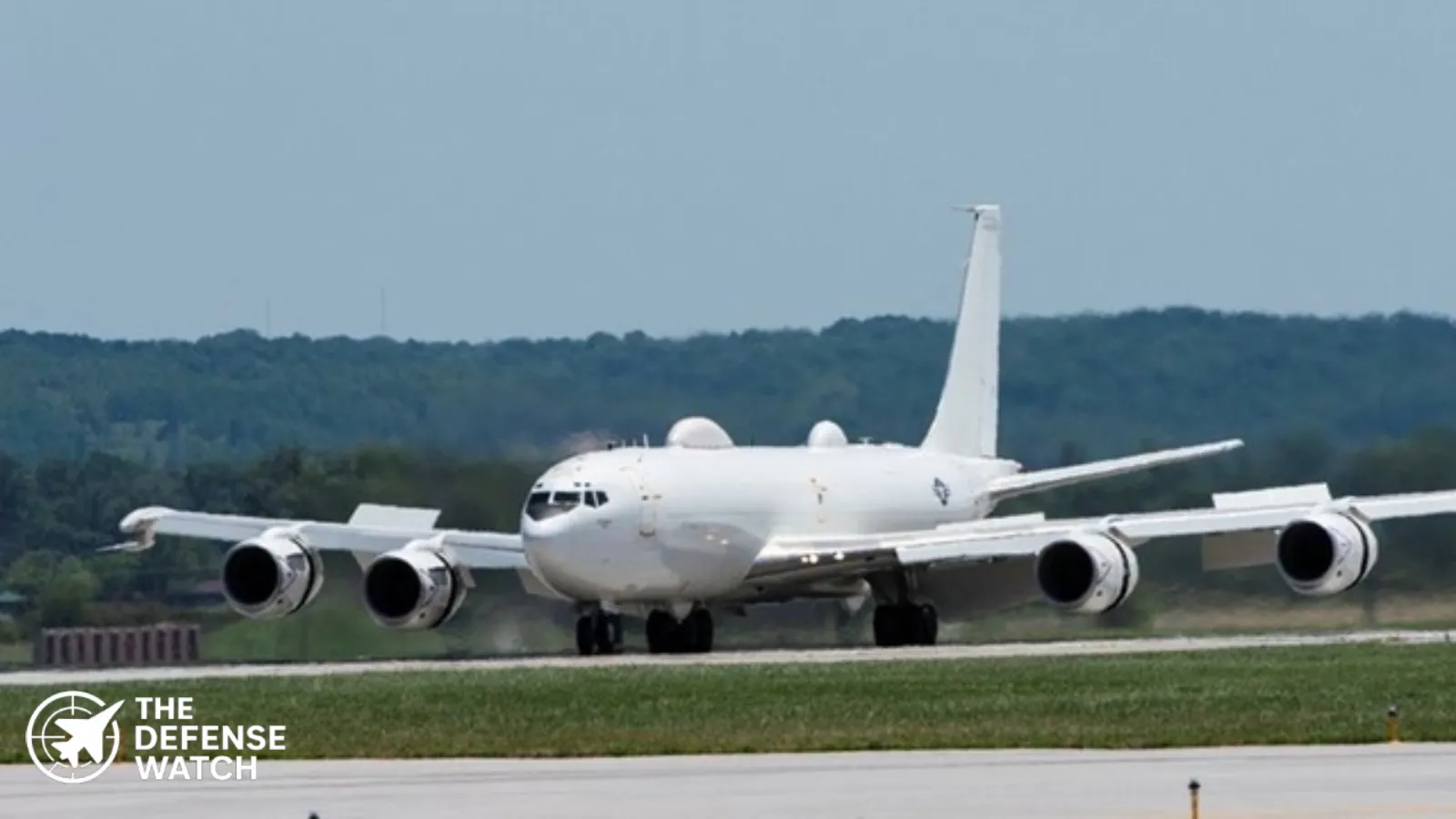
The Boeing E-6B Mercury, derived from the commercial 707 airframe, serves as the U.S. Navy’s primary airborne strategic command, control, and communications (C3) platform. First introduced in 1989 as the E-6A Hermes, the aircraft underwent significant upgrades in the late 1990s to become the E-6B, which incorporated the airborne launch control system (ALCS) previously carried by Air Force EC-135 aircraft.
The E-6B Mercury operates under the U.S. Strategic Command (USSTRATCOM) and is flown by Fleet Air Reconnaissance Squadron Three (VQ-3) and Fleet Air Reconnaissance Squadron Four (VQ-4), both based at Tinker Air Force Base in Oklahoma. The Navy maintains a fleet of 16 E-6B aircraft, ensuring at least one is airborne at all times through Operation Looking Glass—a continuous airborne alert mission that has been maintained since 1961.
(adsbygoogle = window.adsbygoogle || []).push({});Mission Capabilities
The E-6B Mercury fulfills two critical missions within America’s nuclear deterrence architecture. First, it serves as the Take Charge and Move Out (TACAMO) platform, providing a survivable communication link between the National Command Authority (the President and Secretary of Defense) and ballistic missile submarines operating deep beneath the ocean’s surface. Using very low frequency (VLF) radio transmissions via a trailing wire antenna that can extend up to five miles, the E-6B can penetrate seawater to reach submarines that would otherwise be cut off from command during a nuclear crisis.

Second, the aircraft’s Airborne Launch Control System allows authorized personnel aboard the E-6B to remotely launch ground-based ICBMs from Minuteman III silos if land-based launch control centers are destroyed or incapacitated. This redundancy ensures that even catastrophic damage to America’s fixed command infrastructure cannot prevent a nuclear response if ordered by civilian leadership.
The E-6B can remain airborne for extended periods through aerial refueling, with missions sometimes exceeding 15 hours. The aircraft is equipped with advanced communication suites spanning multiple frequency bands, secure satellite links, and hardened electronics designed to withstand electromagnetic pulse (EMP) effects from nuclear detonations.
(adsbygoogle = window.adsbygoogle || []).push({});E-4B Nightwatch: The National Airborne Operations Center
The Flying Pentagon
While the E-6B focuses on nuclear force communication, the Boeing E-4B Nightwatch—nicknamed the “Flying Pentagon”—serves as the National Airborne Operations Center (NAOC), providing a mobile command post for the President, Secretary of Defense, Joint Chiefs of Staff, and other senior civilian and military leaders during national emergencies.
Based on the Boeing 747-200B platform, the E-4B is among the most distinctive aircraft in the U.S. Air Force inventory, identifiable by its prominent dome housing satellite communication equipment and its distinctive white-and-blue livery. The Air Force maintains four E-4B aircraft, operated by the 1st Airborne Command and Control Squadron at Offutt Air Force Base, Nebraska.
Survivability and Endurance
The E-4B Nightwatch is engineered for extreme survivability. The aircraft features extensive electromagnetic pulse shielding, thermal and nuclear flash protection for cockpit windows, and the ability to operate independently of ground infrastructure for extended periods. With aerial refueling, the E-4B can remain airborne for days—limited only by crew endurance and engine oil consumption rather than fuel capacity.

The aircraft’s interior is divided into six functional areas: a command work area, conference room, briefing room, operations team work area, communications area, and rest area for crew. The E-4B carries approximately 112 personnel during crisis operations, including a joint-service operations team, Air Force flight crew, maintenance technicians, and communication specialists.
(adsbygoogle = window.adsbygoogle || []).push({});Advanced communication systems aboard the E-4B include more than 67 satellite dishes and antennas, providing connectivity across multiple frequency bands including super high frequency (SHF), very high frequency (VHF), and ultra high frequency (UHF) systems. The aircraft can establish secure voice and data links with military units worldwide, ensuring uninterrupted command and control even as terrestrial infrastructure fails.
Presidential Support and Continuity
One E-4B is always maintained on alert status, ready for immediate deployment. When the President travels, an E-4B typically shadows Air Force One, ready to assume command post functions if Air Force One is compromised. During the September 11, 2001 terrorist attacks, an E-4B was spotted over Washington, D.C., providing airborne command capabilities as ground-based leadership relocated to secure facilities.
(adsbygoogle = window.adsbygoogle || []).push({});The E-4B represents a critical element of continuity of operations (COOP) planning, ensuring that constitutional government can continue functioning even under the most catastrophic scenarios, including decapitation strikes targeting Washington, D.C., or other centers of government authority.
Operational Doctrine and Strategic Context
Deterrence Through Survivability
Both the E-6B Mercury and E-4B Nightwatch embody a fundamental principle of nuclear deterrence: assured second-strike capability. By ensuring that American leadership can survive an initial attack and retain the ability to command nuclear forces, these doomsday planes make any nuclear first strike against the United States strategically futile. An adversary cannot eliminate America’s ability to respond, making nuclear aggression irrational.
This survivability is particularly critical given advances in adversary capabilities. Russia and China have invested heavily in hypersonic weapons, ballistic missiles, and other systems designed to hold U.S. command infrastructure at risk. The mobility and hardening of airborne command posts provide resilience against these emerging threats.
Modernization Challenges
Despite their critical importance, America’s doomsday planes face growing modernization challenges. The E-4B fleet, based on 1970s-era 747 airframes, is increasingly difficult and expensive to maintain as parts become scarce and systems age. The Air Force has begun early planning for an E-4B replacement, potentially based on more modern commercial platforms like the Boeing 747-8 or even the 777X, though budget constraints and competing priorities have slowed progress.
Similarly, the E-6B Mercury fleet, while newer than the E-4B, will eventually require replacement. The Navy continues upgrading communication systems and avionics, but the fundamental airframe—derived from the 1960s-era 707—presents long-term sustainment challenges.
Global Context: Other Nations’ Airborne Command Platforms
The United States is not alone in operating airborne command posts. Russia maintains the Ilyushin Il-80 “Maxdome,” a modified Il-86 airliner serving as an airborne command post for Russian leadership during nuclear crises. China has developed the Y-20U aerial refueling tanker and is believed to be working on airborne command capabilities, though details remain classified.
(adsbygoogle = window.adsbygoogle || []).push({});These developments underscore the continued relevance of airborne command posts in modern strategic competition. As great power rivalry intensifies and nuclear arsenals modernize, the ability to maintain command and control under the most extreme conditions remains essential to credible deterrence.
Conclusion: Silent Sentinels of Nuclear Deterrence
The E-6B Mercury and E-4B Nightwatch operate largely out of public view, their missions classified and their operations shrouded in necessary secrecy. Yet these doomsday planes represent one of the most critical elements of American national security—the assurance that even in the darkest scenarios, constitutional government endures and strategic forces remain under lawful control.
As emerging technologies reshape warfare and geopolitical tensions rise, the importance of these airborne command platforms only grows. Whether through modernization of existing platforms or development of next-generation replacements, maintaining robust airborne command and control capabilities will remain essential to American deterrence strategy for decades to come.
For defense analysts and policymakers, understanding these capabilities provides essential context for broader discussions about nuclear modernization, strategic stability, and the future of deterrence in an increasingly complex and contested global security environment.
(adsbygoogle = window.adsbygoogle || []).push({});FAQs
What is a doomsday plane?A doomsday plane is an airborne command post aircraft designed to ensure continuity of military command and government operations during catastrophic events, including nuclear war. The U.S. operates the E-6B Mercury and E-4B Nightwatch as its primary doomsday planes.
How many doomsday planes does the U.S. have?The United States maintains 16 E-6B Mercury aircraft and four E-4B Nightwatch aircraft, ensuring at least one is airborne at all times to provide continuous command and control capabilities.
Can the President launch nuclear weapons from a doomsday plane?Yes. The E-4B Nightwatch serves as the National Airborne Operations Center and can facilitate presidential nuclear command authority. The E-6B Mercury can also relay launch orders to submarines and remotely launch ICBMs if ground control centers are destroyed.
How long can a doomsday plane stay airborne?With aerial refueling, both the E-6B and E-4B can remain airborne for extended periods—the E-4B can fly for several days, limited primarily by crew endurance and engine oil rather than fuel.
Are doomsday planes protected against nuclear attacks?Yes. Both aircraft feature electromagnetic pulse (EMP) shielding, hardened electronics, thermal protection, and nuclear flash-resistant windows, allowing them to survive and operate in nuclear warfare environments.
What is Operation Looking Glass?Operation Looking Glass is the continuous airborne alert mission that has kept at least one U.S. airborne command post in the air 24/7 since 1961, ensuring survivable nuclear command and control at all times.