
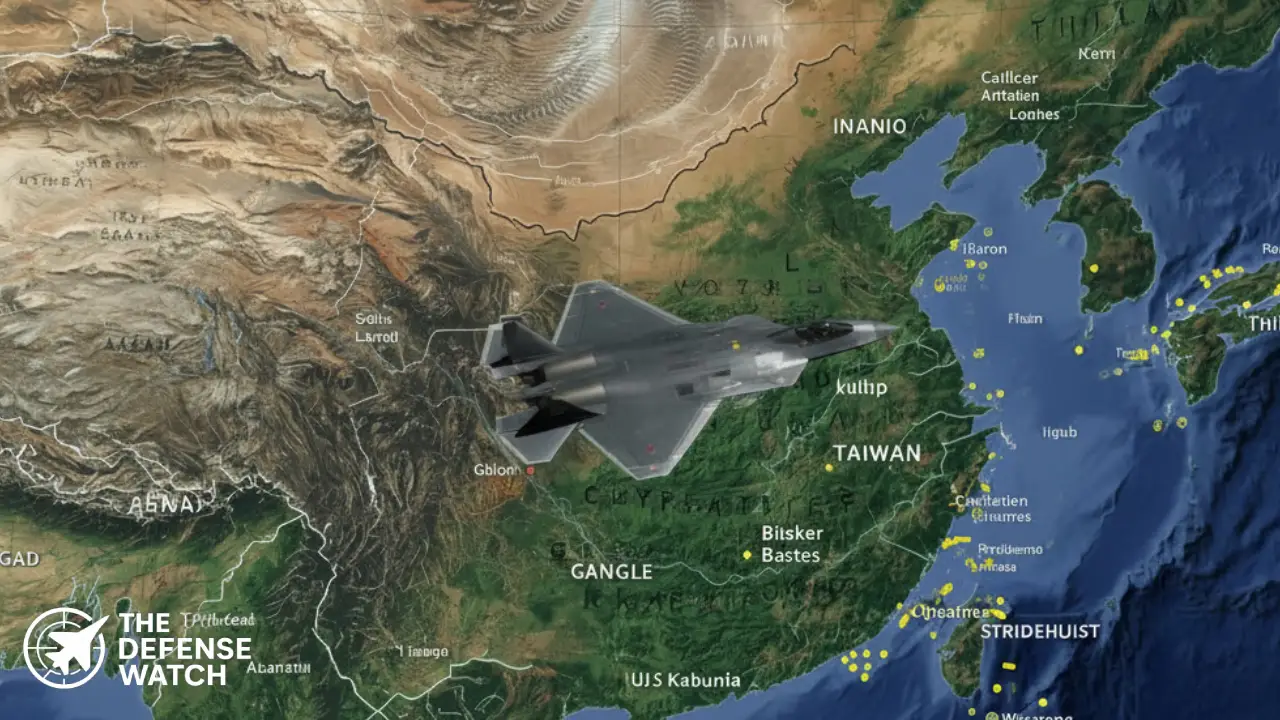
Growing Stakes: China’s Nuclear Expansion
China’s nuclear weapons stockpile is growing faster than any other nuclear power, raising fresh concerns about strategic stability in a potential conflict over Taiwan. According to the Stockholm International Peace Research Institute (SIPRI), China reached around 600 warheads as of January 2025, adding roughly 100 warheads annually.
Data from the Federation of American Scientists (FAS) corroborates this trend, putting China’s current total at about 600 warheads, with most in reserve and only a small fraction deployed.
Meanwhile, the U.S. maintains a significantly larger nuclear inventory, with an active stockpile of roughly 3,700 warheads, per SIPRI.
The Nuclear Dimension of a Taiwan Conflict
Why Nuclear Weapons Could Be a Factor
Analysts argue that in a war over Taiwan, the role of nuclear weapons would be more than symbolic: they could serve as both a deterrent and a coercive tool.
A report from the Atlantic Council suggests that U.S. nuclear forces might be used in several ways in a Taiwan war:
- To restore deterrence if China uses limited nuclear weapons first.
- To attack a Chinese amphibious invasion force at sea, undermining its ability to land on Taiwan.
- Even to shift the balance through limited nuclear use if U.S. conventional forces are insufficient.
Another influential paper from the Atlantic Council recommends that the U.S. revisit its nuclear policy to include first-use options if conventional deterrence fails — arguing that a credible U.S. commitment could help dissuade Beijing from escalating.
The Limits of Deterrence
That said, nuclear deterrence is not ironclad. If China believed it could use nuclear escalation to enforce a fait accompli or coerce the U.S., the risk of miscalculation or unintended escalation could become uncomfortably real. Analysts warn that signaling, communication, and war planning would need to be highly calibrated.
What This Means for U.S. Defense — A Strategic Analysis
From a U.S. defense perspective, China’s nuclear acceleration complicates long-standing assumptions. Here’s how:
- Escalation Risk Is Rising
As China’s arsenal grows, the credibility of its coercive nuclear threats — potentially even in a limited-war context — increases. The more warheads China has, the greater its options to target regional U.S. assets or compel compromise. - U.S. Deterrence Must Be Credible
To sustain deterrence, the U.S. may need to revisit its declaratory policy. If Washington signals that it could rely on nuclear options in response to limited Chinese escalation, it strengthens its deterrence posture — but also raises the political threshold for any action. - Allied Assurance & Extended Deterrence
Allies such as Japan, South Korea, and especially Taiwan could demand greater clarity from the U.S. about its nuclear umbrella. Strategic ambiguity may no longer suffice in a world where China’s nuclear capacity is expanding rapidly. - Arms Control Is Under Pressure
With China’s build-up and continued U.S./Russian nuclear modernization, traditional arms control regimes are increasingly strained. There’s growing urgency for new dialogues on risk reduction, crisis communication, and possibly new bilateral or multilateral pacts.
Broader Global Implications
- New Nuclear Arms Race: According to SIPRI, China is leading a broader trend — global nuclear arsenals are growing, reversing decades of post-Cold War reductions.
- Strategic Stability in Asia: A more powerful Chinese nuclear force could embolden Beijing in other flashpoints beyond Taiwan, such as the South China Sea.
- Escalation Control Challenges: Any conflict over Taiwan could now more easily spiral. Managing nuclear signals, de-escalation, or even limited use becomes harder.
Conclusion: On a Precipice of Strategic Risk
China’s expanding nuclear arsenal underscores a new reality: nuclear weapons are no longer just backstop deterrents in a U.S.–China confrontation — they could plausibly shape a war over Taiwan from the outset. For U.S. defense planners, that raises a hard set of challenges around posture, signaling, and escalation management.
Looking ahead, Washington and its allies may need to calibrate their deterrence strategy more precisely, enhance strategic communication, and press for renewed arms control engagement. Failing to do so risks facing a crisis where nuclear weapons become not just a threat but an active component of the conflict calculus.
Get real time update about this post category directly on your device, subscribe now.

6 comments
[…] reduces radar visibility and supports long range missions. The H 20 is likely intended to give China an air based nuclear deterrent, completing its nuclear triad alongside missiles and […]
[…] Minister Sir Keir Starmer and French President Emmanuel Macron in July 2025, aims to coordinate nuclear deterrence strategies between the two countries, principally as a stronger credible deterrent in Europe. Despite this, […]
[…] schedule extends through June 1, 2033, as noted by the Pentagon, reflecting the long-term nature of strategic weapons support for nuclear deterrence […]
[…] A Saudi F-35 fleet would alter airpower capabilities in the Middle East. Israel has long been the only regional operator of the F-35, and its qualitative edge has been a cornerstone of US policy in the region. A Saudi acquisition would prompt debate over how to balance capability transfers with strategic stability. […]
[…] China’s nuclear buildup represents the most significant expansion by any nuclear power in decades, fundamentally altering the strategic balance that has historically focused on U.S.-Russian bilateral arms control. […]
[…] the outlined limits.” The conditional nature of this commitment underscores the fragile state of nuclear deterrence stability between the […]