
The U.S. Department of Defense released the Annual Report to Congress on Military and Security Developments Involving the People’s Republic of China 2025 on December 23, providing an in-depth assessment of China’s growing military strength across nuclear, maritime, space and cyber domains, and outlining implications for U.S. defense strategy.
Overview and Strategic Context
This annual assessment, mandated by Congress for more than two decades, tracks developments in the People’s Liberation Army (PLA) and China’s broader security strategy. The 2025 report notes China’s rapid force modernization and Beijing’s aim to build a “world-class” military capable of challenging the United States and regional adversaries.
In its preface, the report says that while U.S.–China relations have improved politically, the U.S. will maintain military advantage and deterrence across the Indo-Pacific. U.S. defense strategy aims to prevent any one power from dominating the region, with a focus on strategic strength rather than confrontation.
Key Findings
China’s Strategic Focus and Military Goals
The report reiterates that Beijing considers the First Island Chain — from Japan through Taiwan to the Malay Peninsula — its strategic center of gravity in regional competition. It states China’s national strategy centers on achieving global power status by 2049, a milestone aligned with the centennial of the People’s Republic of China.
China’s leadership publicly frames military development as defensive, but the report underscores capabilities that could directly challenge U.S. interests and allies, particularly in the Western Pacific.
Nuclear Forces Expansion
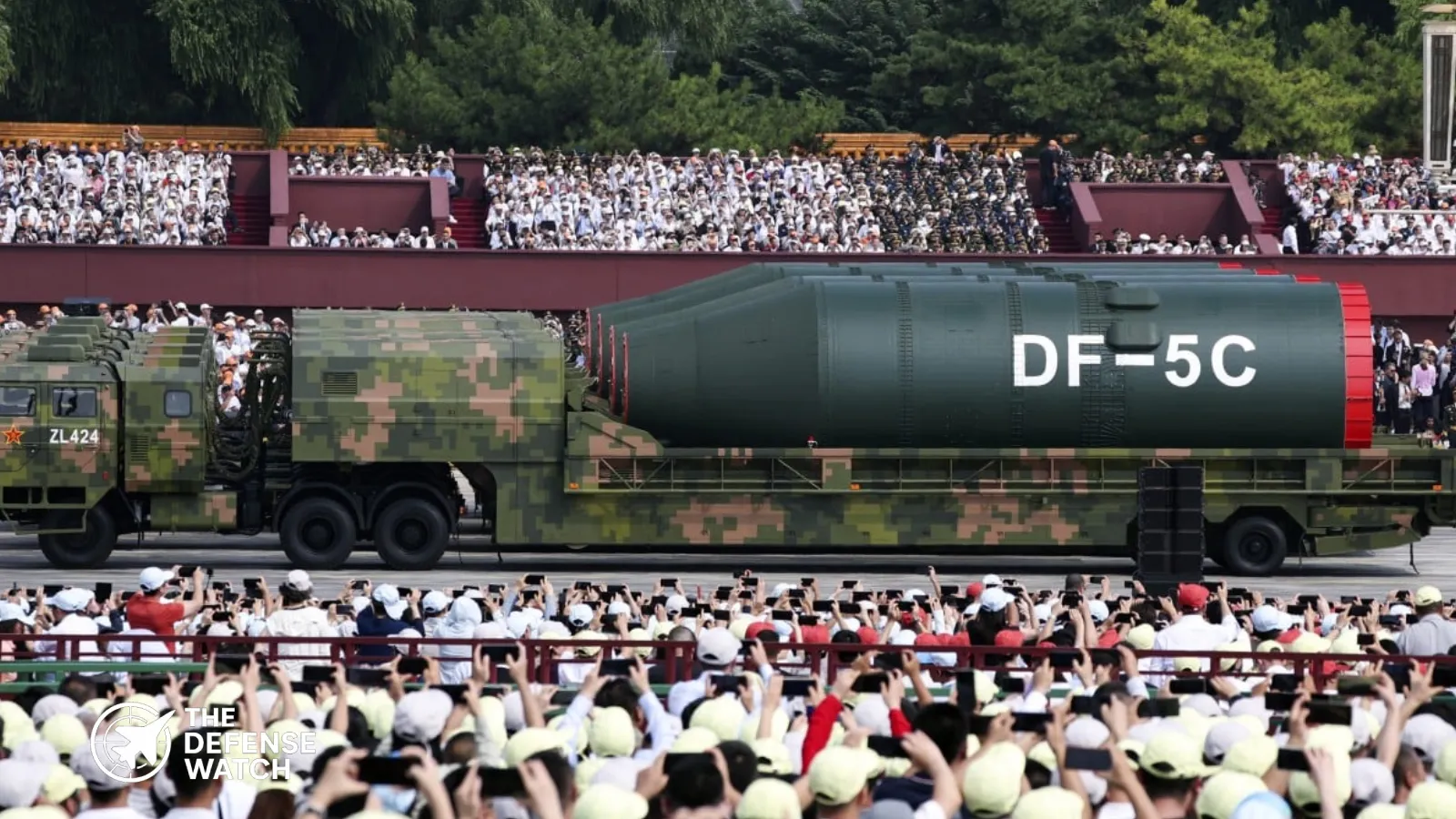
The report highlights sustained expansion of China’s nuclear arsenal. While exact numbers remain classified, U.S. intelligence assessments publicly suggest that China could possess several hundred nuclear warheads with projections that stockpiles may exceed 1,000 by 2030. China’s strategic nuclear modernization emphasizes survivable launch platforms, counterstrike capability, and flexible targeting.
China’s growing long-range strike forces, particularly solid-fuel intercontinental ballistic missiles (ICBMs), contribute to a more credible nuclear deterrent and complicate U.S. homeland defense planning.
Maritime and Conventional Forces
China’s People’s Liberation Army Navy (PLAN) remains among the world’s largest naval forces. The report documents expansion in aircraft carriers, advanced destroyers, submarines and long-range precision strike systems capable of shaping regional maritime contests.
Beyond numbers, the PLA has integrated its forces to operate jointly across domains with advanced sensors, long-range fires and improving logistics. These capabilities enhance Beijing’s ability to project power beyond its borders, according to the report.
Space, Cyberspace and Emerging Technologies
The 2025 assessment gives substantial weight to space and cyber domains. China’s space architecture supports intelligence, surveillance and reconnaissance missions that can enhance targeting and situational awareness, with potential to degrade U.S. advantages in orbit. Cyber operations by state-linked actors have targeted U.S. infrastructure, highlighting Beijing’s emphasis on information-age competition.
Emerging technologies including artificial intelligence, autonomous systems and hypersonic weapons are identified as key enablers of the PLA’s future combat concepts, though specific capabilities are often classified.
Taiwan and Regional Contingencies
A significant theme in the report is China’s preparations regarding Taiwan. The PLA continues to refine integrated joint operational plans aimed at deterring or defeating Taiwan’s defenses, with capabilities that can range from amphibious assault options to sustained blockades. U.S. analysts see this as illustrating Beijing’s intent to shape the military balance across the Taiwan Strait.
The report suggests that by 2027 the PLA will possess necessary components to conduct decisive operations in the region, reinforcing earlier assessments about China’s evolving timelines for coercive military options.
U.S. Security Implications
The Department of Defense emphasizes that China’s comprehensive buildup makes the U.S. homeland and allied interests increasingly vulnerable. Growth in China’s long-range strike, cyber and space capabilities — alongside the nuclear and maritime expansions — shape the strategic competition into the next decade.
The report states that the United States does not seek conflict but will retain a posture that deters aggression, strengthens alliances and preserves stable conditions in the Indo-Pacific. It highlights that U.S. defense planning, investment priorities and force posture reviews factor heavily on current assessments of Chinese capabilities.
Chinese Government Response
Chinese officials have criticized the report, dismissing it as exaggerated and politically motivated. Beijing insists its military development remains defensive and compliant with international norms, even as it accelerates modernization across multiple domains. Chinese commentary also accuses the U.S. of using such assessments to justify its own force expansions.
What Is Next
Looking forward, the findings will shape debate in Congress over defense budgets and Indo-Pacific strategy. The report’s emphasis on multi-domain competition and strategic vulnerabilities is expected to influence U.S. investments in missile defense, space resiliency, cyber operations and allied interoperability.
Analysts say continued monitoring of China’s modernization, force posture and strategic intent will remain critical throughout 2026. U.S. defense planners are likely to balance deterrence priorities with efforts at de-escalation and crisis communication channels with Beijing.
Get real time update about this post category directly on your device, subscribe now.
